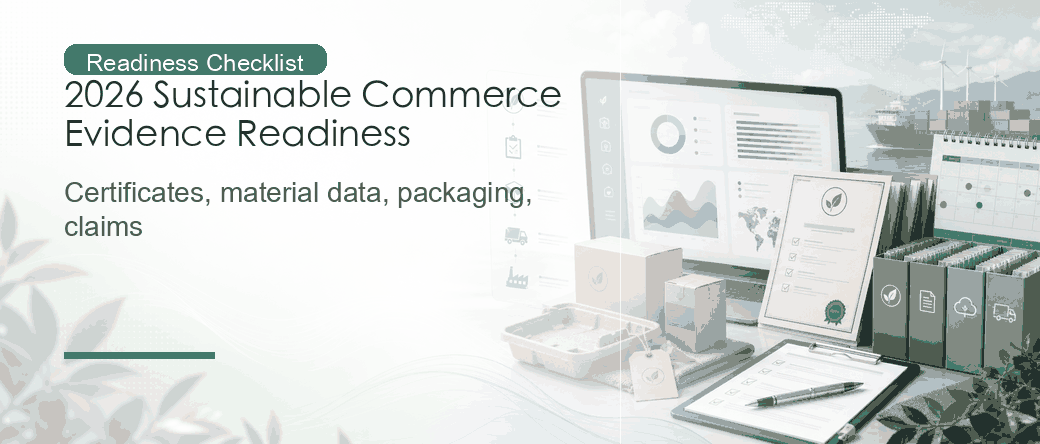
Sustainable-commerce readiness is not the purchase of a universal certificate. It is a traceable register connecting a specific product, target market, packaging, and customer-facing claim. This page provides a bounded preparation framework; confirm the applicable law, platform rule, or buyer requirement before treating any item as mandatory.
1. Build a scope matrix first
For each row, record the SKU or model, product category and main materials, destination market, importer or other economic operator, sales channel, proposed environmental claim, and the objective attribute supporting that claim. Do not use the brand, factory, or storefront as the only scope unit: different materials, packaging, models, or destinations may have different requirements.
Separate the register into product or market-access rules, packaging and waste requirements, platform or retailer requests, and voluntary corporate claims. For each entry, record the source, conditions, responsible party, and evidence to retain. Mark unconfirmed items as “to be confirmed” rather than presenting them as universal obligations.
2. EU regulatory signals relevant in 2026
ESPR and the Digital Product Passport: Regulation (EU) 2024/1781 establishes a framework for ecodesign requirements and digital product passports. The data requirements depend on the delegated act for the relevant product group. A useful preparation set can include model or batch identifiers, materials and components, compliance files, user information, manufacturer/importer details, and facility data. Do not infer that every product already requires or already has a DPP.
Packaging: Regulation (EU) 2025/40 on packaging and packaging waste applies from 12 August 2026, according to the Commission guidance. For export packaging, retain packaging layers, material composition, weight, recycled or reusable attributes where substantiated, labelling/classification, and supplier declarations. Check the provision and implementation material relevant to the destination market.
CBAM and EUDR: CBAM obligations in 2026 concern covered goods and applicable thresholds; EUDR concerns relevant commodities and products listed in its Annex. Check the CN/TARIC code, product scope, responsible operator, and current application date before deciding whether emissions data or supply-chain geolocation is required. Neither regime should be generalized to all cross-border goods.
Primary references: ESPR 2024/1781, PPWR 2025/40, the European Commission CBAM definitive-regime page, and EUDR 2023/1115. Recheck consolidated legislation, delegated acts, implementing material, and Member State information before publication.
3. File evidence by type
Identity and responsibility: legal entity name, brand authorization or trademark-use basis, manufacturer/importer/authorised-representative details, and EORI or other market identifiers where applicable. Names, addresses, and roles should align across declarations, product files, and the listing.
Product and packaging: specifications, BOM or material list, model and revision, packaging breakdown, label and manual artwork, risk or performance material, and supplier documents that explain the material source or calculation basis. Record SKU coverage, date, language, and owner for every file.
Claim substantiation: split each claim into “object—attribute—metric or comparator—evidence—market—time period.” Claims such as recycled content, recyclability, or lower carbon impact need a basis that matches the product and wording. Use a certification mark or third-party name only after its authorization, scope, and current status have been verified.
Supply-chain traceability: retain purchase orders, invoices, batch/quantity records, transport or transaction records, material statements, and origin or geolocation information where applicable. If a field is not applicable, record the reason rather than leaving the decision blank.
4. Six checks before publishing a page
(1) Product name, model, images, and variants match the evidence. (2) The claim’s object and market are explicit; a supplier attribute is not silently expanded to a product line. (3) Numbers, comparators, methods, and periods have sources. (4) High-risk terms such as certified, compliant, official, or sustainable have a matching basis or authorization. (5) Chinese and English express the same scope, with English localized for its reader. (6) Page, packaging, and technical-file versions trace back to the same register.
If evidence covers only some models, batches, or markets, narrow the claim or complete the evidence first. Do not replace verification with phrases such as universally applicable, accepted by every platform, or guaranteed by the industry; a checklist is not a regulator’s finding.
5. Maintenance and conclusion boundary
Create change triggers for materials, formulas, factories, suppliers, packaging, labels, target markets, importers, and page claims. Recheck affected fields when legislation, standards, platform rules, or official guidance changes, and record the source version and review date. This produces an auditable working file, not a permanent passport to market.
绿色方舟(深圳)认证有限公司 can help organize an evidence register, claim boundaries, and missing-file list based on the client’s product scope, market, and materials. Applicability, testing, registration, and market conclusions remain subject to the current requirements of the relevant legislation, authority, platform, or contracting party and to the actual documents available.