
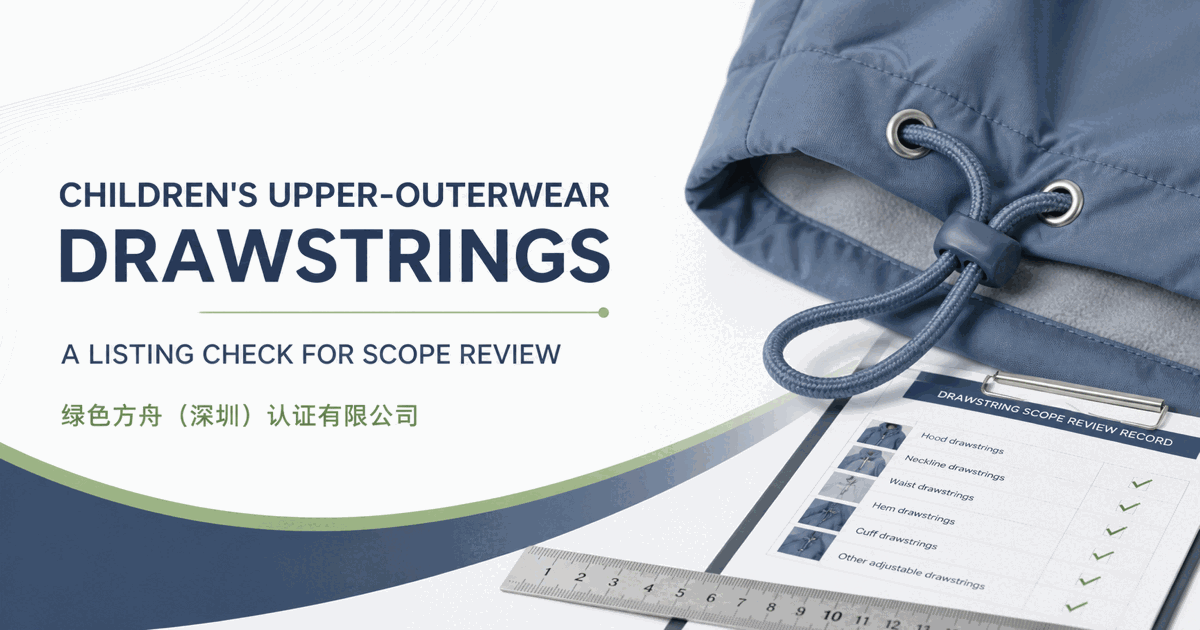
Facts checked on September 24, 2026. This article uses CPSC business guidance, 16 CFR Part 1120 and public recall information to explain how listing records support a scope review. A listing is not, by itself, a compliance determination for a particular product.
A drawstring review should not begin with a ruler. It should begin by identifying the garment, the intended wearer and the drawstring zone. For U.S. children’s upper outerwear, hood or neck drawstrings and waist or bottom drawstrings do not follow the same rule. A product page cannot decide legal scope, but it can either preserve or obscure the facts needed to decide it.
The practical conclusion is simple: identify the garment and zone first, then review size and construction. Words such as “decorative,” “lightweight” or “fashion cord” are not substitutes for those facts.
Two zones, two different questions
CPSC states that hood and neck drawstrings on children’s upper outerwear in sizes 2T through 12, or the equivalent, are a substantial product hazard. The issue is not solved by shortening the cord. The hood and neck location is tied to the risk of a cord catching on playground equipment and tightening around a child’s neck.
Waist and bottom drawstrings are governed by a different set of construction conditions for sizes 2T through 16, or the equivalent. When the garment is expanded to its fullest width, no more than three inches may extend outside the drawstring channel. Free ends must not carry toggles, knots or other attachments. A single continuous string must be bar-tacked at its midpoint so that it cannot be pulled through the channel to one side.
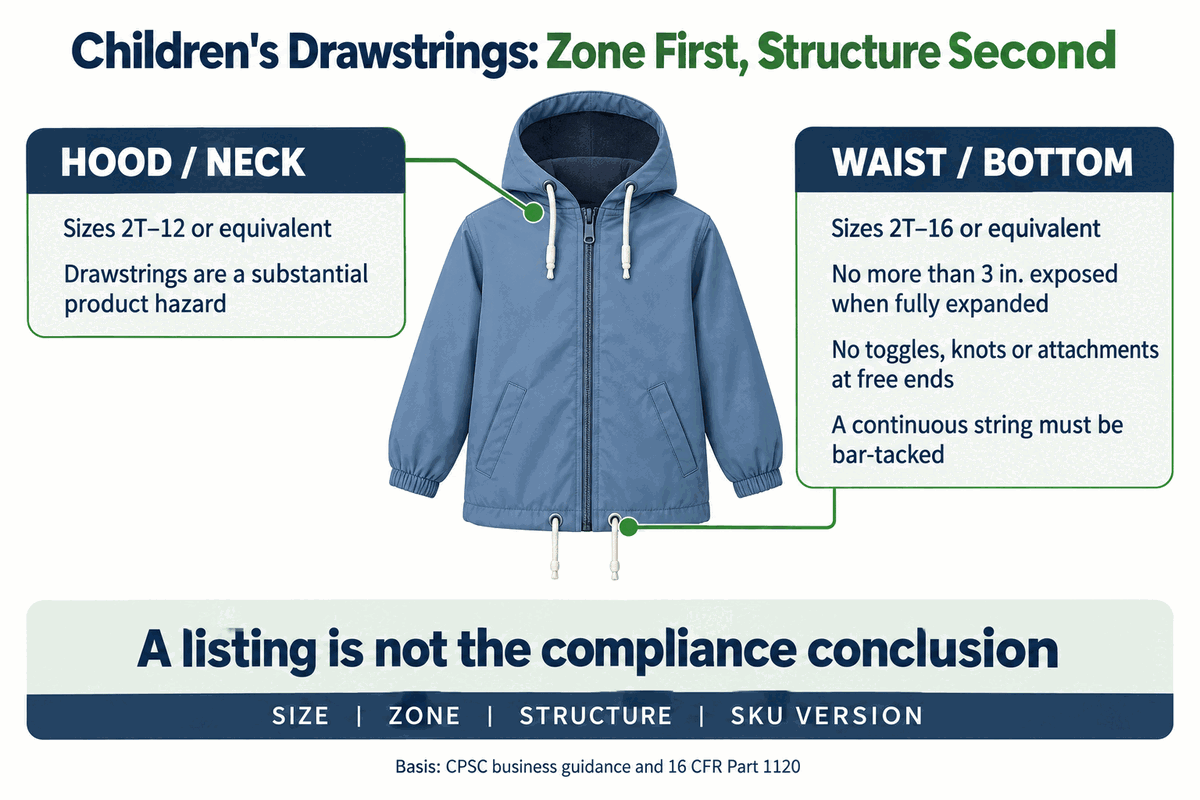
These categories should not be blended. The three-inch condition does not make a hood drawstring acceptable, and a waist cord should not be reviewed only under a blanket statement that “children’s clothing cannot have strings.” Its location, exposed length, free ends and midpoint fixing all matter.
Establish upper outerwear before measuring the cord
The final rule describes upper outerwear as clothing such as jackets and sweatshirts that is generally intended to be worn on the exterior of other garments. Underwear and inner layers are outside that definition. Lightweight garments, however, are not automatically excluded when they are intended to be worn as outerwear in warm weather.
This is where merchandising records become relevant. Imagine one design sold as Child L on one page and Adult S on another. Both pages call it a “lightweight sun hoodie.” Without an equivalency chart, intended-user information, model number and matching labels, reviewers may not be discussing the same product. Conversely, the word “kids” in a title does not settle the question either; actual use, construction, sizing and supporting records still need to align.
The final rule also addresses ambiguous marketing. If upper outerwear is not clearly marketed for adults only and its size may be equivalent to one within the 2T–16 range, an ambiguous label should not be treated as proof that the product is outside the rule. CPSC may consider other evidence of size equivalency. Labels such as “junior,” “unisex streetwear” or “family matching” therefore need a real size and model record behind them.
“Decorative cord” is not a construction description
The regulatory concept of a drawstring is not limited to a round cord running through a channel. In the final-rule explanation, CPSC described non-retractable cords, ribbons or tapes used to pull together parts of outerwear for closure as drawstrings, whether or not they pass through a channel.
A listing that says “decorative drawcord” still leaves material questions unanswered. Can it be pulled? Does it tighten a hood, neckline, waist or hem? Are there free ends? Do those ends carry attachments? Is a continuous cord fixed at the midpoint? If current images show a cord while the specification says “no drawstring,” the discrepancy should be treated as a product-information problem—not corrected by editing one table cell while the sample and image version remain unresolved.
Build one model-specific evidence record
| Record | Question it should answer |
|---|---|
| Intended age, size chart and child/adult equivalency | Could the garment fall within the relevant children’s size range? |
| Close views of the hood, neck, waist and bottom | Which drawstring zone is actually present? |
| Free ends, attachments, exposed length and midpoint fixing | Does the physical construction match the description? |
| SKU, variant, sample label and image version | Are all teams reviewing the same product? |
Completeness is not the same as consistency. A factory may provide photographs of Revision A, e-commerce may publish Revision B, and a compliance note may identify only a family name. Each file can look complete in isolation while the combined record fails to identify one product.
A useful review sequence is to freeze the current SKU and listing version, mark the cord zone, record measurements and end construction, and then align the title, size chart, detail images, packaging and supplier specification. Where a fact is missing, “requires confirmation” is more accurate than turning an unclear photograph into a safety conclusion.
What a recent recall does—and does not—prove
CPSC’s August 27, 2026 recall of specified Little Loves & Co. youth clothing involved waist drawstrings on particular models. It shows that drawstring entrapment hazards still appear in current market surveillance and that waist cords should not be ignored.
The recall does not establish that every visually similar garment is recalled, nor does it determine the scope of a different SKU. The named models and remedy belong to that notice. Another product still requires its own garment, size, zone, construction and version evidence.
Treat the listing as an evidence entry point
For brands, exporters, importers and marketplaces, the listing’s most useful role is not to declare compliance. It is to make the product traceable. If size, zone, construction or model identity remains uncertain, obtain close-up images, measurements and version records before deciding whether to redesign the garment, correct the page or seek a product-specific assessment.
Primary sources: U.S. Consumer Product Safety Commission, Drawstrings in Children’s Upper Outerwear; Substantial Product Hazard List: Children’s Upper Outerwear... Final Rule; 16 CFR Part 1120; CPSC, Little Loves & Co. Recalls Youth Clothing with Drawstrings, August 27, 2026.
绿色方舟(深圳)认证有限公司
Greenark (Shenzhen) Certification Co., Ltd.
Email: sui@greenark-sz.com
Website: www.greenark-sz.com
Phone: +86 184 0755 9004


