Sources checked on September 24, 2026. This article uses the CPSC consumer safety alert dated August 5, 2026 and current CPSC toy-safety guidance to explain evidence boundaries for U.S. listings. The alert addresses fake and counterfeit products and a dangerous heating trend; it is not a finding that every squishy toy has the same hazards.
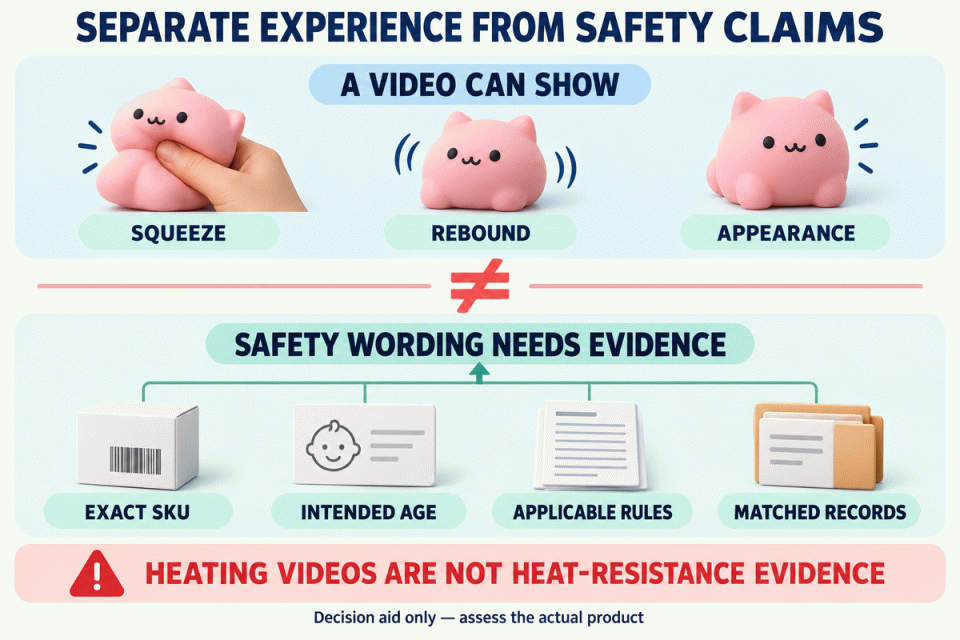
A short video can show a toy being squeezed, stretching and returning to shape. It cannot show what is inside the toy, whether the filmed sample matches the sellable SKU, which age group the product is intended for, or which requirements a test report actually covers. That gap matters when a listing moves from an observable phrase such as “slow rebound” to safety wording such as “non-toxic,” “heat-resistant,” or “safe for children.”
Describe sensory appeal from an authentic demonstration, but treat every safety statement as a separate claim that must match the exact SKU, intended age, applicable requirements and current records.
Read the CPSC alert at its actual scope
On August 5, 2026, CPSC warned about fake and counterfeit squishy toys. The agency said such products may lack manufacturer identification, age grading, warnings, tracking information, and required testing or certification. The alert also identified possible issues involving small parts, lead, regulated phthalates, water beads and other filling materials.
CPSC separately addressed a viral trend in which children and teens microwave or otherwise heat squishy toys to watch them expand, change texture or burst. The agency said those demonstrations are dangerous and should not be attempted or imitated. Some squishy toys contain water beads, gels, liquids, powders or sand; if an outer covering tears or bursts, the contents can create ingestion, inhalation, chemical-exposure or burn hazards.
Two limits are essential. The alert does not classify every squishy toy as unsafe, and its warning signs do not work in reverse. A strong chemical odor, oily or unusually sticky surface, leaking, or easy tearing is a reason to stop use and investigate. The absence of an odor is not a chemical test and does not substantiate a “non-toxic” claim.
What can a rebound video actually establish?
It can document what happened to the sample in front of the camera: how it deformed, how quickly it returned to shape, and what its surface looked like. It cannot establish the formulation, filling, coating, seam strength, small-parts behavior, age suitability or heat resistance. It also cannot prove that the filmed sample is identical to the current production batch.
A common listing combines “satisfying slow rebound” with “safe and non-toxic for children” and then uses a heating clip as visual proof. Those elements belong to different evidence categories. The first is a sensory description. The second reaches chemical, mechanical and age-related questions. The third may normalize a use that CPSC specifically says should not be attempted. Read together, they create a broader consumer impression than any one file may support.
“Non-toxic” is not one box on a universal checklist
CPSC’s toy-safety guidance states that the toy standard covers many product types and that different provisions apply to different toys. There is no one-size-fits-all route. The responsible domestic manufacturer or importer has to identify which requirements apply to the actual product.
For toys designed or intended primarily for children 12 years of age or younger, federal rules generally require third-party testing by a CPSC-accepted laboratory and certification in a Children’s Product Certificate for applicable children’s product safety requirements. The laboratory supplies test results; the responsible manufacturer or importer issues the CPC. A laboratory report therefore should not be presented as a free-standing approval of every adjective used on a listing.
Before relying on a report, check whether its product name, photographs, model, sample and material description match the current SKU. Compare the tested formulation, filling, surface coating, seams and components with the production version. Confirm that the intended age is the same and that the report addresses the requirements implicated by the page wording. A change in colourant, fragrance, filling, supplier or construction can require a fresh scope decision even when the outer shape looks unchanged.
Separate four layers before approving the copy
| Listing layer | Question to ask | Common failure | Safer editorial action |
|---|---|---|---|
| Sensory experience | What does the footage directly show? | Treating rebound as proof of material safety | Describe only the observable experience |
| Product identity | Do the model, batch, maker and package match? | Reusing evidence because two toys look alike | Link the SKU, sample, report and package version |
| Age and use | Are listing, package and instructions aligned? | Assuming “stress relief” avoids toy analysis | Assess real design, marketing and expected use |
| Safety and material claims | Which current record supports each phrase? | Turning “no odor” into “non-toxic” | Remove or narrow words without defined scope |
This review does not allow a listing team to declare the product compliant by itself. It identifies where a product-safety decision, test, certificate or updated supplier record is still needed.
Remove heating demonstrations from the sales story
Do not turn microwaving, hot-water exposure, a hot car, proximity to a heater or any other high-temperature scene into a challenge or durability test. A toy that does not burst immediately on camera has not demonstrated a heat-resistance specification. CPSC warns that heated squishy toys may burst and release material capable of causing severe burns; sticky filling can remain on skin and continue transferring heat.
The cleanest correction is to remove the dangerous demonstration and any unsupported heat-resistance language, then align the listing with the product’s actual instructions. A vague disclaimer underneath a dramatic heating clip does not undo the overall impression created by the clip.
Build a sentence-level evidence review before publication
Review the title, bullets, image text, video captions, packaging and instructions together. For each term such as “non-toxic,” “safe,” “eco-friendly,” “for children,” “heat-resistant,” or “tested,” record the exact product object, intended age, batch, supporting record and version date. If the team cannot answer “which current record supports this sentence?”, narrow or remove the sentence instead of strengthening it with generic phrases such as “lab tested” or “quality guaranteed.”
If customer service, incoming inspection or consumer reports identify strong odor, abnormal stickiness, leaking, easy tearing, missing labels or unclear manufacturer information, do not treat the issue as a copy edit. Stop expanding safety claims, isolate the affected version, and reconcile the physical product, source, package and compliance records. Listing repair cannot substitute for action on a product signal.
Official sources: U.S. Consumer Product Safety Commission, Consumer Safety Alert: CPSC Warns Consumers About Fake and Counterfeit Squishy Toys; Reiterates Warning About Serious Burn Hazards (August 5, 2026); CPSC Toy Safety FAQ; CPSC Toy Safety Business Guidance.
Contact
绿色方舟(深圳)认证有限公司
Email: sui@greenark-sz.com
Website: www.greenark-sz.com
Phone: 18407559004