

Verified September 25, 2026. This review uses current public material from Amazon, FSC, and Textile Exchange. Qualifying certifications, marketplaces, and product conditions can change. Confirm the current requirements for the target marketplace and certification program before submitting. This article does not determine eligibility or promise a badge, review result, or timeline.
The most dangerous pre-submission question is often the shortest one: “Can we use this certificate for the ASIN?”
That question collapses several different objects into one. A product page may refer to the finished item, a component, its packaging, or a material percentage. A certificate may cover a company, site, process, product category, or chain-of-custody activity. A listing claim may be broader or narrower than either of them.
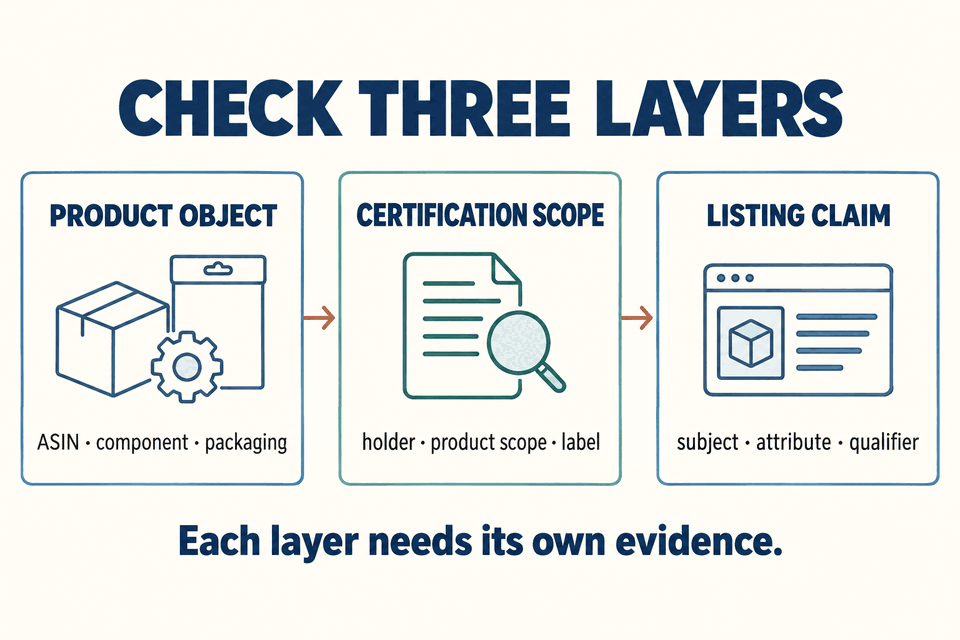
The practical conclusion is straightforward: a CPF submission should be reviewed across three separate layers—the product object, the certification scope, and the listing claim. Each layer needs its own evidence. None can stand in for the other two.
Why a single matching formula is the wrong model
Amazon describes Climate Pledge Friendly as a program that helps customers discover products with sustainability features supported by approved certifications, including trusted third-party certifications and Amazon-developed programs. The unit that receives the customer-facing label is a product. The certification is the basis for a particular sustainability feature; it is not a transferable approval for every product sold by the certified company.
Certification programs also examine different things. FSC requirements address forest-based materials, chain of custody, product labeling, and trademark use. Textile Exchange's RCS and GRS address recycled content and chain of custody, while GRS adds processing requirements covering social, environmental, and chemical practices. A category field in a seller system can help identify a product, but it cannot redefine either certification.
This is why an internal rule such as “Product Code overlap above X percent means proceed” is not an official eligibility test. It may create a neat spreadsheet, but it can hide the real questions: Which physical product is being submitted? What does the current certificate actually cover? What exact claim will the customer read?
Layer one: identify the product object
Start with the marketplace object, not the certificate name. Record the target marketplace, ASIN or SKU, current product version, main materials, and whether the proposed sustainability statement concerns the complete product, a permanent component, or packaging.
This distinction matters because a commercial “product family” is not necessarily one evidence object. Variants can use different fabrics, suppliers, accessories, finishes, or packaging. A listing can retain old images after the physical specification changes. A parent-child relationship in a catalog does not prove that every child shares the same certified inputs.
Counterexample: FSC's current Amazon CPF guidance states that an uncertified product does not become eligible merely because it is placed in FSC-certified packaging. Packaging evidence supports a packaging statement. It does not convert the item inside into an FSC-certified product.
The same discipline applies to components. If certified material is a secondary part of the finished product, the listing must identify that component accurately instead of allowing the customer to infer that the entire product carries the same certification claim.
Layer two: read the certification scope as written
A certificate number or PDF cover page is only the beginning of the review. The team should authenticate the record through the program's official source and examine the certificate holder, certified site, product or material categories, status, and any labeling, licensing, or transaction requirements that apply.
For the FSC pathway, current public guidance distinguishes a company's own Chain of Custody certificate or Promotional Licence from a supplier's or manufacturer's certification. The enrolling company may not use the supplier's certification details as if they were its own. The product must also be finished and carry an FSC label. These are product- and participant-specific conditions, not a generic statement that “the supply chain has FSC somewhere.”
Textile Exchange makes another important distinction. Its Certificate Authentication page identifies Find a Certified Company as the source of truth for scope certificates. Transaction certificates issued after October 1, 2022 are authenticated through a separate tool. A scope certificate helps establish who is certified and for what scope; a transaction certificate supports a particular certified transaction. One does not automatically prove the other, and neither alone establishes that the current listing text is accurate.
The familiar GRS 20% and 50% figures illustrate why scope and claim rules must not be mixed. Textile Exchange explains that GRS may be used as a business-to-business tool for products containing at least 20% recycled material, while consumer-facing labeling requires at least 50%. Those percentages describe different uses within GRS. They are not a universal recycled-content threshold for every CPF certification.
Layer three: audit the sentence the customer will see
Every sustainability statement should make three elements explicit:
Subject: Is the statement about the complete product, its wooden frame, the main fabric, or the packaging?
Attribute: Is the evidence about certified forest-based material, recycled content, chain of custody, organic content, or another defined characteristic?
Qualifier: Does the sentence identify the relevant component, percentage, material, version, or marketplace limitation?
Consider a chair with an FSC-certified wooden frame. A statement about the frame can be accurate when the underlying FSC conditions are met. A whole-product statement may not be. Likewise, a verified recycled-content percentage for the main fabric should not be presented as the percentage for the complete finished item unless the calculation and applicable claim rules support that denominator.
A useful drafting principle is that the claim may be narrower than the evidence, but it must not be broader. “Certified component” cannot silently become “certified product.” Evidence for one shipment cannot become evidence for every future version. A company's scope certificate cannot become a declaration that an ASIN has already qualified for a platform badge.
A pre-submission review that exposes gaps
The review can be conducted as a short conversation among three owners rather than as a universal scoring model.
The product owner confirms the marketplace, ASIN/SKU, physical specification, material version, packaging version, and variant differences. If two variants do not share the same product facts, they should not inherit one conclusion merely because they share a parent listing.
The supply-chain or compliance owner authenticates the certificate through the relevant program, then checks the holder, site, scope, label or licence conditions, and shipment-level records against that product version. Names and product descriptions should be reconcilable without relying on an informal explanation from a supplier.
The listing owner reads every customer-facing location—the title, bullets, description, image text, and sustainability feature—and confirms that each sentence stays within the supported subject and attribute. If removing the certification name makes it unclear whether the sentence concerns the product, a component, or packaging, the statement needs to be narrowed.
When one layer is missing, do not fill the gap with an assumed overlap rate. Obtain the missing evidence, revise the statement, or pause the submission. This process does not guarantee a platform result. Its value is that it reveals object and scope errors before they are embedded in a submission or a customer-facing claim.
Primary sources used for this review
Amazon Sustainability, Products and Services: Climate Pledge Friendly recognizes products through approved certifications and routinely reviews the certification landscape.
FSC Connect, eCommerce Sustainability Programs: current participant, finished-product, labeling, packaging, component, and listing requirements for the FSC pathway into Amazon CPF.
Textile Exchange, Certificate Authentication: separate official authentication routes for scope certificates and transaction certificates.
Textile Exchange, Recycled Claim Standard and Global Recycled Standard: the difference between GRS business-to-business use and consumer-facing labeling thresholds.
Conclusion
The strongest pre-submission control is not a single percentage or category crosswalk. It is a disciplined separation of three questions: What exact product object is being submitted? What does the certification record actually cover? What will the listing claim communicate to the customer?
When those questions are answered independently and then reconciled, the team can detect scope inflation, packaging/product confusion, variant drift, and unsupported wording without pretending that the review itself guarantees CPF eligibility.
GreenArk (Shenzhen) Certification Co., Ltd.
Email: sui@greenark-sz.com
Website: www.greenark-sz.com
Phone: +86 184 0755 9004 (WeChat available)


