Source check: September 25, 2026. This article uses the current eCFR text of 16 CFR Part 260, the FTC’s official Green Guides materials, and Amazon’s Environmental Marketing Guidelines. The FTC has been reviewing the Guides, but the current Part 260 page still identifies the 2012 final Guides as its source. Questions raised in that review are not new requirements. This article supports compliance preparation; it is not legal advice and does not promise a marketplace outcome.
An environmental claim can fail even when every sentence sounds modest in isolation. The listing title may say “eco-friendly,” an image may carry an unexplained green seal, a bullet may say “recycled,” and a small note may refer only to the package. A shopper sees one page, not four separate legal files.
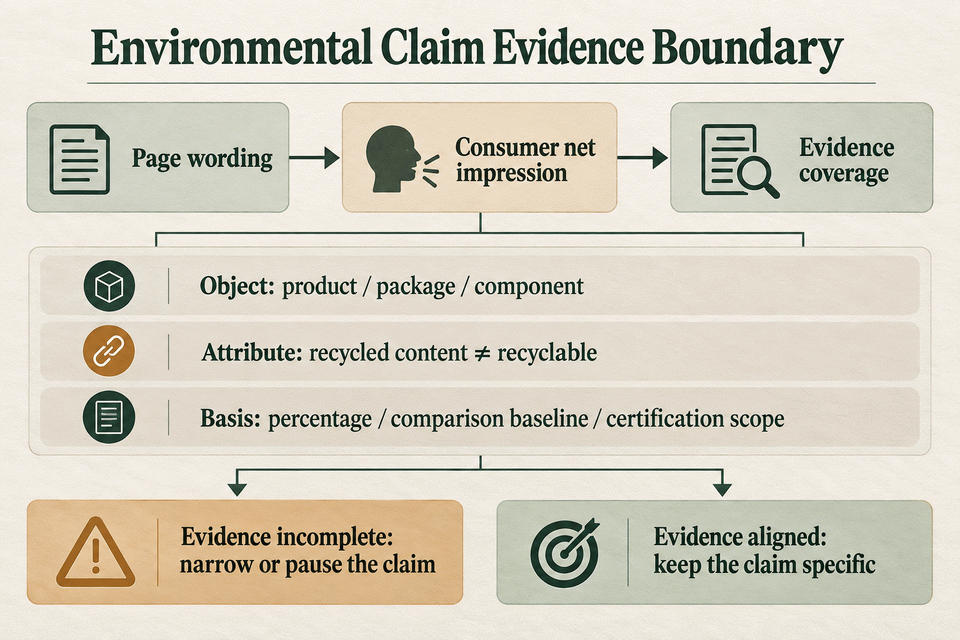
That is the central test for an Amazon listing review: the scope of the page’s message should not exceed the scope of the evidence. If the evidence supports one packaging attribute, the page should not imply that the entire product has broad environmental benefits. If the percentage, comparison baseline, geographic access, test conditions, or mark authorization is missing, narrow or pause the claim.
Current rule, pending review, and Amazon’s audience boundary
The FTC Green Guides are administrative interpretations of Section 5 of the FTC Act. They describe the Commission’s current views, help marketers avoid unfair or deceptive claims, and do not independently bind the public. The Guides apply to express and implied environmental claims made through words, symbols, logos, depictions, brand names, and other forms of marketing. Whether a claim is deceptive depends on the net impression of the material at issue.
The FTC opened a regulatory review in 2022 and later held a workshop on recyclable claims. Those proceedings asked whether the Guides should change; they did not themselves amend the current text. A compliance file should therefore distinguish the rule that applies today from proposals, comments, and workshop discussions.
Amazon’s one-page Environmental Marketing Guidelines require specific environmental benefits, clear and prominent qualifications, a distinction between products, packaging, and services, a stated basis for comparisons, and detail-page claims that do not go beyond claims on the product itself. The document says it assists Amazon.com Vendors. Sellers, brands, and other marketplaces should still verify the current requirements visible in their own account and market rather than treating that PDF as a universal enforcement notice.
A packaging fact can become an unsupported product claim
Consider a storage item shipped in a box containing a measured percentage of recycled paper. The listing headline calls the product “eco-friendly,” a secondary image uses an unexplained green seal, and a bullet says “recycled.” The only record on file is a supplier statement about the box.
That record may support a carefully limited packaging claim. It does not automatically support a claim that the complete product is recycled, environmentally preferable, or independently certified. A qualification at the bottom of the page may not cure the wider message created by the headline, imagery, and seal.
The correction is not to replace “eco-friendly” with a different vague adjective. Identify the object, name the specific attribute, state the supported percentage or condition, and tie the evidence to the current SKU and packaging version.
Identify the object before evaluating the adjective
Section 260.3 says an environmental claim should identify whether it refers to the product, package, service, or part of one when the context is unclear. If recycled fiber appears only in the carton, the title and imagery should not make the complete item look recycled. A minor component may not always require separate treatment, but an incidental component that materially limits recyclability can change the analysis.
This is more than copyediting. The object named on the page sets the boundary for the supplier record, test report, calculation, or certification scope that must support it.
Recycled content and recyclable require different files
Section 260.13 addresses recycled content. The material must have been recovered or diverted from the waste stream, and a product or package made only partly from recycled material should disclose the percentage by weight of the finished item. Scrap routinely returned to the original manufacturing process does not automatically qualify.
Section 260.12 addresses recyclability. The question is whether the product or package can be collected, separated, or otherwise recovered through an established recycling program, including whether appropriate facilities are available where the item is sold. The current Guides use at least 60 percent of consumers or communities as the “substantial majority” threshold for an unqualified claim. The FTC’s review asked whether that threshold should change, but the question did not change the current text.
Material origin therefore does not prove practical end-of-use recyclability, and recyclability does not prove recycled content.
A comparative number needs a named baseline
“20% less plastic,” “greener,” and “industry-leading” invite different comparisons. Section 260.3 requires marketers to make the basis of a comparative environmental claim clear and to substantiate the reasonable interpretations the wording conveys.
If the calculation only shows that the current package weighs 15 percent less than the immediately preceding package, name the package version, metric, and baseline. Do not expand that one improvement into an overall claim that the product is environmentally superior. A mathematically correct percentage can still mislead when the page communicates a broader benefit.
A certification seal does not carry every claim on the page
Section 260.6 states that third-party certification does not remove the marketer’s obligation to substantiate all claims reasonably communicated by the certification. A seal that does not explain its basis may imply a general environmental benefit.
Before using a mark, verify the certificate holder, covered product or material, validity period, authorization to use the mark, and nearby wording that limits the certification to the supported attribute. A supplier certificate is not automatic permission for a brand to place the mark on every ASIN. The certification program’s own rules and the product-specific evidence remain necessary.
Compostable and degradable claims depend on disposal conditions
Section 260.7 calls for competent and reliable scientific evidence that a compostable item will become usable compost safely and in a timely manner in an appropriate facility or home composting environment. Qualifications may be needed when home composting is unsuitable or appropriate facilities are not widely available.
Section 260.8 gives a different boundary for an unqualified degradable claim. For an item entering the solid-waste stream, the claim is deceptive if the item does not completely decompose within one year after customary disposal. A laboratory result does not show what happens in a landfill, incinerator, recycling facility, or another real disposal route.
Build a claim file that can survive a page revision
Do not maintain only a glossary of approved green words. For each proposed claim, retain the exact page wording and screenshot; identify whether it concerns the product, package, or component; record the percentage, comparison baseline, test conditions, certification scope, or facility access; and connect those records to the current SKU, physical version, market, source file, and review date.
Then make an explicit decision. Keep a specific claim when the evidence covers it. Narrow the object or attribute when the evidence covers only part of the message. Pause the claim when a material percentage, test, access condition, or authorization is missing. Reopen the analysis when the supplier, material, package, product, or listing changes.
Greenark (Shenzhen) Certification Co., Ltd. can support evidence organization, certification-scope review, and claim-boundary checks. This work does not replace Amazon, the FTC, a certification program, or legal counsel, and it does not promise approval, badging, ranking, traffic, or sales.
Email: sui@greenark-sz.com
Website: www.greenark-sz.com
Phone: +86 184 0755 9004
Official sources
1. eCFR, 16 CFR Part 260, Guides for the Use of Environmental Marketing Claims.
2. Federal Trade Commission, Environmental Claims: Summary of the Green Guides; Green Guides regulatory-review materials.
3. Amazon, Environmental Marketing Guidelines.