Information reviewed on September 24, 2026. This article uses current public information from Amazon and Textile Exchange. Certification versions, marketplace pathways, and product matching can change, so teams should verify the records that apply to the target marketplace and product.
Suppose an internal bill of materials shows 52% recycled content. That number may be relevant to a Global Recycled Standard (GRS) consumer claim, but it does not by itself establish Climate Pledge Friendly (CPF) eligibility. It says nothing conclusive about the certification route, the certificate scope, transaction traceability, or Amazon's product-level match.
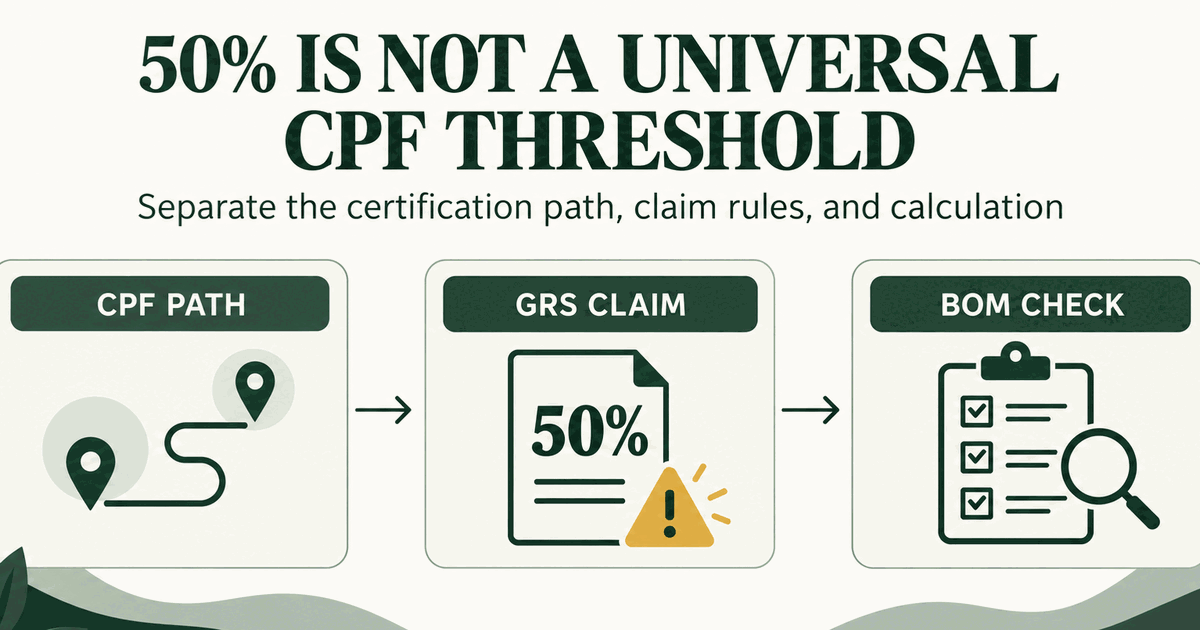
The central distinction is simple: 50% is not a universal threshold across every CPF route. Choose the certification path first, identify the intended claim and calculation object second, and only then test the percentage.
Twenty percent and fifty percent belong to different uses
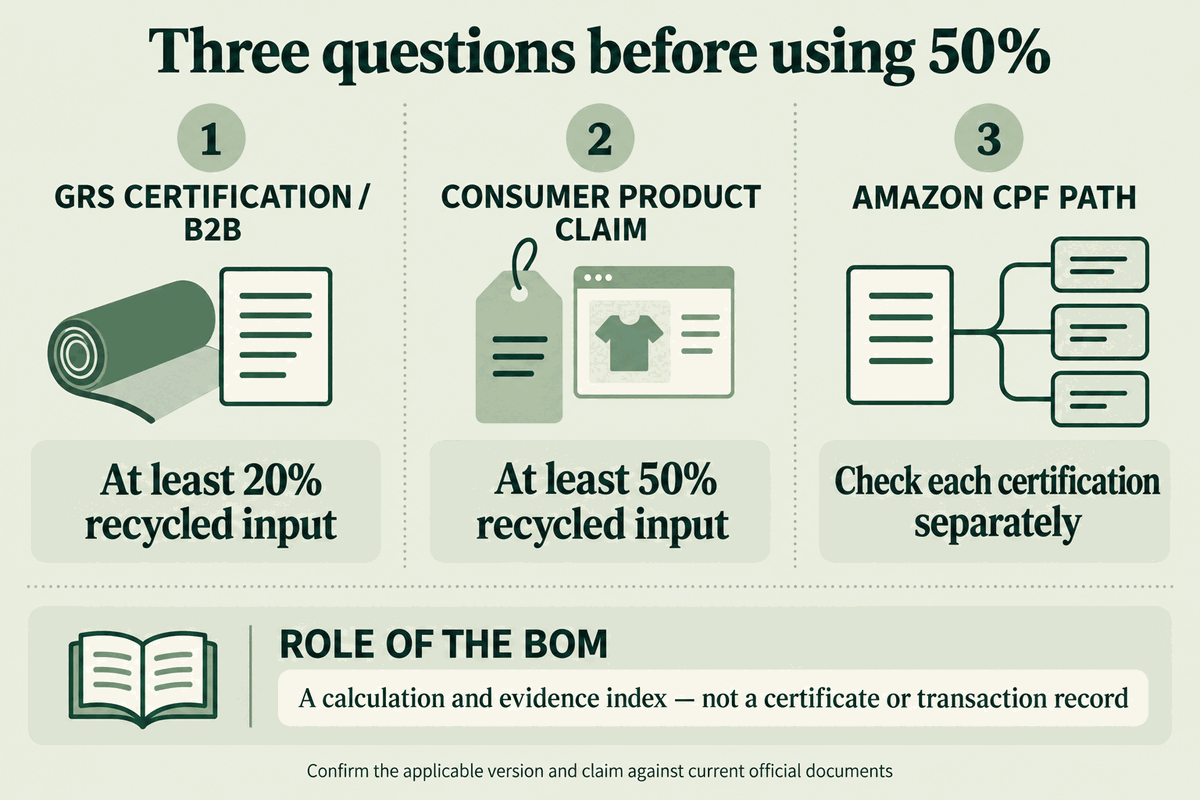
Textile Exchange's current FAQ draws a specific line. A product with at least 20% recycled input may use GRS as a certification and business-to-business tool. A consumer-facing GRS product claim—on a hangtag, sewn-in label, or product webpage—requires at least 50% recycled input.
A product at 25% may therefore sit within GRS certification and B2B traceability while remaining ineligible for a consumer-facing GRS product claim. The reverse problem is just as important: a spreadsheet calculation above 50% does not create a certified chain. The product must still fall within the relevant certificate scope and be supported by the applicable transaction and traceability records.
Component claims require another deliberate choice. Teams must identify the claimed component and apply the current claims policy to the percentage basis. Trims and accessories do not disappear merely because they are small, and their presence in a BOM does not automatically make them certified inputs.
GRS claim rules and CPF recognition are different layers
Amazon describes CPF as a program that works with trusted third-party certifications and Amazon-created certifications. Those routes do not share one material threshold. Amazon's public explanation of GRS refers to products containing at least 50% recycled content, but that GRS example should not be generalized to RCS, OCS, RWS, FSC, or another CPF certification.
Nor does holding a certification automatically prove that a specific ASIN has been matched correctly. The certificate holder, certified site, product description, material attribute, transaction record, sales version, and marketplace record still need to point to the same product. A CPF label displayed on a product page is a marketplace recognition outcome; it is not a substitute for the evidence underneath it.
The BOM should reveal what the percentage belongs to
A reviewable BOM connects each component and material with unit weight, recycled attribute, supplier, evidence reference, batch or transaction record, and the current sales version. Its first task is not to reach 50%. Its first task is to answer three questions: Is the claim about the whole product or one component? What belongs in the denominator? Which record supports every included input?
For example, a main fabric that contains 60% recycled polyester does not automatically make a finished item with lining, zippers, filling, and accessories a “60% recycled product.” If the claim is about the fabric, the wording needs to identify that object. If the claim is about the finished product, the team must recalculate within the scope defined by the applicable rule.
The BOM cannot replace a scope certificate, transaction certificate, or other chain-of-custody record. It also cannot prove that Amazon has connected the certification record to the ASIN. Its value is operational: it exposes mismatched objects and unsupported lines before submission.
Do not confuse the GRS 5.0 document update with the Materials Matter claims transition
Textile Exchange published and made GRS 5.0 effective on July 1, 2026, with mandatory implementation on December 31, 2026. The official update states that the revision is limited to changes needed for the updated Reclaimed Material Declaration Form (RMDF) and improved reclaimed-material tracking; it is not a broad rewrite of the standard.
A separate change is coming through the Materials Matter Claims and Labeling Policy. It becomes effective on December 31, 2026 and introduces a 30% labeling threshold for Materials Matter consumer-facing claims, with a transitional 20% exception for specified recycled cotton and recycled man-made cellulosic fibers. The mandatory transition date for claims and labels is June 30, 2029. That future threshold is tied to a different policy and transition; it should not be restated as a new universal CPF threshold.
During the transition, the right response is not to replace “50%” with another generic number. Review the certificate and RMDF version, the date and type of the claim, the applicable claims policy, and the material or component scope, then return to the specific CPF certification path.
A five-object review is more reliable than a one-cell test
Certification route: identify the CPF-recognized certification expected to support this product.
Claim type: distinguish B2B traceability, a consumer product claim, and a claim about an identifiable component.
Calculation object: confirm whether the percentage belongs to the finished product, a component, or another standard-defined scope.
Evidence chain: connect the scope certificate, supplier, batch, transaction records, and current sales version.
Marketplace object: make sure the evidence points to the correct SKU or ASIN and that the page claim stays within the supported scope.
The practical risk is not merely a calculation error. It is calculating the wrong threshold accurately. Separating the route, claim, object, and evidence turns the BOM into a useful control instead of a false eligibility test.
Official sources reviewed
Amazon Seller Sustainability Solutions Hub; Amazon Sustainability's CPF overview; Textile Exchange Standards FAQs and the GRS/RCS page; Textile Exchange Standards Policy & Resource Updates, including the Materials Matter claims transition; and the GRS 5.0 document page.
Greenark (Shenzhen) Certification Co., Ltd. recommends documenting the certification route and claim scope before using a percentage as a decision rule.