Checked on 25 August 2026 against the European Commission’s CRMA strategic-project pages, selected-project information and Regulation (EU) 2024/1252. This article is not legal advice and does not promise certification, market access or a sales result.
Suppose a supplier tells a battery-materials buyer that its group participates in a European Commission Strategic Project. The project concerns lithium or graphite, so the product team drafts: “Made with EU strategic-project raw materials and compliant with EU requirements.” That sentence moves too quickly. It combines a project fact, a material-origin claim and a product-law conclusion.
The Commission’s project pages can support the first part: the name, location, project type and linked raw materials of a project selected under the Critical Raw Materials Act. They do not, by themselves, show that the material in a particular delivery came from that project or that the finished SKU meets every rule applicable to it.
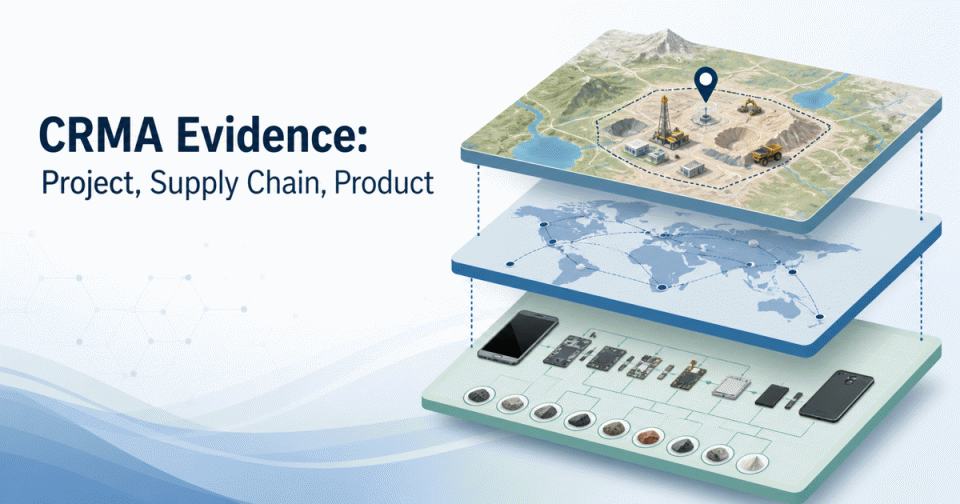
Follow the claim through three records
The project record should preserve the Commission page, the official project name, location, status, raw-material reference and the date checked. The supply-chain record should identify the supplier, contract or statement, batch, quantity, processing location, delivery date and material flow. The product record should identify the BOM, material share, SKU, batch and the exact wording shown to customers.
These records answer different questions. A project name without a batch connection does not establish origin. A batch document without a BOM or SKU connection does not establish product use. Even when those links exist, a material traceability record does not replace a separate assessment under battery, packaging, digital-product-passport or environmental-claim rules.
A realistic mismatch
A supplier may participate in a strategic project at group level while a particular product is made with material purchased from another processor. That does not prove that the supplier has no project-related supply; it does show that the project page alone cannot be used as the origin statement for every SKU. The appropriate wording should stop at the strongest fact that the current documents support and should identify what evidence is still missing.
With only the official project entry, describe the selected project and the raw material listed there. With supplier, processing and batch records, describe the traceability that those records actually establish. Use a product-compliance statement only after identifying the specific rule, responsible party, time scope and evidence required for that product.
The strategic-project list is valuable because it gives procurement and due-diligence teams a reliable starting point. Its value is lost when a policy project is treated as a universal product endorsement. Keep the project, supply-chain and product layers linked, but do not let one layer speak for the others.
Sources: European Commission Strategic Projects under the CRMA, Selected Projects, critical-raw-materials pages and Regulation (EU) 2024/1252, checked on 25 August 2026.
A strategic project is a policy designation
An EU strategic project under the Critical Raw Materials Act identifies a project selected within a policy framework for extraction, processing, recycling or substitution of strategic raw materials. That project-level fact is useful for supply-chain research. It is not a certificate, test report or automatic market-access conclusion for a product SKU.
Connect project, supply chain and product
To make a product-level statement, identify the official project, supplier or processor involved, material and batch relationship, and BOM or product version that receives the material. A supplier’s general participation statement is not the same as a record connecting this delivery to the project.
Do not use CRMA as a universal compliance label
A battery, packaging, digital-product or environmental claim may have its own law and evidence requirements. If a page says that a product complies with EU requirements, specify which requirement is meant and check its scope, responsible party and date independently. Use the narrow statement supported by the project record.
The project list does not identify a finished product
The Commission list can verify a project name, location, status and linked raw material. It does not identify the material in a supplier’s shipment, the processing step that produced it or the SKU that contains it. A product page should therefore separate the official project fact from any later supply-chain conclusion.
Use a three-layer evidence map
At project level, retain the official entry and its date. At supply-chain level, retain supplier identity, contract or declaration, batch, quantity, processing location and material flow. At product level, retain the BOM, material share, SKU, version and exact page wording. A missing link is a boundary to disclose, not a reason to fill the gap with a broader claim.