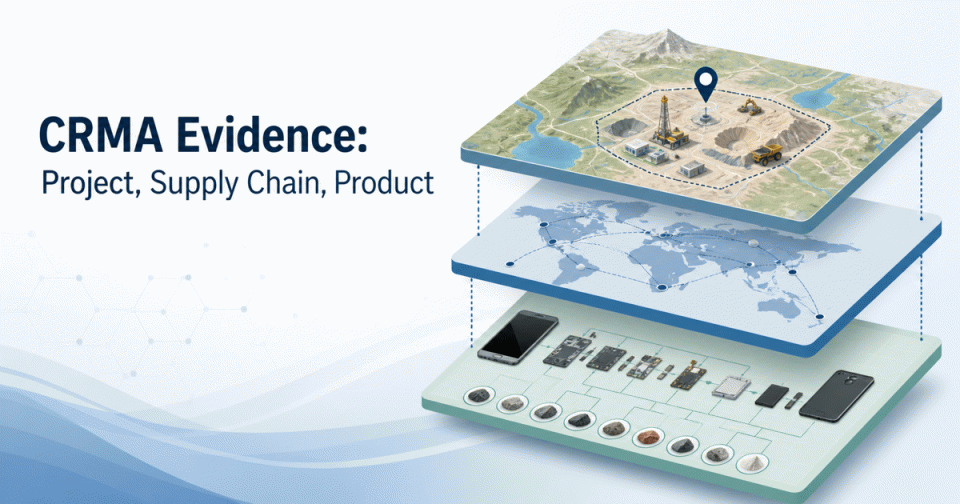
The European Commission’s strategic-project list can support a record of project names, locations, statuses and linked strategic raw materials. It should not be used as a standalone certificate for a product or a finished SKU.
The project layer answers a project-level question: which project was selected under the CRMA framework? It does not, by itself, answer whether a supplier’s material came from that project, whether a specific batch can be traced through processing, or whether a product meets all applicable EU requirements.
Keep three linked evidence layers. The project register should preserve the official Commission page and date. The supply-chain file should contain the supplier, contract or statement, batch, quantity and processing location. The product file should contain the BOM, material share, SKU and the exact wording used on the page.
Terms such as strategic raw material and critical raw material have specific regulatory meanings. They do not automatically mean certified, recycled, compliant or approved. Battery, packaging, DPP and environmental-claim requirements must be reviewed separately. This note does not promise project selection, certification, financing or market access.
A strategic project is a policy designation
An EU strategic project under the Critical Raw Materials Act identifies a project selected within a policy framework for extraction, processing, recycling or substitution of strategic raw materials. That project-level fact is useful for supply-chain research. It is not a certificate, test report or automatic market-access conclusion for a product SKU.
Connect project, supply chain and product
To make a product-level statement, identify the official project, supplier or processor involved, material and batch relationship, and BOM or product version that receives the material. A supplier’s general participation statement is not the same as a record connecting this delivery to the project.
Do not use CRMA as a universal compliance label
A battery, packaging, digital-product or environmental claim may have its own law and evidence requirements. If a page says that a product complies with EU requirements, specify which requirement is meant and check its scope, responsible party and date independently. Use the narrow statement supported by the project record.
A project name can be a useful lead without becoming a claim
The most useful page may explain that the official list is a starting point for supplier due diligence. It can identify what the project record says and invite a separate check of material origin and product obligations. That is more informative than turning a policy designation into a general badge for every product sold by the company.