Category: Supplementary Documentation / Audit Risk

Data Verification Date: 2026-08-05

Source Basis: Textile Exchange official MMS release, December 12, 2025 (confirmed via Intertek)

Official Source: https://www.intertek.com.cn/Reading_itemid_2017111778017677312_lcid_40.html

Executive Summary

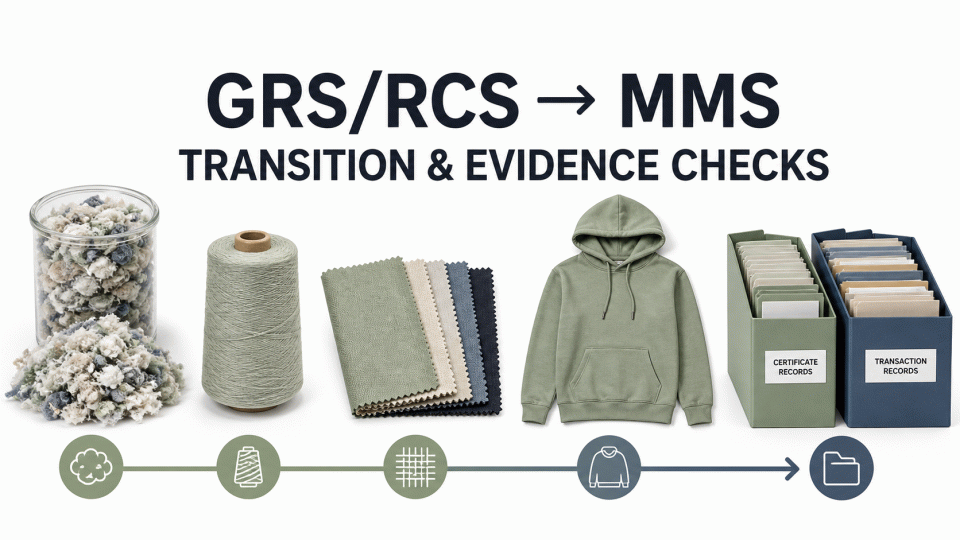
On December 12, 2025, Textile Exchange (TE) officially released the Materials Matter Standard (MMS), bearing the document reference TE-MM-STN-101-V1.0. This single, unified standard is set to replace five existing TE standards — including the Global Recycled Standard (GRS) and the Recycled Claim Standard (RCS), which are currently the most widely held sustainability certifications among Chinese Amazon sellers participating in the Climate Pledge Friendly (CPF) programme. The transition carries significant implications for the CPF green label evidence chain, as Amazon has not yet confirmed whether MMS will be accepted as a recognised certification under CPF. This article provides a fact-based overview of the MMS transition timeline, scope boundaries, and the specific risks that GRS-certified Amazon sellers must address before their certificates expire in 2027.

1. What Is the Materials Matter Standard (MMS)?

The Materials Matter Standard (MMS), document reference TE-MM-STN-101-V1.0, was released by Textile Exchange on December 12, 2025. It is a consolidated sustainability standard designed to streamline and unify several previously separate TE standards under a single framework.

1.1 Standards Being Replaced by MMS

MMS replaces the following five TE standards:

  1. GRS-101-V4.0 — Global Recycled Standard
  2. RCS-101-V2.0 — Recycled Claim Standard
  3. RWS — Responsible Wool Standard
  4. RMS — Responsible Mohair Standard
  5. RAS — Responsible Alpaca Standard

1.2 Important Correction: OCS and RDS Are NOT Being Replaced

A critical clarification must be made regarding reporting accuracy. Some third-party media outlets have incorrectly reported that the Organic Content Standard (OCS) is among the standards being replaced by MMS. This is incorrect. Both OCS (Organic Content Standard) and RDS (Responsible Down Standard) will remain as separate, standalone standards and are not being consolidated into MMS. Organisations certified under OCS or RDS should not anticipate a forced migration to MMS and should continue to maintain those certifications under their existing frameworks.

2. MMS Transition Timeline

The MMS rollout follows a phased implementation schedule:

Milestone Date
MMS official release December 12, 2025
Voluntary effective date December 31, 2026
Mandatory implementation date December 31, 2027

During the voluntary period (from December 31, 2026), organisations may choose to certify under MMS ahead of the mandatory deadline. From December 31, 2027, MMS becomes the required standard for all organisations previously certified under the five replaced standards. Existing GRS and RCS certificates that have not yet expired by the mandatory implementation date will need to be transitioned to MMS to maintain valid certification status.

3. Scope Boundaries: Who Must Audit Under MMS?

3.1 Tier 4 Organisations

Under the MMS framework, Tier 4 organisations — which include farms, recycling facilities, and primary processors — must audit directly under MMS. These organisations sit at the origin of the supply chain and are responsible for the initial production or reclamation of raw and recycled materials. Their direct certification under MMS is essential for establishing the credibility of the entire downstream evidence chain.

3.2 CCS for Mid- and Downstream Supply Chain Tracking

For mid-stream and downstream organisations, the Content Claim Standard (CCS) handles supply chain tracking. CCS does not replace MMS; rather, it serves as the mechanism through which material claims are traced from Tier 4 producers through to the final product. This division of responsibility — MMS at the source, CCS along the chain — is designed to maintain traceability without requiring every supply chain participant to undergo a full MMS audit.

3.3 Baseline and Enhanced Tiers

MMS introduces a tiered structure comprising a baseline tier and an enhanced tier. These tiers are designed to accommodate different company sizes and operational complexities. Smaller organisations may certify at the baseline level, while larger or more complex operations are expected to meet the enhanced tier requirements. This tiered approach is intended to reduce the certification burden on smallholders and small enterprises while maintaining rigour for larger supply chain actors.

4. GRS and the Amazon Climate Pledge Friendly (CPF) Programme

4.1 GRS: The Most Popular CPF Certification Among Chinese Amazon Sellers

Among Chinese Amazon sellers participating in the CPF programme, GRS is the most widely held sustainability certification. This is largely because GRS directly addresses recycled content claims, which align with the growing consumer and regulatory demand for circular-economy products in categories such as apparel, home textiles, and accessories.

4.2 Amazon CPF Recognises 56 Sustainability Certifications

Amazon's CPF programme currently recognises 56 sustainability certifications, including GRS. These certifications serve as the basis for awarding the CPF green label badge on product detail pages. Sellers who hold a recognised certification can apply for the green label, which may improve product visibility to environmentally conscious shoppers.

4.3 Key Uncertainty: Amazon Has Not Confirmed MMS Acceptance

As of the data verification date of 2026-08-05, Amazon has not yet confirmed whether MMS will be accepted as a recognised certification under the CPF programme. This is a critical uncertainty. If MMS is not added to the CPF-recognised certification list by the time GRS certificates expire and mandatory MMS implementation takes effect on December 31, 2027, sellers who transition from GRS to MMS may face a gap in their CPF eligibility. Conversely, if Amazon does recognise MMS, sellers will need to ensure that their new MMS certification is properly linked to their CPF evidence chain.

Sellers should monitor official Amazon CPF documentation and Textile Exchange announcements for updates on MMS acceptance status.

5. CPF Evidence Chain: Scope-TC-ASIN Three-Line Alignment

The CPF green label is not granted on the basis of a certificate alone. Amazon requires a complete evidence chain that demonstrates alignment across three critical lines:

  1. Scope Certificate (SC): The organisational certification that defines the scope of a company's certified activities, including the materials and product categories covered.
  2. Transaction Certificate (TC): The document that accompanies each shipment of certified material, confirming that the specific quantity of material in the transaction meets the standard's requirements.
  3. ASIN: The Amazon Standard Identification Number, which uniquely identifies each product listing on Amazon.

For the CPF green label to remain valid, the Scope Certificate, the Transaction Certificate, and the ASIN must all be aligned — meaning the material described in the TC must fall within the scope of the SC, and the product associated with the ASIN must correspond to the material documented in the TC. Any misalignment among these three elements can result in the green label being revoked or the application being rejected.

6. Critical Threshold and Timing Distinctions

6.1 GRS 20% Recycled Threshold vs. CPF 50% Threshold

A common source of confusion is the difference between the recycled content thresholds used by GRS and by Amazon CPF:

  • GRS threshold: A product must contain a minimum of 20% recycled material to qualify for GRS certification.
  • CPF threshold: Amazon's CPF programme may require a higher recycled content percentage — commonly cited as 50% — for certain product categories to qualify for the green label.

Sellers must understand that holding a GRS certificate does not automatically guarantee CPF green label eligibility. A product certified under GRS at the 20% recycled content level may still fall short of the CPF 50% threshold. These two thresholds must be evaluated independently and should not be conflated.

6.2 Transaction Certificate 45-Day Time Limit

Transaction Certificates (TCs) are subject to a 45-day time limit. This means that a TC must be issued within 45 days of the transaction date. Failure to obtain a TC within this window can result in the transaction being deemed non-compliant, which would break the evidence chain required for CPF green label eligibility. Sellers and their suppliers must establish reliable TC issuance workflows to ensure that no TC is delayed beyond the 45-day deadline.

6.3 Supplier SC Certificates Cannot Be Shared

A further compliance constraint is that supplier Scope Certificates (SCs) cannot be shared between different buyers or product listings. Each seller must hold or have legitimate access to the SC that covers the specific scope applicable to their product. Attempting to use a supplier's SC to support CPF green label claims for a product that is not within the certified scope constitutes a misrepresentation and can lead to CPF removal and account-level penalties.

7. Recommended Actions for GRS-Certified Amazon Sellers

Given the MMS transition timeline and the CPF evidence chain requirements, GRS-certified Amazon sellers should consider the following actions:

  1. Check certificate expiry dates: Review the expiry date of your current GRS certificate. If it expires on or after December 31, 2027, plan for MMS transition rather than GRS renewal.
  2. Plan MMS migration: Begin discussions with your certification body about the MMS audit process, including whether your organisation falls under Tier 4 (requiring direct MMS audit) or mid/downstream (handled via CCS).
  3. Monitor Amazon CPF MMS acceptance status: Regularly check whether Amazon has added MMS to the list of CPF-recognised certifications. Until MMS is confirmed, maintain valid GRS documentation for as long as possible.
  4. Verify Scope-TC-ASIN alignment: Conduct an internal audit of your CPF evidence chain to ensure that your Scope Certificate, Transaction Certificates, and ASINs are properly aligned. Identify and correct any misalignments before they are flagged during Amazon's verification process.
  5. Confirm recycled content thresholds: Verify that your product's recycled content percentage meets both the GRS 20% minimum and the CPF 50% threshold where applicable. Do not assume that GRS certification alone satisfies CPF requirements.
  6. Establish TC issuance workflows: Ensure that your suppliers and logistics partners have a reliable process for issuing Transaction Certificates within the 45-day time limit. Delays in TC issuance can break the evidence chain.
  7. Avoid SC sharing: Ensure that each product listing is supported by its own legitimate Scope Certificate. Do not rely on a supplier's SC for products outside the certified scope.

8. About Greenark (Shenzhen) Certification Co., Ltd.

Greenark (Shenzhen) Certification Co., Ltd. (绿色方船(深圳)认证有限公司) provides sustainability certification consulting and support services for manufacturers and Amazon sellers navigating GRS, RCS, MMS, and CPF compliance requirements.

Email: sui@greenark-sz.com

Website: www.greenark-sz.com

Phone: +86 18407559004

Disclaimer: This article is provided for informational purposes only and is based on publicly available information as of the data verification date of 2026-08-05. The MMS transition timeline, scope boundaries, and CPF requirements described herein are based on Textile Exchange's official MMS release (TE-MM-STN-101-V1.0, December 12, 2025) and Intertek's published summary. Greenark (Shenzhen) Certification Co., Ltd. does not guarantee any specific certification outcome, product ranking, traffic result, or CPF approval. Certification eligibility depends on individual organisational circumstances and is determined by the relevant certification body and platform policies. Readers are encouraged to consult official Textile Exchange and Amazon CPF documentation for the most current information.