
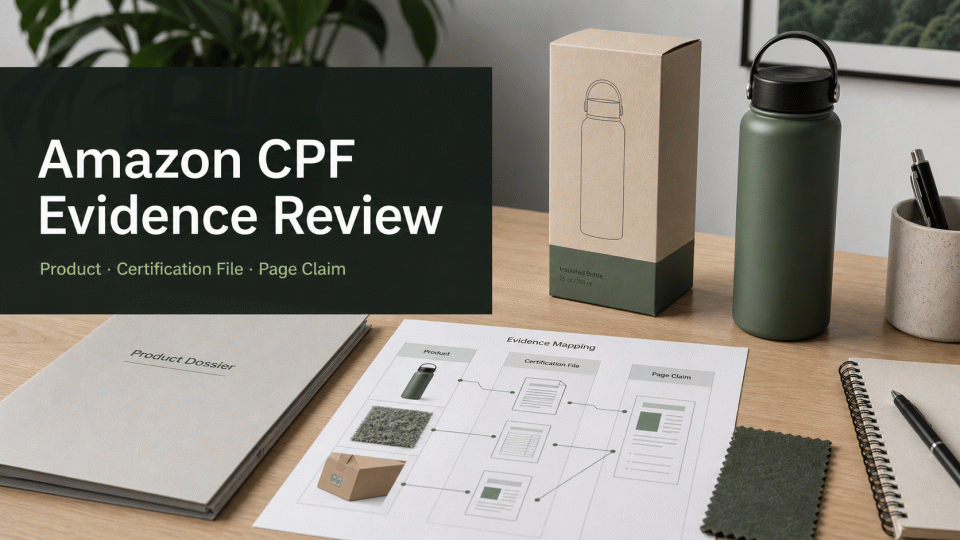
Climate Pledge Friendly (CPF) is an Amazon program that helps customers identify products with sustainability features. A useful evidence review therefore starts with one specific product, then checks whether the certification scope, product records, and customer-facing claims describe the same object.
This page is a documentation reference. It does not establish CPF eligibility, guarantee a badge, or predict an Amazon review outcome. Program entry points, accepted certifications, and display status should be checked in the current Seller Central or Vendor Central workflow.
1. Separate the program label, certification, and product claim
Amazon describes CPF as a product-level framework that works with recognised third-party certifications and Amazon-developed programs. A CPF reference for one product does not automatically describe the entire brand, factory, or supplier. A company policy or facility certificate is not, by itself, a substitute for evidence covering the listed product.
Record three separate questions: what the certificate or program covers; which product, model, material, or batch is within that scope; and what the Amazon detail page currently says. A claim is ready for review only when its subject and boundaries can be explained from those records.
2. Build the file around one product record
Identify the product: retain the ASIN, SKU, model, variation, brand, and manufacturer information. Note whether a colour, size, formula, or bundle remains within the same evidence scope. Do not use a brand or factory name as a substitute for product identification.
Map certification evidence: keep the certificate or registry record, holder, scope, standard or program name, status information, and the basis for linking it to the product. A supplier document is a lead for verification; it should not be treated as product evidence merely because the supplier provided it.
Collect supporting records: depending on the program, these may include specifications, a BOM, material or composition information, labels and packaging artwork, product photographs, or transaction and batch records. Only list documents that the applicable program or certification actually requires; do not turn assumptions into a universal submission checklist.
Review the page: copy the relevant wording from the title, bullets, description, images, attributes, and brand content. Link each statement to evidence. If a certificate supports one material or feature, keep the page claim within that same boundary instead of expanding it to the whole product line, brand, or an unqualified environmental conclusion.
3. Fields worth keeping in the CPF evidence sheet
A practical row can contain the ASIN or SKU, model and variation, certification or program name, certifier or program owner, certificate holder, product or material scope, document number, current status, verification source, page claim, supporting-file location, open questions, and last review date. Use statuses such as verified, pending verification, or not applicable; do not replace evidence with labels such as “approved” or “guaranteed.”
When a product has more than one certification, record what each one supports and what it does not support. Certifications, test reports, supply-chain records, and Amazon page status are different evidence types and should not be collapsed into a generic compliance certificate.
4. Human review before any submission
Open the underlying certificate and product records. Check names, model identifiers, scope, and page wording rather than relying on file names or screenshots. If the holder, product, material, or claim cannot be reconciled, mark the item for verification or remap it; do not fill the gap with an assumption.
Amazon’s public advertising guidance also states that the CPF label applies to a single product and that environmental or sustainability claims need appropriate substantiation. Whether a product qualifies, displays the label, or needs an account-side action must be checked in the current Seller Central or Vendor Central workflow. Preserve any difference between the file set and the account status as an explicit review note.
5. Sources and boundaries
The program-level points in this article are based on Amazon’s Sustainability Solutions Hub, Climate Pledge Friendly Creative Guidelines, and related public sustainability guidance. Program scope, submission routes, and accepted evidence may change; return to the current Amazon account workflow and the original certification record before using a file.
Keep the final package traceable as product record, certification evidence, supporting records, page claim, and account status. That structure helps a team identify scope gaps, but it does not replace an independent decision by Amazon or the relevant certification body.


