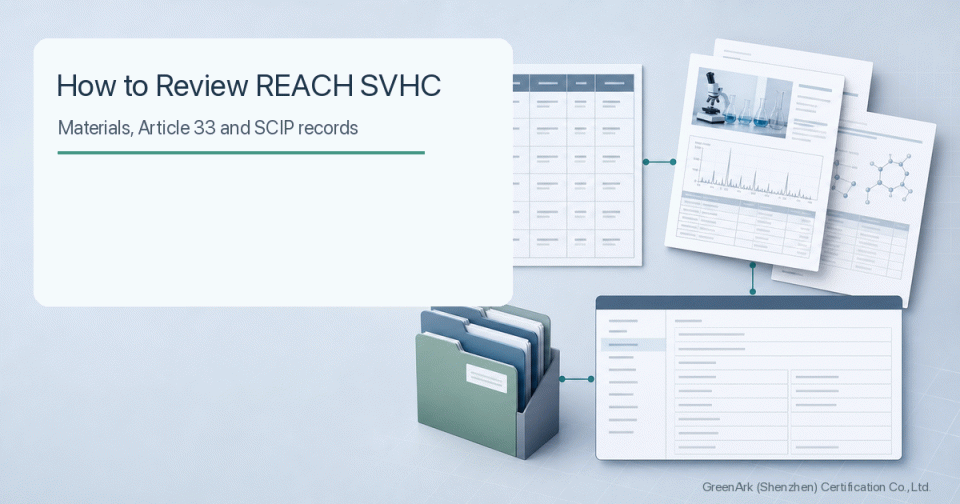
A REACH SVHC review should not begin with a search for a generic “compliance certificate.” It should identify whether Candidate List substances may be present in the product, parts or materials, then connect that finding to supply-chain information, Article 33 communication and any applicable SCIP record. This is a documentation guide, not a product-specific legal conclusion.
The Candidate List can change. This page therefore does not treat “the 2026 list” as a permanent fixed version. For each review, use the current ECHA Candidate List and applicable rules, and save the review date, substance name, EC or CAS number and source version.
1. Separate Substances, Mixtures and Articles
A substance, a mixture and an article are different review objects under REACH. For a finished product or component, build a material register first: part name, material or formulation, supplier, batch or version, intended use, and whether the material remains a separate article in the finished product. A product name, HS code or supplier statement alone is not enough.
Electronics, coatings, inks, adhesives, textile parts, plastics and packaging may require different evidence. For composite products, match supplier declarations, formulations or BOMs, test information and the actual product version item by item. If the evidence is incomplete, record “evidence pending” rather than infer “zero content.”
2. Read the ECHA Candidate List Carefully
The Candidate List is published by ECHA for substances of very high concern. A review record should retain at least the substance name, EC or CAS number, reason for inclusion, page version or update date, and the link to the relevant product material. Similar names do not prove that two substances are identical; identifiers and intended use need to be checked together.
“SVHC” in a page title should describe a substance-identification and information-communication scope. It does not mean that a product has received certification, or that a particular product necessarily contains a Candidate List substance. For each SKU, record the actual state: identified, not identified, evidence pending, or further analysis required.
3. The 0.1% w/w Threshold and Article 33 Information
ECHA’s explanation of REACH Article 33 addresses communication where an article contains a Candidate List substance above 0.1% by weight. This threshold should not be rewritten as a universal safety line for every product, test or country. The article boundary, substance identity, weight basis and calculation method for the relevant market still need to be documented.
Where communication applies, the supply-chain record should provide information needed for safe use, including the substance name and relevant safe-use information. ECHA also explains that the information is to be provided free of charge within the applicable period after a recipient’s request. Page wording should say “review and communicate where applicable,” not promise that an obligation is always avoided or that a result is guaranteed.
4. What a SCIP Record Should Cover
For articles placed on the EU market that contain a Candidate List substance above 0.1% w/w, ECHA’s SCIP information describes the relevant notification scope. SCIP is not simply a portal for uploading a test report. It is a database notification process built around article identity, composition, SVHC information and safe-use information.
A working SCIP file can cover the article name and component level, primary or other identifiers, material composition, SVHC name and concentration range, and use or disassembly information. A top-level product and an incorporated article should not be merged without checking the applicable structure. Retain the submitter, version and source documents for later change review.
5. Link the Conclusion to the SKU and Evidence
A useful register links SKU, component, material, substance, evidence and page wording. At minimum, record the product version, supplier and batch, BOM or material declaration, analysis or test evidence, Candidate List review date, Article 33 assessment, SCIP status and reviewer. Supplier documents must match the actual product, legal entity, specification, version and date.
When a material, formulation, coating, supplier or production version changes, recheck the affected article boundary and evidence links. This is a records-maintenance action; it is not a promise of a fixed renewal cycle, automatic acceptance or a guaranteed platform outcome.
6. Claim Boundaries and Source Basis
A page may say that its material records were organized with reference to the current ECHA Candidate List and applicable REACH/SCIP requirements. It should not turn a supplier statement into a product certification, official endorsement or guaranteed result. Claims such as “SVHC-free” or “REACH compliant” require a defined object, scope, date and evidence; one report cannot replace the review of every component or market.
The factual boundaries for this page are based on the ECHA Candidate List, ECHA’s REACH Article 33 supply-chain communication explanation, and ECHA’s SCIP Database and SCIP introduction pages. GreenArk (Shenzhen) Certification Co., Ltd. provides a documentation review framework; the responsible party should verify each product against current official materials, supply-chain evidence and destination-market requirements.