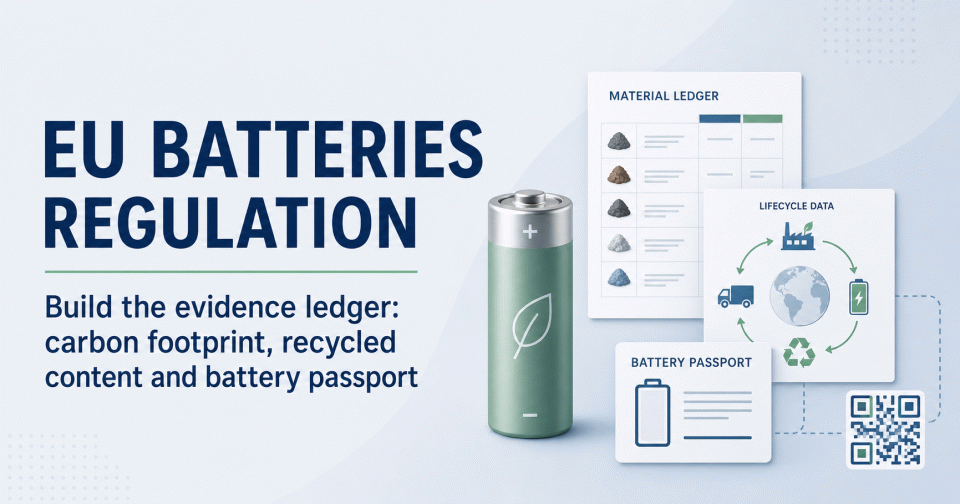
Regulation (EU) 2023/1542 creates a life-cycle framework covering the manufacture, placing on the market, use and end-of-life management of batteries. A useful preparation file is not a generic certificate: it starts with the battery category, economic-operator role, battery model and manufacturing site, then maps each applicable requirement to traceable documents and data. This is an evidence-reference article for product review; it does not promise a test outcome, certification result, market access or a fixed completion date.
1. Define the battery category, model and responsibility boundary
Record whether the product is a portable battery, light means of transport (LMT) battery, starting, lighting and ignition (SLI) battery, electric-vehicle battery or industrial battery, together with capacity, chemistry, use, whether it is incorporated into equipment, the manufacturer, importer or other economic operator, the EU market and the manufacturing plant. Do not extend a brand-level conclusion across different models. Changes to cells, modules, packs, battery-management systems, enclosures or associated equipment may affect sample representativeness and the evidence mapping.
2. Organize performance, safety and labelling records
Keep the technical documentation, product identity, key components and materials, performance and durability records, safety assessment, test records, label artwork, instructions and EU declaration of conformity by model and version. Check that model, revision, manufacturing site, applicable requirement and test sample agree across the file. Labels and instructions should also match the product’s language, warnings and relevant removability or replaceability information. Requirements and implementation details can apply by category and in stages, so record the basis and review date instead of treating one date as a universal start date.
3. Keep carbon-footprint and recycled-content data traceable
Carbon-footprint records should trace to the specific battery model and manufacturing plant. Retain the bill of materials, energy and auxiliary materials, life-cycle stages, calculation method, data sources, versions and relevant verification records. Recycled-content records should reflect the applicable category, materials and plant, with supplier declarations, batch or annual scope, calculation basis and the link to the model. Do not turn a supplier’s “green” or “low-carbon” wording into a regulatory statement, and do not enter percentages or performance classes without supporting data.
4. Prepare the data structure for QR codes, the battery passport and waste information
For battery categories requiring a battery passport, design a field map for the model identifier, unique identifier, QR code, public information and access-controlled information. Preserve sources for material composition, carbon footprint, recycled content, capacity, voltage, lifetime, the declaration of conformity and waste-battery management information. Passport information should be updateable, searchable and structured, with a clear responsible party. A QR code or data platform is not evidence by itself: before release, check the link, access rights, version and field-to-model match.
5. Manual pre-release review
□ Category, model, capacity, chemistry, manufacturing plant and economic operator are recorded; □ technical files, tests, labels, instructions and the declaration of conformity match; □ carbon-footprint and recycled-content data have a source, scope and version; □ QR-code, passport fields and access rights were checked for the applicable category; □ packaging, page copy and product contain no environmental or safety claim beyond the evidence; □ a model, material, plant, supplier or regulatory change triggers review. GreenArk (Shenzhen) Certification Co., Ltd. may support product-to-data-to-document mapping and gap identification, but it does not replace the economic operator, a laboratory or a competent authority.
Sources: European Commission, “Sustainability rules for batteries and waste batteries”; Regulation (EU) 2023/1542, including provisions and annexes on carbon footprint, recycled content, QR codes and battery passports. This is an evidence reference, not a testing, certification or market-access conclusion.