
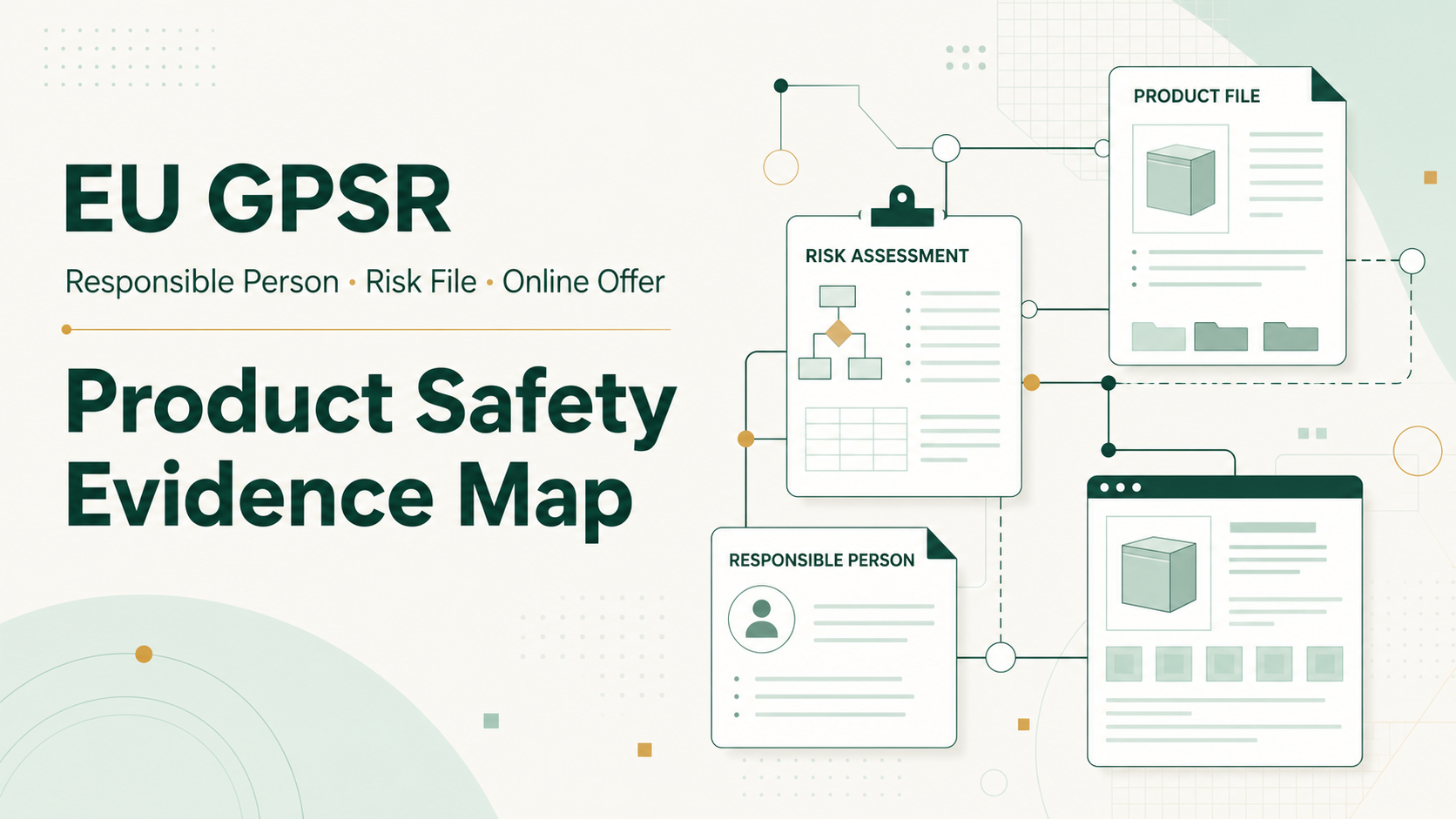
Regulation (EU) 2023/988, the General Product Safety Regulation (GPSR), has applied since 13 December 2024. It provides a general safety framework for non-food consumer products not fully covered by other EU product-safety legislation, and adds information and cooperation requirements for economic operators and online sales. This page is a record-building checklist, not a product-specific legal opinion or a finding that a product may be placed on the market.
1. Define the product and regulatory boundary
For each product, record the model, brand, intended use, foreseeable users, sales channel, and Member States targeted. Then check whether sector-specific EU legislation also applies, such as rules for toys, machinery, radio equipment, cosmetics, or food-contact materials. GPSR is a general safety framework; it should not be reduced to a single “GPSR certificate” when another EU regime covers a particular safety requirement.
Use a versioned SKU record for the model or variant, critical materials, software version, manufacturer, importer or other supply-chain parties, target territory, and technical-file location. A different structure, formulation, or software version should not inherit a complete evidence file solely because the brand is the same.
2. Identify the economic operators and responsible person
The file should distinguish the manufacturer, importer, distributor, and, where applicable, the EU-established responsible person carrying out the tasks required for a manufacturer established outside the Union. Record each party’s legal name, postal address, electronic address, product scope, and contractual or supply-chain relationship. For a non-EU manufacturer, verify that the applicable EU responsible operator can be matched to the product, packaging, accompanying document, or online offer.
Do not merge the factory, brand owner, importer, marketplace account holder, and responsible person into one undefined label. A change in legal entity, authorisation scope, or supply chain calls for a fresh check of labels, technical documentation, online information, and handover records.
3. Build the risk and technical evidence file
Keep model-specific evidence that explains the product-safety assessment: product description and key specifications, design or construction information, materials and critical components, applicable standards or test bases, identified risks and controls, instructions and warnings, label and packaging versions, batch or serial-number rules, and relevant test reports or supplier evidence. Each record should be traceable to the model and version sold; a generic certificate without a defined product scope is not a substitute for the file.
The risk assessment should consider normal use and reasonably foreseeable misuse, including situations involving children, older people, or other users who may need particular protection. For products with software, connectivity, or updates, record safety-relevant functions, update controls, and version management. Match the laboratory, report number, date, sample model, and covered items to the product record. Sufficiency depends on the product risk, applicable legislation, and evidence scope; a universal “valid for 24 months” rule is not a replacement for that assessment.
4. Check information in the online offer
For products offered to EU consumers online or through other distance sales, check that the required product information is displayed clearly and visibly. The offer should identify the product, the manufacturer and its postal and electronic address; where the manufacturer is outside the Union, the applicable responsible person; and relevant warnings or safety information in a language consumers can readily understand. The page should agree with the physical label, packaging, and accompanying documents.
Store a page snapshot, date, product reference or internal page ID, language version, and linked SKU in the evidence register. Broad phrases such as “safe,” “risk-free,” or “compliant with all regulations” need a defined object and evidence boundary; a marketplace display status should not be presented as a regulatory conclusion.
5. Maintain traceability through changes and incidents
When materials, construction, software, packaging, warnings, manufacturer details, or sales territories change, record the reason, affected SKUs, risk decision, documents requiring revision, and reviewer. If an accident, complaint, or internal test anomaly occurs, keep the event, product batch, territory, known risk, interim measure, and subsequent decision as separate fields. A single event should not automatically be expanded into a conclusion about every model or inventory unit.
Before a submission or business communication, confirm that the product boundary is defined, operators are identifiable, risk evidence matches the model, the technical-file location is traceable, page information agrees with the label, and warnings have been reviewed in the target language. The checklist helps locate missing records; it does not replace a Member State authority’s assessment or the requirements of product-specific legislation.
6. Official sources and limits of use
The references checked for this page are the European Commission’s Product safety page and the text of Regulation (EU) 2023/988, including provisions on manufacturer duties, the responsible person, accident notifications, and distance-sales information. The regulation, Member State enforcement arrangements, and sector-specific requirements may change; re-check the current official text for the product, target market, and date in scope.


