Greenark (Shenzhen) Certification Co., Ltd. | Cross-Border E-Commerce Compliance

Data Verification Date: 2026-07-23
This article is based on the official text of Directive (EU) 2024/825 (ECGT) published in the Official Journal of the European Union, with cross-verification from CIRS Sustainability research and East Money financial news. All regulation numbers, dates, and provisions have been verified.

Introduction: September 27, 2026 — A Compliance Deadline You Cannot Ignore

If your Amazon listing includes terms like "eco-friendly," "green product," or "sustainable" without any third-party certification to back them up, you may face compliance scrutiny under the EU's anti-greenwashing directive starting September 27, 2026.

The EU's Empowering Consumers for the Green Transition Directive (Directive (EU) 2024/825, commonly referred to as ECGT) officially entered into force on March 26, 2024. Under the directive, all EU member states must transpose it into national law and begin enforcement by September 27, 2026. This means the window for cross-border e-commerce sellers to prepare compliance documentation is narrowing rapidly.

Crucially, the directive's scope is not limited to EU-based companies. It applies to any business making environmental claims directed at EU consumers, regardless of where the business is registered. For Chinese cross-border sellers, every environmental statement in product detail pages, packaging, and labels will be subject to the principle: claims stand with evidence, or they violate the rules without it.

1. The Core Prohibition of ECGT: What Is Banned

The core of the ECGT directive is the prohibition of unsubstantiated general environmental claims. "General environmental claims" are vague, broad statements about environmental benefit that cannot be specifically verified. The directive explicitly identifies the following as prohibited practices:

  • Using generic environmental claims such as "eco-friendly," "green," or "sustainable" without providing sufficient, verifiable evidence
  • Using vague language to imply that a product has overall environmental benefits when only one aspect qualifies
  • Displaying environmental labels that are not based on a certification scheme or that are self-created
  • Making claims about environmental benefits that cannot be achieved
  • Claiming a product is "more environmentally friendly" than others without a comparable basis
Core Principle: The directive does not ban environmental claims themselves. It requires that every environmental claim be backed by sufficient, verifiable evidence. The scope of the claim must match the scope of the evidence — you cannot use a certification for your packaging materials to support a claim that "the entire product is green."

2. Which Claims Are Banned: Comparison Table

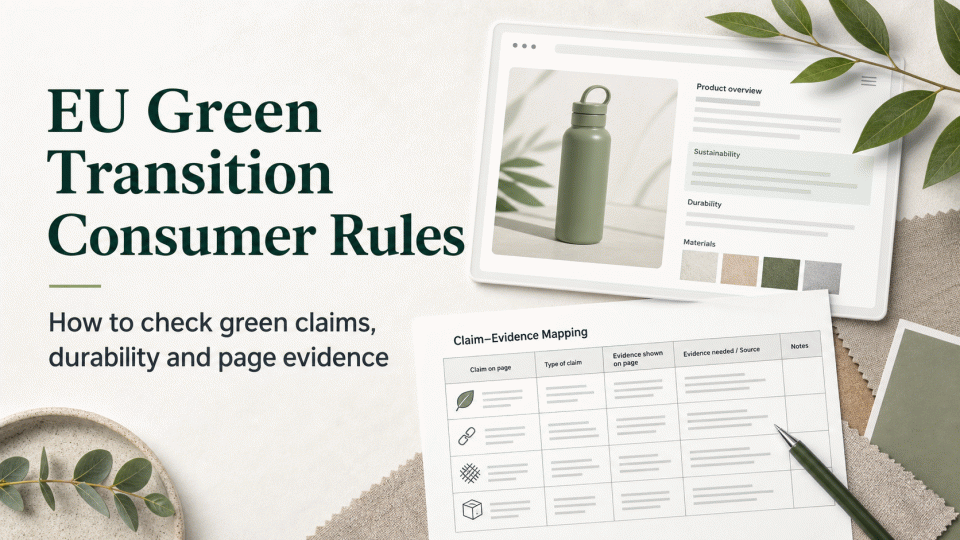
The following table lists common high-risk claims found in cross-border e-commerce listings, along with compliant alternatives. This is not legal advice but a practical reference based on the ECGT directive's provisions.

High-Risk Claim (Potentially Non-Compliant) Compliant Alternative Required Evidence Type
"Eco-friendly product" "Packaging made from FSC-certified recycled materials" FSC certification, raw material supply chain documentation
"100% Green" "Energy efficiency class A (per EU regulation 2017/1369)" EU energy label registration, test report
"Sustainable and natural" "Contains 85% GOTS-certified organic cotton" GOTS certification, composition test report
"Climate neutral product" "Carbon footprint verified by [accredited body], offset via [registered project]" Carbon footprint verification report, offset project registration
"Zero waste" "Manufactured in a facility certified to ISO 14001" ISO 14001 environmental management system certificate
"Biodegradable" "Biodegradable per EN 13432 standard, tested by [lab name]" EN 13432 standard test report

3. What Certification Evidence Is Required

ECGT requires "sufficient, verifiable evidence." This means the evidence must come from a credible third-party source, cover the specific scope of the claim, and be independently verifiable. Below is a mapping of common evidence types by claim category:

Material-Related Environmental Claims

If your listing involves material-related environmental attributes (e.g., recyclable, organic, recycled content), you need corresponding material certifications: FSC (Forest Stewardship Council) for wood and paper products; GOTS (Global Organic Textile Standard) for organic textiles; GRS (Global Recycled Standard) for recycled material content claims; OEKO-TEX Standard 100 for textile harmful substance testing.

Carbon and Climate Claims

Claims involving carbon footprint, carbon neutrality, or climate neutrality require verification under ISO 14067 (product carbon footprint) or PAS 2060 (carbon neutrality implementation specification), with a verification report from an accredited third-party body. Self-calculated carbon data is not considered sufficient evidence.

Energy Efficiency Claims

Energy efficiency claims must be based on relevant EU energy efficiency regulations (e.g., Regulation 2017/1369), with EU energy label registration completed and the corresponding efficiency class displayed on the product page.

Biodegradability Claims

Biodegradability claims require testing under EN 13432 (packaging biodegradability standard) or other applicable standards, with a test report from an accredited laboratory. A bare "biodegradable" claim without standard support is high-risk.

Environmental Management System Claims

If your claim relates to the environmental management of your production process (e.g., "green factory," "low-carbon production"), you need ISO 14001 environmental management system certification or EMAS (EU Eco-Management and Audit Scheme) registration.

4. Listing Self-Audit Checklist

The following checklist helps sellers complete a self-audit before September 27, 2026. Review each item systematically:

  1. Scan for environmental keywords: Search your listing title, bullet points, product description, and A+ content for terms like "eco," "green," "sustainable," "natural," "biodegradable," "climate," "carbon," "zero waste." Mark each occurrence.
  2. Verify evidence for each claim: For every environmental claim, confirm whether you have a corresponding certification document, test report, or registration. Does the evidence scope match the claim scope?
  3. Check images and labels: Are environmental symbols in product images and environmental labels on packaging backed by certification? Self-created eco-icons must be removed.
  4. Check variants and child ASINs: Does each variant's environmental claim have independent evidence? A parent ASIN's certification does not automatically cover child ASINs.
  5. Verify certification validity: Are existing certificates within their validity period? Do test reports still apply to the current product version?
  6. Assess claim wording: Rewrite generic claims into specific, verifiable statements. Ensure the claim scope does not exceed the evidence scope.
  7. Build an evidence archive: Create an evidence file for each environmental claim, including certification certificate, test report, applicable standard, and validity period — ready for platform audits and regulatory inspections.

5. Compliance Timeline

March 26, 2024
ECGT directive (Directive (EU) 2024/825) published in the Official Journal of the European Union and entered into force
2024 — 2026
Transposition period for member states to convert the directive into national law; some countries have already begun legislative processes
September 27, 2026
Deadline for member states to complete national law transposition and begin enforcement. After this date, non-compliant environmental claims may face enforcement action by national consumer protection authorities
Now
Sellers should immediately begin listing self-audits, certification assessments, and claim rewrites to ensure compliance before the enforcement date

At the same time, platforms like Amazon are tightening their own environmental claim audits. The platform's verification of certification status, supporting documents, and on-page labels continues to intensify. Platform-level compliance requirements often arrive earlier and more directly than regulatory enforcement — a listing may be removed or suppressed due to environmental claim issues before any regulatory penalty is issued.

6. FAQ: Common Seller Concerns

My product is genuinely made from eco-friendly materials. Why can't I just write "eco-friendly"?
ECGT does not prohibit environmental claims themselves — it requires that every claim be backed by sufficient, verifiable third-party evidence. "Genuinely eco-friendly" and "able to prove eco-friendly" are two different things. If your materials are genuinely eco-friendly, we recommend obtaining the corresponding material certification (such as FSC, GRS, GOTS), then rewriting the claim into a specific, verifiable statement, such as "Packaging materials FSC-certified."
Our company is not registered in the EU. Does this directive apply to us?
ECGT applies to "businesses making environmental claims directed at EU consumers," with no restriction on where the business is registered. As long as your products are sold to EU consumers through any channel (including cross-border e-commerce platforms) and you make environmental claims on product pages, packaging, or labels, you fall within the directive's scope.
I already have a certification certificate. Does that mean I'm fully compliant?
Having a certification is necessary but not sufficient. You need to confirm: the certificate's product scope matches your claim; the certificate is within its validity period; the listing's claim wording matches the certificate content; and the claim scope does not exceed the certificate's coverage. Additionally, different types of claims require different types of certification — one certificate cannot cover all environmental claims.
If we don't have certifications yet, what's the fastest emergency measure?
The most immediate measure is to remove or rewrite all unsubstantiated generic environmental claims in your listings into specific, verifiable statements. Until certifications are obtained, we do not recommend retaining any environmental claim that cannot be independently verified. In parallel, assess which claims require certification and begin the application process.
Will Amazon proactively audit our environmental claims?
Amazon has been continuously strengthening environmental claim audits in recent years, including verification of Climate Pledge Friendly and Compact by Design labels, as well as automated scanning of environmental keywords in listings. Platform audits and ECGT regulation are two independent compliance channels — both require serious attention.

How Greenark (Shenzhen) Certification Co., Ltd. Can Help

Greenark (Shenzhen) Certification Co., Ltd. specializes in cross-border e-commerce environmental compliance consulting. For ECGT compliance requirements, we offer:

  • Comprehensive listing environmental claim audit and risk assessment
  • Environmental certification pathway planning (FSC, GRS, GOTS, OEKO-TEX, ISO 14067, etc.)
  • Claim rewriting guidance to ensure wording matches evidence
  • Certification application process support and document preparation assistance

We provide compliance consulting and certification planning services based on regulatory provisions, helping sellers understand requirements and plan pathways. Certification outcomes depend on the independent review of certification bodies.

Contact Greenark (Shenzhen) Certification Co., Ltd.

Email: sui@greenark-sz.com

Website: www.greenark-sz.com

Phone / WeChat: 18407559004

Welcome to inquire about ECGT compliance assessment and environmental certification planning.