
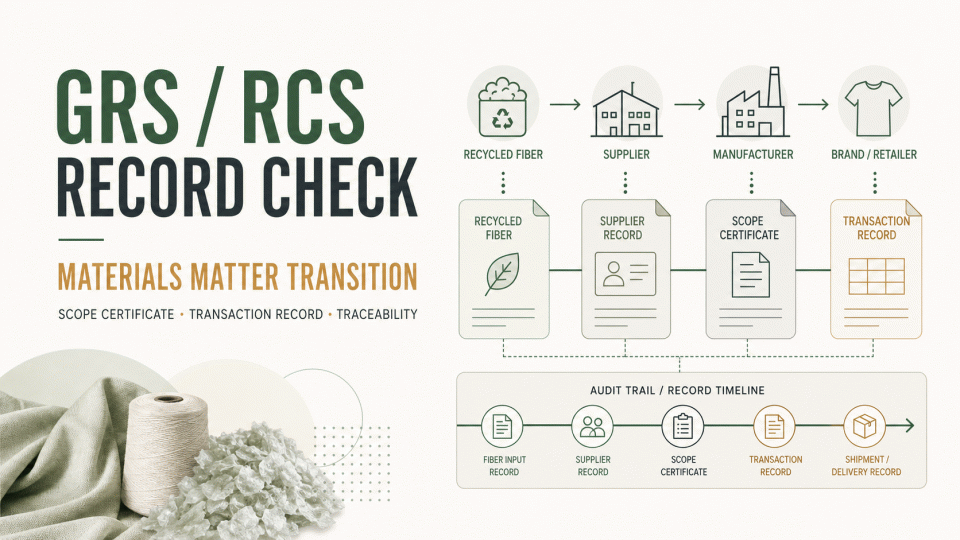
For products using recycled materials, preparation should not stop at one certificate. Recycled input, suppliers and processing sites, scope certificates, transaction records, product claims, and internal version notes should form one traceable record set. The next audit route should then be confirmed against Textile Exchange’s current transition information.
1. Define the standard, organization tier, and product scope
Record the organization’s place in the supply chain first: recycling or recycled-material processing, spinning, weaving, dyeing and finishing, cut-and-sew, brand, or retail. Map sites, activities, product categories, recycled material types, and relevant suppliers. A brand name, a supplier’s general statement, or a product-page claim should not be treated as the certification scope.
GRS addresses recycled materials, chain of custody, and additional social, environmental, and chemical-related requirements. RCS is used for recycled-material and chain-of-custody claims. The exact requirements depend on the applicable version and scope; a generic checklist cannot replace the standard or the certification body’s audit arrangement.
2. Connect scope certificates and transaction records
For each supplier and processing site, record the legal or certified entity, location, activities, standard and version, certificate number, covered products or materials, issue and expiry information, certification body, and file source. Check whether the entity, location, scope, and version cover the current purchase rather than storing only a file name.
Transaction records should link to purchase orders, invoices, inventory or transport records. Capture the material, quantity, batch or period, parties, and related scope certificate. If a Trackit or eTrackit process applies, retain records and exception handling evidence according to the rules in force at that time.
3. Reconcile product composition, recycled input, and page claims
Create a composition record for each product linking the SKU, component or fabric, material, recycled source, supplier, batch, processing site, quantity unit, and evidence file. The standard name, recycled-material description, and any mark or claim on labels, packaging, webpages, and customer files must align with the documented scope. Do not turn an uncertain percentage, source, or standard reference into a definite claim.
GRS content thresholds, product marking, and claims should be checked against the applicable version and Claims and Labelling Policy. During page review, link each environmental or material claim to its evidence, version, and page location, and retain the before-and-after wording.
4. Keep a separate Materials Matter transition record
Textile Exchange has published the Materials Matter Standard and a related Claims and Labelling Policy. Its transition information states that from December 31, 2026, eligible Tier 4 organizations may begin to request an audit to the Materials Matter Standard or continue under current standards. From December 31, 2027, the new standard becomes mandatory for eligible Tier 4 audits. Whether an organization is in scope must still be confirmed with its certification body.
For preparation, map current GRS/RCS scope, sites, material categories, recycled-input records, social and environmental management records, chemical records, supplier files, and claims samples against the new requirements. Separate “checked,” “evidence to add,” and “confirm with the certification body.” Do not present the transition schedule as a completed conversion or a predetermined audit outcome.
5. Perform a manual review before external submission
Check each point: entity and location match; certificate version and scope cover the activity; transaction records trace to supply-chain nodes; product composition matches the page claim; marks are used under the applicable policy; and transition items have a source and an owner for confirmation. If a customer or platform requests additional material, record its source separately rather than generalizing it into a GRS or Materials Matter requirement.
Sources: Textile Exchange pages for GRS/RCS, GRS certification procedures, Materials Matter Standards Transition, standards FAQs, and certificate authentication. This page is a record-organization and boundary-checking reference; an actual audit should follow the latest applicable standard, certification-body instructions, and customer requirements.


