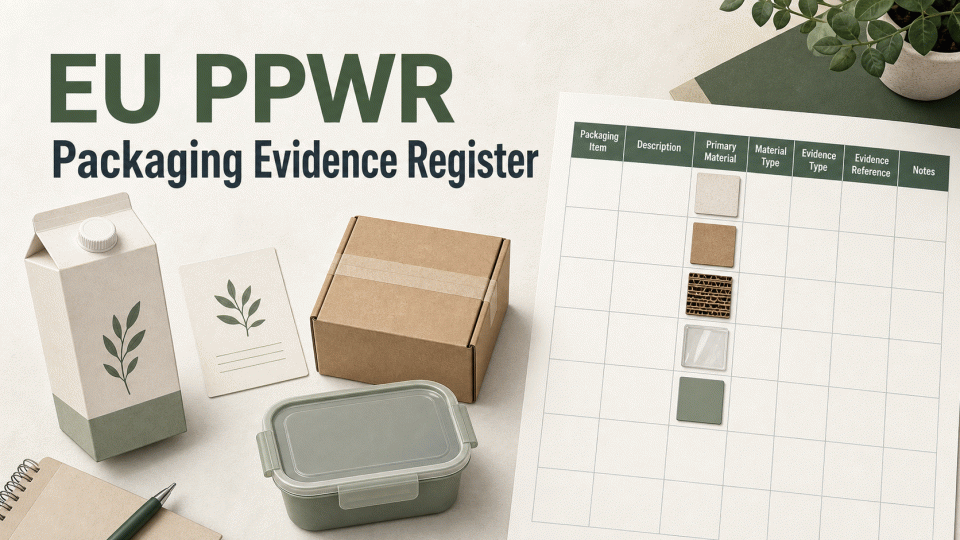
Regulation (EU) 2025/40, commonly called the Packaging and Packaging Waste Regulation (PPWR), covers packaging placed on the EU market and packaging waste. A practical preparation file should break each SKU into sales, transport and other packaging components, then link material, weight, labelling, reuse and recyclability information to the records that support each item. The applicable duty still depends on the packaging type, product context, business role and market involved.
1. Confirm the instrument and the packaging boundary
PPWR is an adopted EU regulation, not the same thing as an earlier proposal or a marketplace document request. The European Commission states that Regulation (EU) 2025/40 entered into force on 11 February 2025 and generally applies from 12 August 2026. Individual provisions may have different conditions, transition arrangements or later implementation material, so that date should not be presented as a universal application date for every package.
Start the register by recording how each package relates to the product: product-contact packaging, sales or presentation packaging, transport or grouped packaging, service packaging, and components supplied with the product. Also record the entity placing the packaging on the market, the target Member State, sales channel and packaging version. Do not turn PPWR into a general conclusion about product safety, customs, or every other EU regime; those questions require separate scope checks.
2. Create a component list for each SKU and version
A reviewable minimum unit is usually “SKU or version + packaging component + target market”. Give each component its own row and record at least:
- packaging level and function, such as inner, outer, transport, securing or delivery packaging;
- material, main composition, colour or coating, adhesive and composite structure;
- unit weight, measurement basis, package quantity and the method used;
- supplier, production site, batch or version, and the linked product SKU;
- labels, material-identification information, disposal or sorting instructions and reuse arrangements;
- change history for materials, dimensions, suppliers, printing, structure or pack count.
When a component changes, reopen the review of the material statement, test file, label artwork and calculation. The same product name does not prove that two packaging structures or supplier files cover the same version.
3. Link each requirement to the right evidence
The goal is not to collect the largest number of certificates. It is to show what each file supports, which object it covers, who supplied it and which version it belongs to. A useful mapping includes:
- Composition and weight: packaging specifications, bills of materials, material declarations, weighing records and calculations, with unit, tolerance, sample and version.
- Materials and substances: supplier declarations, formulation or material data, and relevant tests or assessments; check coatings, inks and food-contact context where applicable.
- Recyclable or reusable design: drawings, component separation, material combinations, use and collection descriptions, and the version of any method or standard used.
- Recycled content or another environmental attribute: use a specific statement only when data, calculation basis, material layer and SKU scope support it; a supplier marketing phrase is not a traceable record.
- Labels and page wording: retain packaging artwork, page text or screenshots, language, publication date and version, and link each claim to its evidence.
The legal entity, product scope, component, period and version in the evidence should match the current package. The existence of a document does not by itself prove that a package satisfies a particular obligation or has obtained a certification or regulatory outcome.
4. Keep PPWR separate from adjacent reviews
The same SKU may raise separate questions about food-contact materials, chemicals, labelling, producer-responsibility organisations or Member State collection arrangements. Those records may have different legal bases and responsible entities. Add an “applicable rule / open question” field and distinguish PPWR work from each specialist review.
Do not present a marketplace upload field, customs document, private customer standard or certification-scheme certificate as a universal PPWR requirement. Do not use one generic laboratory report as a substitute for the component, label, design and responsible-entity mapping. For later guidance, harmonised standards or Member State arrangements, record the source, version and review date instead of turning an open question into a fixed conclusion.
5. Six checks before publication
- Are the packaging levels, components, materials, weights and SKU or version scope listed?
- Does each material or environmental attribute have a source file, calculation basis and owner?
- Do supplier files cover the current entity, batch, packaging structure and time period?
- Do the label, product page and physical package use the same version without broadening the claim object?
- Are PPWR, food-contact, chemicals, producer responsibility, customs and marketplace matters kept distinct?
- Are application dates, implementation material and Member State arrangements cited and review-dated rather than treated as one universal date?
Sources and limits
The status, scope and overall measures described here are based on the European Commission’s Packaging waste page, its PPWR overview, and the official EUR-Lex text of Regulation (EU) 2025/40.
This is an evidence-register framework. It is not a substitute for product-specific packaging analysis, Member State requirements, technical standards, producer-responsibility arrangements or legal advice. Before publication, review the actual SKU, packaging version, business role and target market.