
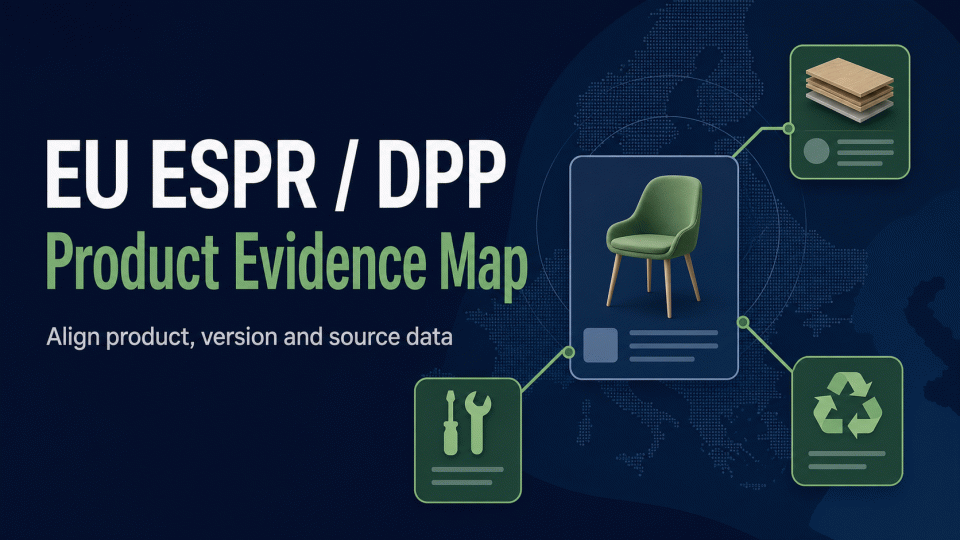
The EU Ecodesign for Sustainable Products Regulation (ESPR) creates a framework for product sustainability requirements and Digital Product Passports (DPPs). A useful working file links the specific product, version, responsible parties, and traceable sources instead of treating certificates from unrelated schemes as one universal compliance file.
1. Define the ESPR and DPP scope
ESPR provides a framework for setting ecodesign requirements for product groups. The detailed requirements are established through the measures applicable to the relevant product group. A DPP is not a single certification certificate: its data, identifiers, access arrangements, and information requirements must be assessed against the Regulation and the applicable product-group rules. Start with the product category, model or SKU, market, manufacturer, and other economic operators before deciding what belongs in the working file.
2. Build a product and version register
Keep a separate record for each product version. Record the product name, model or SKU, variant, materials or components, manufacturer, importer or other responsible operator, production location, relevant commodity code, software or label version, and change dates. Do not copy a brand-level statement across every SKU. Changes to materials, components, packaging, instructions, software, or the supply chain should trigger a version comparison.
3. Link DPP data to evidence
Use an index with five fields: data item, source file, owner, version, and review date. Depending on the applicable product-group requirements, relevant files may include product identifiers, technical documentation, declarations or other conformity information, material and component data, and information related to durability, reparability, recyclability, or other required product characteristics. Required data should follow the applicable rules. Do not invent values merely to complete a table when a reliable source is not available.
4. Reconcile pages, labels, and internal records
Compare the product page, packaging, instructions, QR code or other access point with the internal register. Check the name, model, version, material wording, responsible operator, and any environmental statement that can be verified. Claims such as recyclable, durable, or repairable should link to a source and a defined boundary. A DPP record should not be presented as a certification result or as proof of a conclusion that has not been established.
5. Human review before release and after changes
Before release or submission, product, supply-chain, and document owners should check the scope, source for each data item, SKU and version match, access responsibility, and honest treatment of missing information. Retain a change note when materials, factories, labels, software, or responsible operators change, then reassess the affected data. 绿色方舟(深圳)认证有限公司 recommends keeping the register, evidence index, and page versions in one change-controlled record for later human review.
Sources and limits
This reference is based on Regulation (EU) 2024/1781 published by EUR-Lex, including its framework for ecodesign requirements, Digital Product Passports, data accuracy, and the information elements listed in its annexes, together with European Commission public explanations of ESPR and DPP. Product-group requirements, responsible parties, and timing must be checked against the applicable EU legislation, delegated acts, and official information. This is not product-specific legal advice or a guarantee of an outcome.