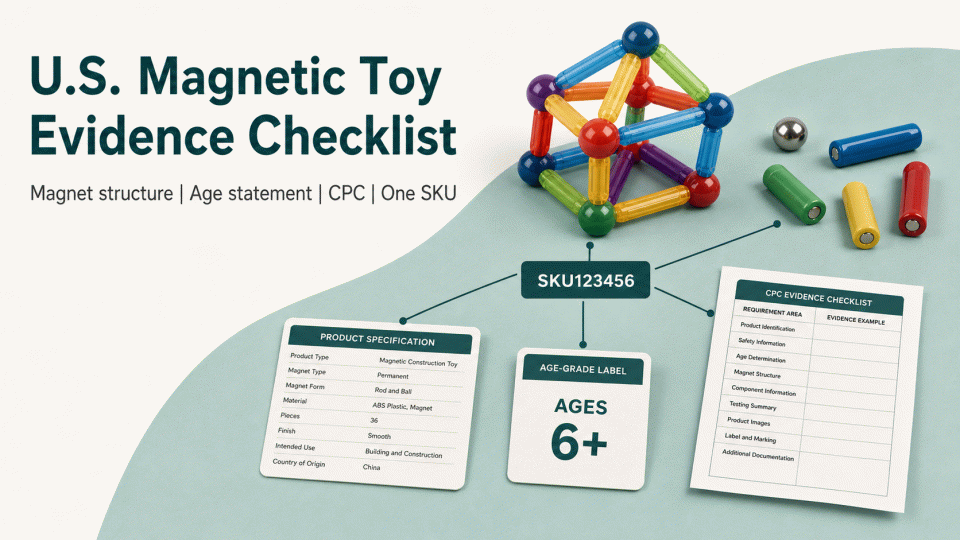
For a magnetic toy sold in the United States, a test report alone is not an evidence map. The product structure, magnet configuration, age statement, labels and instructions, test scope, Children’s Product Certificate (CPC), and product-page information should all point to the same SKU.
1. Confirm whether the product is a children’s toy
CPSC treats a product designed or intended primarily for children 12 years of age or younger as a children’s product. Children’s toys generally require third-party testing to applicable children’s product safety rules and a CPC issued by the manufacturer or importer. The age statement, packaging, instructions, product imagery, sales copy, and actual play pattern should support one product classification; an age number by itself is not the complete analysis.
This page addresses toys that use magnets or magnetic components for connection, construction, or interaction. A separate magnetic product marketed for adult entertainment, collecting, or another purpose may have a different scope. Do not combine the toy requirements and the separate magnet-product requirements without checking the product’s intended use.
2. Record the magnet structure at a reviewable level
For each SKU, record whether each magnet is exposed, covered, embedded, or separable; its quantity, shape, dimensions, magnetic characteristics, and retention method; whether it could be released during normal use or reasonably foreseeable use-and-abuse testing; and whether packaging, replacement parts, or accessories contain a different magnet. The specification, BOM, structure drawing, sample photographs, and laboratory sample identifier should agree.
CPSC’s toy-safety guidance explains that the magnet provisions in ASTM F963 address loose or liberated magnets that fit in the small parts cylinder and the applicable flux-index requirement. Educational toys and age-related warning language also require a context-specific review. “Contains magnets” or “magnet testing completed” is not a complete conclusion.
3. Match the CPC to the product, responsible party, and test record
CPSC’s CPC guidance identifies seven required information groups: product identification; each applicable children’s product safety rule; the domestic manufacturer or importer issuing the certificate; the person maintaining test records; the date and place of manufacture; the date and place of testing; and the CPSC-accepted third-party laboratory. The certificate should identify the products it actually covers rather than grouping different structures, materials, or age versions without a defensible basis.
For a magnetic toy, the CPC citations and applicable ASTM F963 sections should be supported by the product scope, structure record, and test report. If the model, sample description, production information, photographs, or key parameters differ across the CPC, report, and listing, pause the submission and reconcile the difference. The laboratory performs testing; the manufacturer or importer is responsible for issuing the CPC.
4. Keep the product page, labels, and instructions within the evidence boundary
Maintain one SKU cross-reference containing the model, magnet structure, product and package photographs, age statement, warnings, instruction version, CPC version, report number, production batch or date, manufacturer/importer information, and change history. The product name, quantity, set contents, and age wording on the page should be traceable to that record.
When the magnet, plastic part, connection method, package, instructions, supplier, factory, or target age changes, reassess the testing scope and CPC coverage. Do not treat another SKU, another market’s document, or a supplier’s certificate as complete evidence for this SKU. Platform wording should not be presented as a uniform statement of U.S. law.
5. Manual pre-submission review and sources
Before submission, ask: Does the product classification match the age statement? Is every magnet and magnetic component recorded? Is there supporting evidence for release risk after use-and-abuse testing? Are the seven CPC information groups complete? Do the CPC, report, sample, manufacturing information, and page identify the same SKU? Are the current versions of labels, instructions, packaging, and images being used? Any unresolved point should be reviewed by the responsible business and an appropriate specialist.
Sources: CPSC Toy Safety Business Guidance; CPSC Magnets Business Guidance; CPSC Children’s Product Certificate. Recheck the current source wording, scope, and applicable citations for the specific product.