For: Cross-border brands, product managers, supply-chain teams, and listing editors.
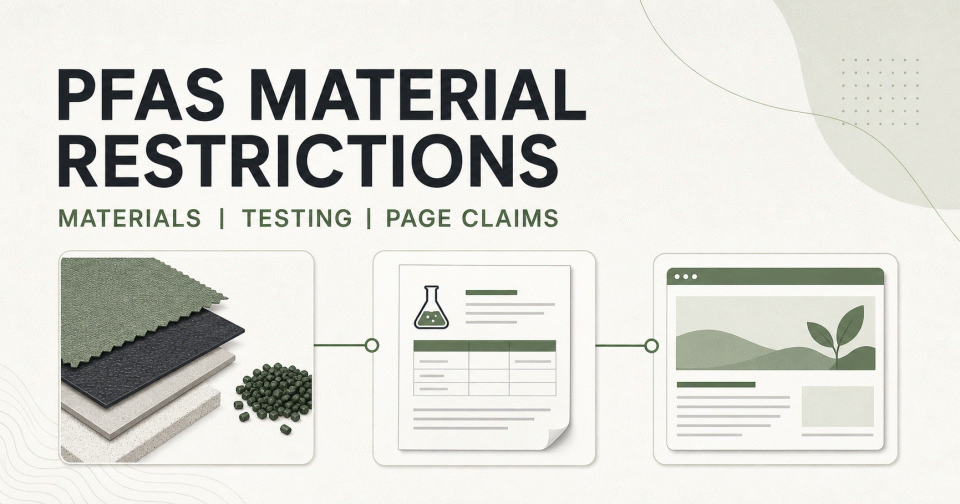
Summary: PFAS is not a universal compliance label that covers every product and market. Rules can differ by jurisdiction, product category, intended use, substance or substance group, component, and whether the obligation is a restriction or a report. Before using “PFAS-free,” “fluorine-free,” or “meets PFAS limits,” map the target market, SKU, material and component scope, test method, and supplier records. When evidence is narrower than the proposed claim, narrow the claim rather than turning a component result into a whole-product conclusion.
Core rule: the page claim cannot be broader than the evidence, and the evidence cannot be broader than the applicable rule. “Not detected” means that the target analytes were not detected under the stated method, sample, scope, and detection limit. It does not automatically mean that every PFAS substance is absent.
1. Break the PFAS question into four checks
- Which market and product? A rule may depend on the place of sale, product category, use, and supply-chain role. A platform category is not a substitute for a legal product definition.
- What is restricted? Confirm whether the rule addresses named PFAS, a defined group, a total, intentional addition, a component, or a particular use. “PFAS” as a keyword is not enough.
- What does the evidence cover? List the SKU, model, material version, coating, adhesive, seal, label, packaging, and contact surface. Mark what was sampled and what was not.
- What is the page actually saying? Separate a material fact, a test observation, a legal comparison, and an environmental marketing claim. They need different support.
2. Put the rule scope into an SKU evidence register
3. Read a laboratory report without overextending it
Start with the tested object and sample description, then check the target list, method, units, results, detection or quantitation limits, and uncertainty. If a report says “not detected,” the page should still be traceable to the method and scope. A test of one fabric or component should not become “the entire product is PFAS-free.”
- If the report does not identify the method, sample, or scope, do not publish a test conclusion.
- If the test covers named PFAS analytes, limit the wording to that panel and method; do not expand it to the whole PFAS family.
- A supplier, formulation, coating, or process change requires a new scope review; an old report does not automatically cover a new version.
- When comparing a result with a legal limit, retain the section, unit, component, and sample context.
4. Narrow page claims to what can be checked
5. Keep market examples separate
PFAS product rules in the United States are not one national checklist. For example, Washington State’s Chapter 173-337 WAC Cycle 1.5 contains restrictions or reporting requirements for intentional PFAS in specified product categories, with separate dates shown by the Department of Ecology. That cannot be turned into a conclusion for every US market or product. California AB 1817 also addresses specified textile articles. Return to the source rule to confirm the product definition, exceptions, regulated conduct, and effective date.
For consumer-facing US claims, the FTC Green Guides remain relevant to the general substantiation question: environmental marketing claims need competent and reliable support, and free-of claims must not create a misleading broader impression. The Guides are not a PFAS test method and do not replace a state rule, product rule, or laboratory report.
6. Five checks before publication
- Lock the market, product definition, SKU/model, and material version.
- Mark each substrate, coating, adhesive, seal, and package as covered or not covered.
- Read the source rule and record the regulated object, conduct, date, and exceptions.
- Map reports and supplier statements to the rule; fill missing fields before drafting copy.
- Have a person review every sentence, remove absolute or over-broad wording, and archive the final version.
Boundary note
This page is an evidence-review framework, not legal advice, a product-classification opinion, or a laboratory test. Whether a product is covered by a PFAS rule depends on the current rule, official interpretation, and actual product records for the target market. 绿色方舟(深圳)认证有限公司 can review a defined scope only after complete product and evidence materials are available.
Sources: US EPA PFAS research and TSCA materials; US FTC Green Guides and environmental-claims summary; Washington State Department of Ecology Chapter 173-337 WAC and Safer Products for Washington; California AB 1817. Accessed 2026-08-25.