
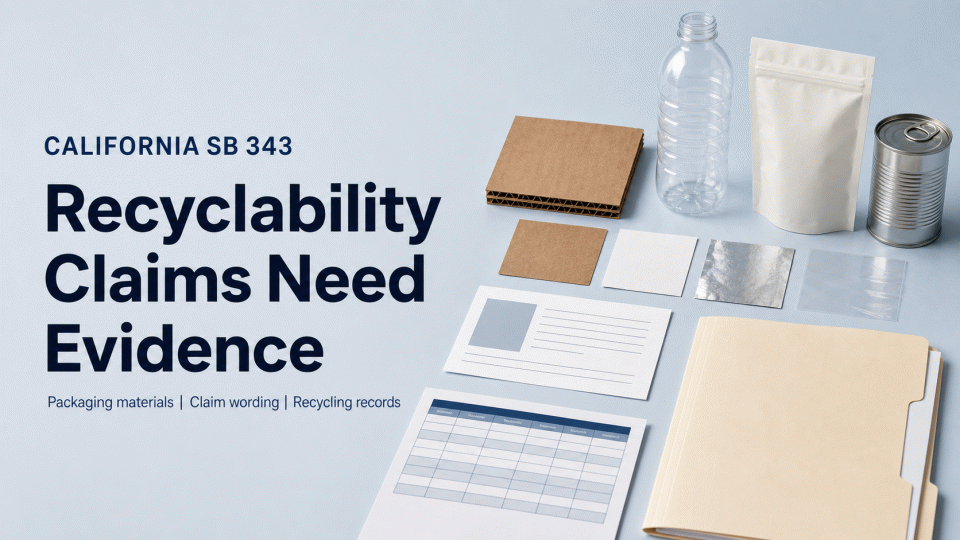
Use case: When a product or package is sold in California and the business is considering the word “recyclable,” the chasing-arrows symbol, or another statement that directs consumers to recycle, review the package construction, claim wording, and recycling pathway in one record. This reference is based on SB 343 and CalRecycle’s published implementation materials. It does not determine whether a specific product may be labeled recyclable and is not legal advice for a particular fact pattern.
1. Separate the legal subject from the current date
SB 343 (Allen, Chapter 507, Statutes of 2021) addresses recyclability symbols and other indicators of recyclability on products and packaging. CalRecycle explains that producers and other responsible parties must consider information about materials actually collected, sorted, sold, or transferred for recycling in California when evaluating a claim. CalRecycle does not pre-approve the label for an individual product.
Use the current official implementation record for timing. CalRecycle’s current page states that the restrictions apply to products and packaging manufactured after the 18-month period following publication of the final findings report, and identifies October 4, 2026 as the current date. Keep the manufacturing date, package version, and California sales status as separate fields; an online listing date is not automatically a manufacturing date.
2. Build a product–package–claim register
For each SKU, record the internal product and package identifiers, package level, material and form, weight or dimensions, color and coatings, inks, adhesives, composite layers, supplier and production batch, first manufacturing date, California sales status, and every environmental claim used. Assign a version to each package or artwork change and retain the reason for the change.
“Paper box,” “plastic bag,” or “metal can” is not enough for a claim review. Break out multilayer structures, films, coatings, attachments, colors, and contamination risks. Link the sample photographs, bill of materials, specifications, and batch information to the same version.
3. Decompose the claim wording
Preserve original versions of the package, product page, images, video captions, manuals, and marketing copy. Mark every use of “recyclable,” the chasing-arrows symbol, recycling instructions, and wording that could imply recyclability. Record where the claim appears, its language, date, covered SKU, and package version. An online claim still belongs in the review even when it does not appear on the physical package.
Keep the claim no broader than the evidence. A generic supplier statement or a material certificate does not automatically cover a different color, composite structure, size, or finished package. “Contains recycled material” is not the same claim as “recyclable.” If the evidence supports only a material description, use the precise material fact rather than expanding it into a recycling outcome.
4. Use CalRecycle information to map material type and form
CalRecycle’s SB 343 Material Characterization Study Final Findings (2023/2024) provides information about California recycling streams. Start by identifying the package’s Material Type & Form, then check whether that material appears in the collection, sorting, sale, or transfer pathways covered by the study and whether limitations relate to contamination, size, color, composites, or end markets.
The study is an input to the evaluation, not a certificate for an individual SKU and not CalRecycle’s advance approval of a label. A producer may add reliable package-sample, supply-chain, processing, and recycling information, but should distinguish official study facts, business-collected evidence, and assumptions that remain open.
5. Assemble a traceable evidence file
For each SKU and package version, keep the material/BOM and artwork, supplier specifications and change history, sample photographs and batch mapping, claim and page-version records, the Material Type & Form location used in the CalRecycle study, any additional recycling information and its source, the reviewer, review date, and open questions. Record the source, version, date, scope, and cross-reference for each file instead of keeping an isolated supplier PDF screenshot.
The review should answer five questions: Does the material description match the finished package? Does the wording stay within the evidence? Do the package version, photographs, and BOM match? Are the dates and sources of the study and supplemental information clear? If “recyclable” is not supported, has the wording been paused while the reason is retained? These records support internal review and later communication; they do not represent a regulator or platform decision.
6. Human pre-publication review
Confirm that: (1) the SKU, package version, material type, and supplier entity match; (2) multilayer structures, coatings, inks, adhesives, and attachments are not omitted; (3) Chinese, English, and graphic wording convey the same meaning; (4) online pages do not imply more than the package evidence supports; (5) every source can be traced to a version and sample; and (6) unresolved points are described as facts or open questions rather than guarantees.
Sources: CalRecycle Accurate Recycling Labels; CalRecycle SB 343 FAQ (August 2025); SB 343 Material Characterization Study Final Findings—2023/2024; California SB 343 bill text.


