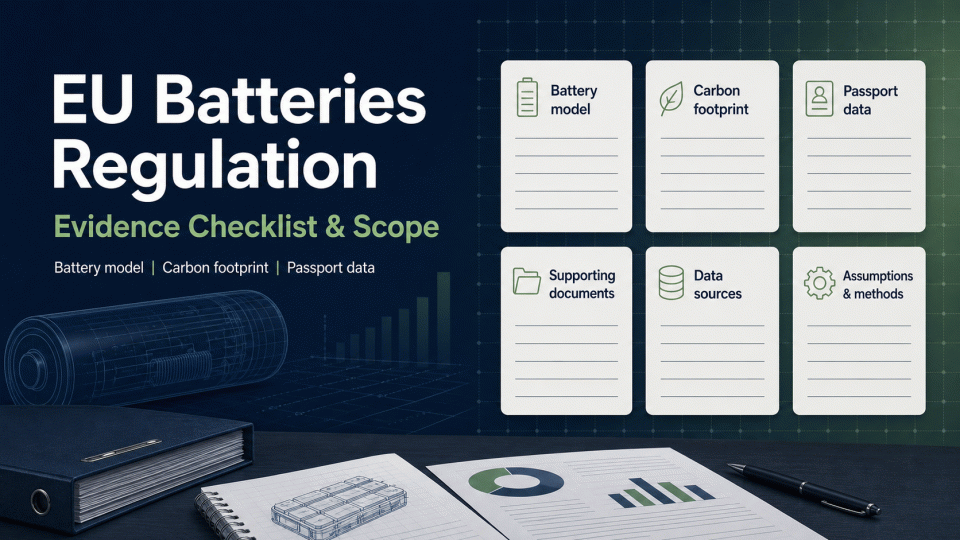
This reference page helps product, technical and supply-chain teams organize evidence under Regulation (EU) 2023/1542. It focuses on battery categories, carbon-footprint information and battery-passport data. Applicability still depends on battery category, capacity, use, market-facing operator and the latest legal text.
1. Define the product scope and roles
Build a base register linking battery model, manufacturing plant, market-facing economic operator, intended use and destination market. Distinguish portable, light means of transport (LMT), industrial and electric-vehicle batteries, and record capacity, chemistry, rechargeability, integration into a product and the responsible operator. A supplier name or brand name is not a substitute for model-level scope.
2. Separate the evidence by requirement
Product and technical files: model, chemistry, rated capacity and voltage, key components, manufacturing site, label and manual versions, and the defined use scope.
Carbon-footprint files: where the Regulation applies, connect the model and manufacturing plant to the bill of materials, manufacturing energy, auxiliary materials, life-cycle boundary, calculation method and supporting or verification records. Annex II links the calculation to the materials and energy used for a specific model at a specific plant; offsets should not be included in the carbon-footprint declaration.
Battery-passport preparation: use Annex XIII as a field matrix covering model data, material composition, carbon footprint, responsible sourcing, recycled content, capacity, voltage, performance and durability, lifetime, marking, the EU declaration of conformity and waste-battery information. Mark each field as public, restricted or update-controlled, with an owner, source version and update history.
Supply-chain and due-diligence files: keep supplier identification, raw-material information, purchasing and transaction records, risk identification and response records. Include a document in the model evidence chain only where the relevant duty applies and the source can be verified.
3. Put the evidence boundary into the register
Each row should state the legal article or annex, battery category, field, source, responsible entity, model or plant scope, document version, verification status, access class and permissible page wording. A page may explain how evidence is organized; it should not imply that an assessment is complete, that a result has been obtained or that market access is guaranteed. Any service description by 绿色方舟(深圳)认证有限公司 should remain within the agreed scope, applicable law and verifiable files.
4. Check the time status in 2026
Regulation (EU) 2023/1542 introduces carbon-footprint, labelling and passport requirements in stages. Article 77 provides that each applicable LMT battery, rechargeable industrial battery above 2 kWh and electric-vehicle battery placed on the market or put into service must have a battery passport from 18 February 2027. Other duties have different application dates by battery category. Record the legal version and applicable date in the evidence register; do not apply one “2026 deadline” to every battery.
5. Five manual checks before publication
1. Do model, manufacturing site and responsible operator match? 2. Do category, capacity and use fit the cited scope? 3. Do carbon-footprint and passport fields have sources and versions? 4. Are public and restricted data separated? 5. Does the page describe a checking method and evidence boundary without presenting a service process as a certification result or market-access conclusion?
Sources and limits
The main references are Regulation (EU) 2023/1542, especially Articles 7, 13, 18, 77 and 78 and Annexes II, VIII and XIII, together with public European Commission information on the Batteries Regulation. Delegated acts, implementing acts and official guidance may change; re-check the official text before publication.