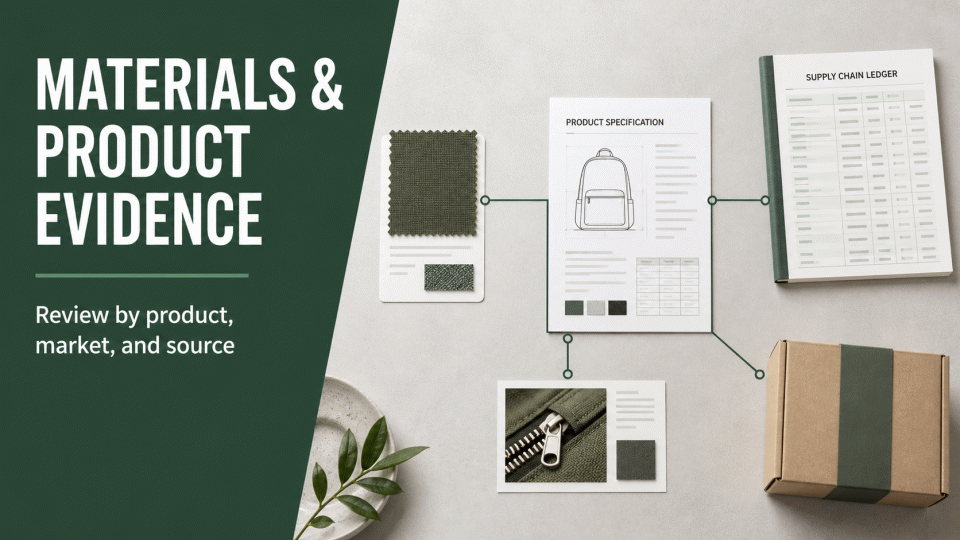
“Materials Matter” is best treated as a documentation theme, not as one regulation, certification, or platform programme. Materials, products, packaging, supply chains, and page claims may be governed by different rules or contractual requirements. This reference separates those objects so a team can confirm scope and build a traceable evidence register. It does not promise certification, customs clearance, platform acceptance, or a market outcome.
1. Separate four objects before collecting files
First define the product and its composition: model, SKU, batch, formulation or material mix, critical parts, and BOM. Next define the market and roles: manufacturer, importer, authorised representative, brand owner, or seller. Then identify the external requirement: law, standard, buyer specification, or platform rule. Finally define the page claim: recycled content, material composition, recyclability, a certification name, an environmental attribute, or another consumer-facing statement.
These objects cannot be substituted with one generic certificate. Different SKUs, materials, versions, or destinations may require different scope decisions and supporting files. Bind each conclusion to a product and a source rather than to a broad statement that a company “has a certificate.”
2. Minimum fields for an evidence register
Product fields: SKU/model, version, batch, materials and components, BOM version, packaging composition, product images, and label version.
Market fields: destination, sales channel, responsible role, applicable rule name and version, applicability decision, and the source supporting that decision.
File fields: file name, issuing party, covered product or site, test or certification scope, date, version, original-file location, public verification route, and open factual questions. Dates are record fields; without a rule-specific basis they should not be rewritten as one universal “24-month validity” or renewal cycle.
Claim fields: proposed page wording, claim subject, calculation basis, evidence link, trademark or label permission, reviewer, and review date. The page claim should not exceed what the evidence supports.
3. Keep evidence types distinct
Regulatory technical files. Use the target market’s official rules to confirm the product, responsible role, and required evidence. For EU product rules, Your Europe explains that manufacturers prepare technical documentation before placing a product on the market and use it to support the declaration of conformity. CE marking applies only where specific harmonised EU rules require it; whether a notified body is needed depends on the conformity-assessment procedure for the product.
Material and packaging records. Composition, recycled content, substances, packaging components, and sorting information should each have an object, calculation basis, and source. The European Commission’s packaging information addresses recycled content, reuse, and consumer information, but it does not create one identical metric for every product. Check the product category and current rule.
Supply-chain and origin records. Where a rule requires supply-chain, origin, or geolocation information, connect suppliers, production places, batches, and upstream/downstream files. Public EUDR information-system materials show structured fields for production geolocation and related due-diligence information; that should not be generalised into a geolocation requirement for every material.
Emissions and trade data. CBAM covers specified goods and reporting information within its scope. If the product is in scope, connect the CN code, installation, embedded emissions, and reporting record to the relevant goods. A materials evidence topic alone is not a basis for applying a CBAM conclusion to an out-of-scope product.
4. Check mismatches and claim boundaries
A supplier certificate’s holder, site, or product scope may not match the brand owner’s current SKU. A test report does not automatically cover untested materials, components, or versions. Certificates, reports, contractual specifications, and platform files should each state what they prove; one file should not be rewritten as “globally compliant,” “valid for every market,” or “guaranteed to be accepted by a platform.”
Before publication, check each sentence: does the claim concern a material, product, company, or supply chain; does every number have a calculation and source; is a certification name or mark authorised; does the cited rule cover this product; and does the English version preserve the same boundary? Remove unsupported wording such as “100% compliant,” “zero risk,” “guaranteed approval,” or a universal fixed deadline.
5. A minimum team workflow
Freeze the product and material version first, then confirm the destination and responsible role. Retrieve the official rule and buyer requirements, record the applicability decision, and collect technical files, test or certification records, supply-chain evidence, and the proposed page wording. A file becomes “ready to cite” only after its holder, scope, version, date, and source have been checked. Reassess affected fields when a product, material, supplier, packaging component, or destination changes.
Source boundary: this reference uses public EU Your Europe material on technical documentation and CE marking, European Commission packaging information, public EUDR Information System materials, and official CBAM materials. Rules, platform requirements, and buyer contracts may change; return to the relevant official source for the current version. Prepared by 绿色方舟(深圳)认证有限公司. This page is not certification, legal advice, or a promise of an outcome.