This is a practical reference for product, packaging and compliance teams. The PPWR is Regulation (EU) 2025/40. It covers packaging and packaging waste placed on the EU market; the European Commission states that it generally applies from 12 August 2026. The final assessment still depends on the packaging format, material, use, responsible party and applicable annexes.
1. Confirm scope and document version
The Commission overview says that the PPWR covers packaging and packaging waste of all materials and origins, including requirements related to manufacturing, composition, reusability or recoverability, and waste prevention and management. A register should identify the market, product SKU, packaging level, components, material, mass, use, food-contact context, transport or sales function, and data version.
PPWR, extended producer responsibility, a buyer standard and a platform document request are different assessments. They may be tracked together, but a platform screenshot, customer questionnaire or document from another regulation should not replace the Regulation (EU) 2025/40 scope review.
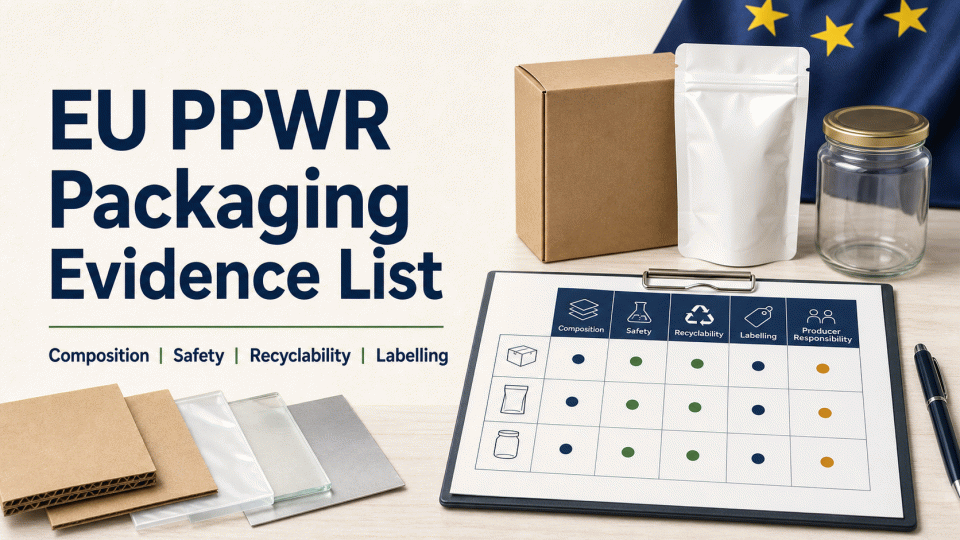
2. Organize evidence by requirement type
1. Materials and composition: keep the packaging BOM, component drawings, material grades or formulation information, component mass, supplier statements and change records. Do not describe a multilayer pouch, coating, ink, adhesive, lid or liner only as a generic “box” or “plastic”.
2. Safety and substances of concern: following the direction of Article 5, record information on the presence and concentration of substances of concern in packaging materials or components. Food-contact packaging needs its own evidence for the applicable material, formulation and migration-risk context. A generic SDS or supplier statement should not be expanded to every SKU.
3. Recyclability, recycled content and reuse: retain design notes, separability, material compatibility, recycled-content sources and calculation methods. For reusable packaging, document the intended use, return or circulation context and relevant technical records. “Recyclable” should not be presented as a certification or as a universal conclusion for every region.
4. Labelling, information and responsibility: keep label artwork, material-identification information, sorting instructions, language versions, producer or importer records, and the source records used for information supplied to EU customers or authorities. Labelling should follow the applicable provision and final version, not an old directive or another country’s symbol.
3. Suggested evidence-register fields
Use one row per packaging component: SKU and packaging level, component name, material and mass, use and contact scenario, supplier and production location, applicable provision, document name and version, test or calculation method, label version, responsible party, gap, reviewer and review date. If one document covers several models, record its exact coverage and limits on extrapolation.
A useful review order is: confirm the regulation version and scope; check materials and components; check safety and substances of concern; check recyclability, recycled-content or reuse evidence; then check labels and page wording. Reassess affected rows when the supplier, packaging version, formulation or responsible party changes.
4. Page-claim boundaries
A page may accurately describe the packaging material, document types retained, market scope and review scope. It should not turn “records collected” into “approved”, “recognised by the EU”, “guaranteed customs clearance” or “no platform restriction”. A statement that packaging is “PPWR compliant” should identify the packaging unit, version, scope and evidence instead of standing alone as a broad marketing claim.
绿色方舟(深圳)认证有限公司 provides evidence-organization and boundary-review references. The project owner should determine the final scope, responsible party and local implementation position against the latest legal text, Commission implementation information and relevant national requirements.
Sources and review points
Primary sources: Regulation (EU) 2025/40 on EUR-Lex; the European Commission “Packaging waste” page; and the European Commission “FAQ on Packaging and Packaging Waste Regulation (PPWR)” published 3 August 2026. Annexes, implementing measures and Member State authority information may change, so recheck them before publication.