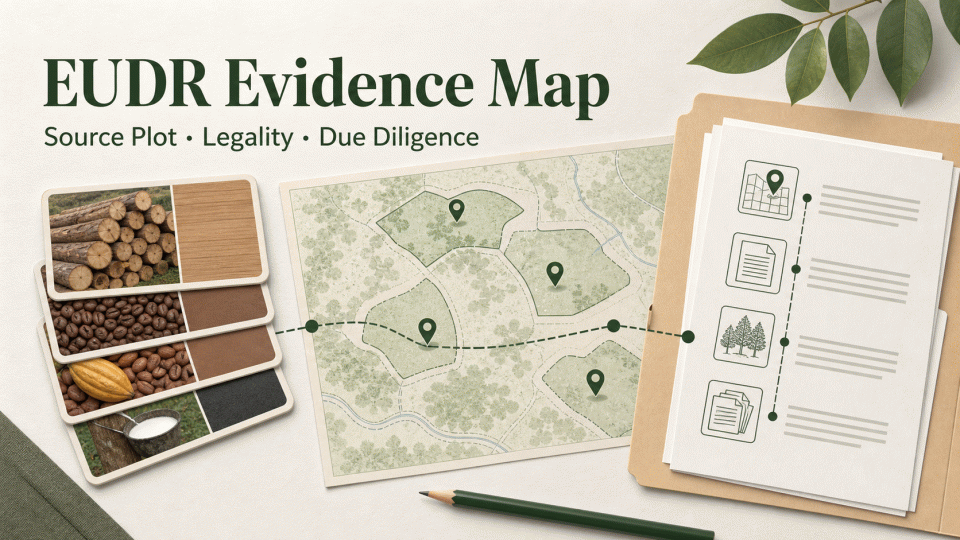
EUDR preparation starts with confirming whether a product is in the current scope, then connecting the relevant commodity, product, country of production, source plots and transaction records. This is a documentation reference; it does not replace the operator’s legal assessment, due diligence or competent-authority requirements.
1. Confirm the product and responsible roles
Build a product-scope table with the trade description, HS code, quantity, relevant commodity and the relationship to a derived product. Check Annex I and current official amendments item by item. Do not infer scope from a similar product name, or merge PPWR, CBAM or general green-claims requirements into an EUDR conclusion.
Record the roles of the operator, trader, supplier and parties in the import or export chain. Who places a relevant product on the EU market or exports it, and when, affects the applicable due-diligence, statement-reference and record-keeping duties. Specific cross-border structures should be checked against the current text.
2. Source plots and production information
For each relevant product, keep the country of production, production date or time range, supplier and transaction records, together with the geolocation of every plot where the relevant commodities were produced. If a product uses commodities from multiple plots, retain all relevant plots rather than one representative point. For cattle and products made using cattle, record the establishments where the cattle were kept as required by the Regulation.
Geolocation should reconcile to the product, quantity, batch and supply-chain records. Retain the format used for the Information System, original data and version history, including the source, collection date, plot identifier and supplier confirmation. A map screenshot alone is not a completed due-diligence procedure.
3. Legality and deforestation-free evidence
Separate the register into two evidence lines. One covers applicable laws in the country of production, including land-use rights, environmental and forest rules, labour rights, taxes, trade and anti-corruption requirements. The other addresses whether the product comes from land associated with deforestation or forest degradation after the cut-off date set by the Regulation. The legal scope depends on the country, commodity and facts; “a certificate exists” is not a complete analysis.
Evidence may include land or government records, supplier statements, transaction and transport records, geospatial or remote-sensing information, third-party materials and risk-mitigation records. Its value depends on the product scope, source and risk context. FSC, PEFC or another private scheme does not automatically replace EUDR due diligence; document its scope and any uncovered portion.
4. Risk assessment, mitigation and the statement
Keep three linked records: information collection, risk assessment and risk mitigation. The assessment should consider the country or region, forest and deforestation risk, supply-chain complexity, mixed or unknown origin material, document reliability and corruption risk. When information is missing, record the clarification, additional evidence, verification performed and decision basis.
After the assessment, the operator must submit or reference a due diligence statement as required by the current Regulation and Information System. The operator, EORI where applicable, HS code, trade description, quantity, country of production, all relevant plot geolocations and any referenced statement number should reconcile to the evidence register. A statement is a responsibility-bearing filing, not a third-party certificate or a universal licence for every SKU.
5. Minimum fields and page-claim boundaries
Product: SKU, trade description, HS code, quantity, batch, relevant commodity and derived-product relationship.
Source: country of production, plot or cattle-establishment geolocation, production date or time range, supplier, transaction and transport chain.
Decision: deforestation-free evidence, country-of-production legality records, risk factors, supplementary checks, mitigation, owner, decision date and document version.
Page wording: limit wording to the products, sources, standards or statement scope supported by records. Do not extend “traceable”, “deforestation-free” or “due diligence completed” to uncovered products, suppliers or batches.