Audience: Brands, retailers, marketplace sellers and inventory teams placing apparel, clothing accessories or footwear on the EU market.
Summary: The Ecodesign for Sustainable Products Regulation (ESPR), Regulation (EU) 2024/1781, creates a framework for disclosures and restrictions concerning the destruction of unsold consumer products. This page uses the legal text to outline the product scope, timing, inventory records and claim boundaries that apparel businesses should verify. The applicable duty still depends on enterprise size, product classification, Member-State rules and later implementing or delegated acts.
1. Confirm the legal object before calling everything “textile”
Article 23 of the ESPR requires economic operators to disclose information about unsold consumer products discarded during the relevant reporting period, including product categories or types, quantities or proportions, and the proportions sent to preparation for reuse, recycling, other recovery including energy recovery, or disposal. Article 25 and Annex VII establish restrictions for listed unsold consumer products; Annex VII lists apparel, clothing accessories and footwear.
This does not automatically place every home-textile product, upholstery fabric, automotive interior, mask or protective item under the same apparel restriction. First check the commodity code, product description and Annex VII scope, then consider any later delegated act. A cross-border seller should not decide the full legal position from the fact that EU consumers can buy the goods; confirm the relevant economic-operator role, supply-chain position and placing-on-the-market facts.
2. Read the dates together with enterprise size and the operative provision
Article 25(1) of Regulation (EU) 2024/1781 provides that the destruction prohibition for the Annex VII products applies to large enterprises from 19 July 2026 and to medium-sized enterprises from 19 July 2030. Article 25 also contains arrangements for small enterprises and a legal route for specific derogations. One date must not be presented as a single start date for every seller.
Article 25(5) allows the Commission to establish specific derogations by delegated act. Inventory decisions therefore should not use an unsupported template saying that every case follows five mandatory tiers or that destruction is permitted only after a particular contamination test. Commission Delegated Regulation (EU) 2026/296, adopted in 2026, should be read with the basic Regulation and the actual product facts.
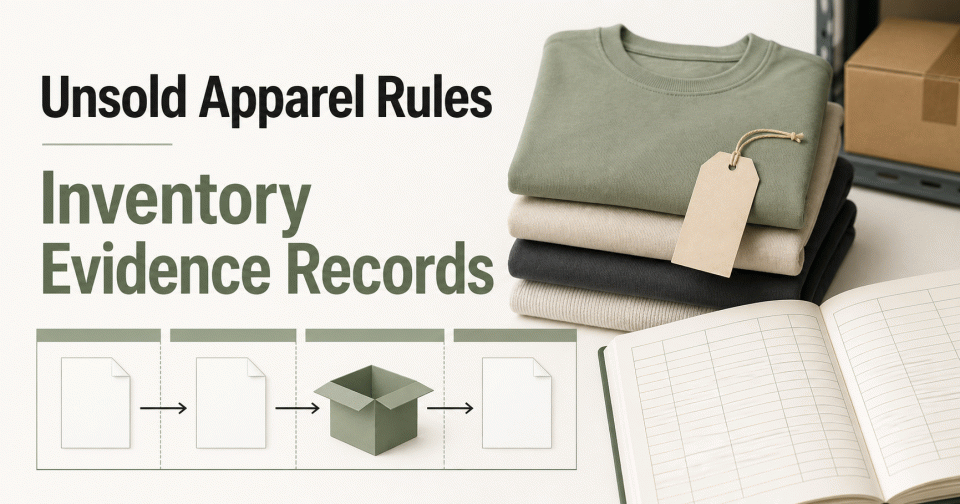
3. Build disposition records from the SKU and batch
An internal ledger can function as a traceability index, but its format is not a single form prescribed by the Regulation and it does not prove legality by itself. A practical record should identify:
- SKU, product name, product category, quantity, weight or another explained measurement basis;
- the entity and location holding the stock, the batch or storage reference, and the dates on which the stock and disposition decision were recorded;
- the actual route: preparation for reuse, recycling, other recovery or disposal;
- the receiving party, contract or order reference, handover date, quantity and receipt;
- the link between the ledger, public disclosure figures, financial records, logistics records and third-party documents.
For donated, resold, repaired, recycled or externally processed stock, retain business records showing who received what and when. Photos, an internal spreadsheet or the phrase “handled sustainably” can support a file, but they do not replace the applicable legal documents and factual checks.
4. Keep public wording within the evidence
Public copy should distinguish between a legal obligation, a completed fact that can be evidenced, and a future plan. A plan should be presented as a plan only when it has an approved basis, defined period, measurement method and owner for updates. Do not write a target as if it were an achieved result.
- Suitable: an actual quantity or proportion for a defined reporting period and product scope, with its record basis explained;
- Use care with: broad claims such as “sustainable”, “circular”, “zero destruction” or “fully recycled”, unless the evidence and boundaries are complete and reviewable;
- Do not state: that the Regulation imposes a universal “four tiers first” test, a fixed Amazon rejection rate, a universal fine percentage, a fixed approval period, or an inevitable delisting or customs outcome.
5. A working checklist for apparel sellers
- Use the commodity code, product description and Annex VII to confirm whether the product falls within apparel, clothing accessories or footwear.
- Confirm the enterprise size and the Article 25 timing; do not apply the large-enterprise date to every seller.
- Create a SKU- or batch-level index for quantities, disposition, receiving parties and document references.
- Record reuse preparation, recycling, energy recovery and disposal separately; packaging records are not records for the garment itself.
- Before publishing, reconcile the figures, product scope, reporting period, partner names and evidence location line by line.
Sources and boundaries
The primary sources checked for this page are Regulation (EU) 2024/1781, especially Articles 23 and 25 and Annex VII, and Commission Delegated Regulation (EU) 2026/296. Application can differ by product, entity, enterprise size, Member State and later acts. This is a source-led reference page, not legal advice for a specific inventory or transaction chain.
绿色方舟(深圳)认证有限公司 recommends keeping versioned ledgers, original business records and calculation notes before publishing any customer-facing statement.