
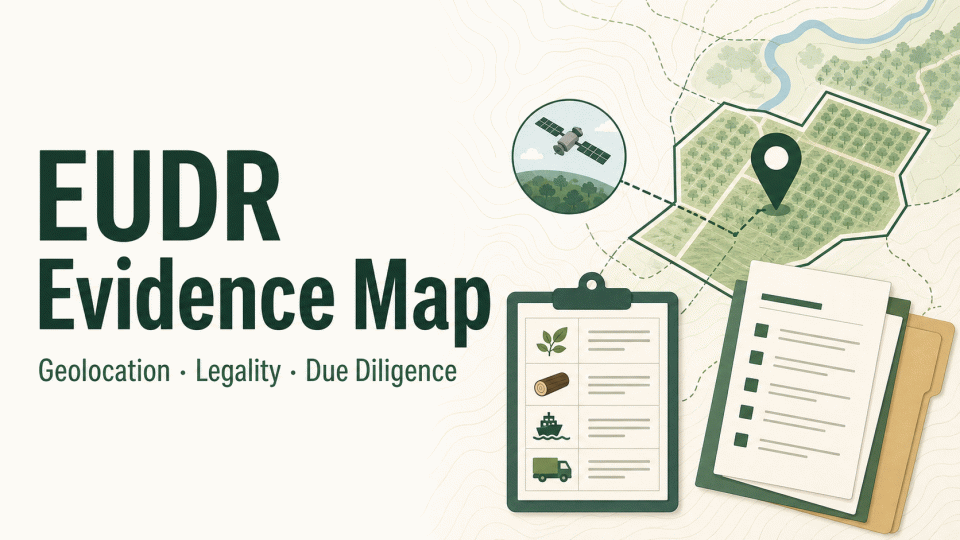
Regulation (EU) 2023/1115, commonly called the EU Deforestation Regulation (EUDR), sets conditions for relevant products listed in Annex I that contain, are fed with or are made using relevant commodities such as cattle, cocoa, coffee, oil palm, rubber, soya and wood. It is not a universal certificate and does not equal an Amazon, customs or buyer approval.
Start with product scope: Do not decide applicability from a material label alone. Record the product, HS/CN code, relevant commodity, country of production, production timing and the matching Annex I entry against the current Regulation and amendments.
1. Lock the scope and current application status
The relevant commodities are cattle, cocoa, coffee, oil palm, rubber, soya and wood. Whether a product is in scope depends on the specific Annex I entry and product description. Furniture, paper, coffee, cocoa products, rubber goods and palm-derived products should be checked against composition, source and customs classification. Exceptions such as waste and products that have completed their lifecycle must be assessed against the legal definitions.
Application dates and transitional arrangements can change with amendments. The European Commission’s current topic page lists 30 December 2026 for large and medium operators and 30 June 2027 for micro and small operators, with a separate arrangement for micro and small operators already covered by the EUTR. Recheck the current consolidated EUR-Lex text, operator size and product facts; do not describe EUDR as universally applicable from 2025 or as a platform or customs deadline.
2. Turn Article 9 information into an evidence register
For each product, batch or transaction, record the relevant commodity and Annex I entry, quantity, country of production, production date or period, suppliers and operator identities, product description, applicable legal requirements, and evidence supporting deforestation-free production and legality. “Deforestation-free” is not established by a supplier assurance alone; assess the legal definitions, the 31 December 2020 cut-off and the actual production locations and chain.
Geolocation data should point to the plots where the relevant commodity was produced. Article 9 requires polygons for relevant commodities produced on plots of four hectares or more; smaller plots have corresponding coordinate requirements under the Regulation. Do not replace a production plot with a city centroid, factory address or unverified map screenshot, and do not invent a universal “±1 hectare” precision rule. Preserve coordinate format, source, version and the link between plots and batches.
3. Separate legality, deforestation status and risk work
Article 3 requires relevant products to be deforestation-free, produced in accordance with relevant legislation in the country of production and covered by a due diligence statement. The legality file may involve land-use rights, environmental and forest rules, third-party rights, labour and human rights, taxes, trade and customs matters that relate to production. A single FSC, PEFC or supplier certificate does not automatically replace the full evidence assessment.
Article 8 describes due diligence through information collection, risk assessment and risk mitigation. State the sources and reasons for risks involving country and region, commodity, supply-chain complexity, mixed or unknown material, deforestation and forest degradation, legality, and indigenous or third-party rights. Certification, satellite data and supplier questionnaires may form part of the record, but their coverage, reliability and link to the batch require separate review. Do not turn a country classification into a conclusion that a product is compliant.
4. Record operator roles and the due diligence statement
Identify the operator, trader, authorised representative and downstream roles in the actual transaction. The party with the relevant legal responsibility generally performs due diligence and submits the due diligence statement through the information system; downstream parties may need to obtain and retain statement reference information. Do not automatically label an EC REP, platform account or supplier as the legal filer without checking the transaction and current rules.
The file should trace operator details, products and quantities, country of production, geolocation, production dates, risk assessment and mitigation conclusions, together with the submitted reference information. Avoid promoting a fixed “38-field” template, a universal TRACES turnaround or an Amazon compliance result; system fields and implementation guidance can change. Invoices, packing lists, transport records, supplier documents and product BOMs should match the relevant batch.
5. Manual review before publication or delivery
Check: Does the product match Annex I? Are the commodity and country of production clear? Do coordinates point to production plots? Do production dates and cut-off evidence agree? Does the legality file cover the actual production? Are risk sources and reasons documented? Do batch, quantity, supplier and transport records align? Does the page avoid turning an evidence review into certification, market access, customs clearance or platform approval? If a point is missing, narrow or pause the claim instead of filling it with a fixed penalty, detention, delisting or promised result.
This reference is based on EUR-Lex Regulation (EU) 2023/1115 and its amendments, the European Commission EUDR topic page and official implementation materials. The Regulation, Annex I, information system and national implementation information may be updated. 绿色方舟(深圳)认证有限公司 may assist with product–supply-chain–evidence mapping, but this page is not a certification decision, legal opinion, customs conclusion or market-access promise.


