
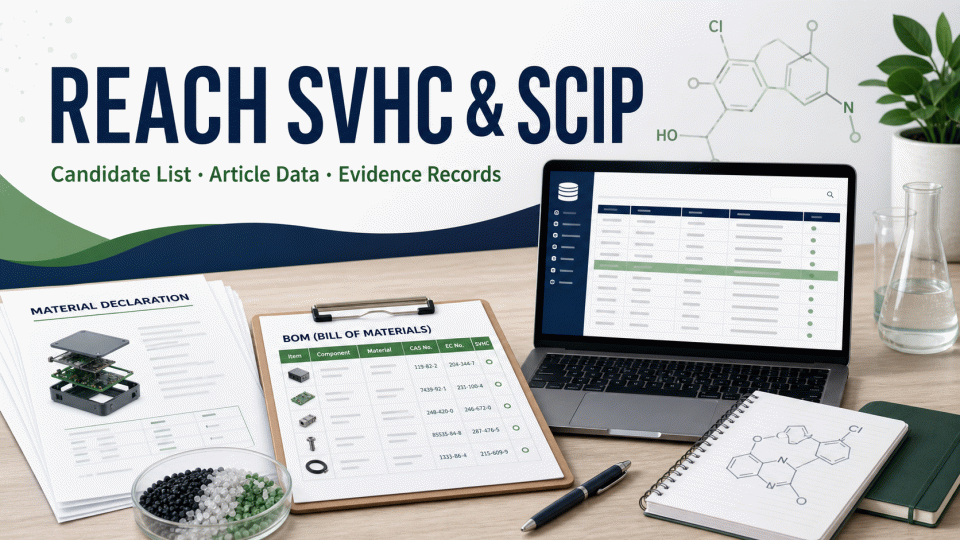
For: Brand owners, importers, manufacturers and supply-chain teams preparing material declarations, supplier evidence or SCIP records for products placed on the EU market.
Scope note: This is a record-preparation and page-wording reference, not a product-specific legal opinion. Check current ECHA pages and applicable legal text for the Candidate List, information requirements and the company’s role.
1. Separate the three concepts
The REACH Candidate List is the list of substances of very high concern published by ECHA under Article 59 of REACH. Inclusion can trigger obligations under, among others, Articles 7, 31 and 33; the applicable duty depends on the substance, product form, concentration and economic-operator role. Candidate-List inclusion should not be rewritten as a blanket ban or an automatic product failure.
An article is not the same as a substance or mixture. For a complex product, identify the relevant article, component, coating or other article boundary first, then record where the Candidate List substance is present and which denominator applies. A product name or one finished-product test report cannot by itself determine the SCIP position.
SCIP is the database established under the Waste Framework Directive to collect information on articles and complex objects placed on the EU market that contain Candidate List substances. ECHA describes information such as article identification, substance identification, location, concentration range and material category. A SCIP record is not a certification certificate.
2. Keep a versioned evidence trail
At minimum, retain the assessment date, the ECHA Candidate List page or version used, product model and variants, article/material boundaries, supplier and factory, BOM version, substance name and CAS/EC where available, location, concentration or concentration range, reasoning and reviewer. The Candidate List can change, so a report or declaration should not be used without its scope and date.
Useful supplier evidence may include material or composition declarations, an SDS where relevant, BOM and weight relationships, test reports, change notifications and batch records. A test report covers its sample, method and substance scope; it does not automatically cover every variant, material or future revision.
For an article requiring a SCIP notification, retain the article identifiers, substance entry, location, concentration range, material category, safe-use or waste information where applicable, and the submission receipt or SCIP number. Do not invent a fixed “31-field” rule or a platform-specific mandatory upload list; reconcile each field against ECHA’s current information requirements.
3. How to word the 0.1% boundary
ECHA’s SCIP information states the notification-triggering concentration range as “>0.1% w/w and ≤100% w/w”. The assessment still requires confirmation of the article boundary, complex-object structure and economic-operator role. Do not combine all components into one finished-product denominator or present 0.1% as a universal product safety line.
A bounded page statement is: “Assess the Candidate List version, article structure and supply-chain evidence for the relevant article; where the applicable threshold or another duty is met, assess Article 33 communication and SCIP notification duties for the responsible role.” Do not claim that a result below the threshold eliminates all records, or assert unverified notifier, platform, approval-rate or penalty outcomes.
4. Suggested evidence-register fields
Product: model, variant, brand, category, GTIN/SKU, market and assessment date; Article: component name, article boundary, material category, location, weight or composition relationship and parent complex object; Substance: Candidate List name, CAS/EC where available, Candidate List version, concentration range and function or location; Evidence: supplier declaration, SDS, BOM, test report, change record, review conclusion, owner and archive path; Page wording: state only what the current evidence supports.
5. Manual pre-publication review
Check the title and H1, summary, Candidate List version, REACH provisions, SCIP role and article boundary. Review the Chinese and English versions independently for reader context rather than translating paragraph order mechanically.
Trace at least one product variant from BOM to material declaration, substance identity, concentration range, location and the exact page wording. If evidence is incomplete, soften the claim or mark the missing record.
Customer-facing copy uses the full company name “绿色方舟(深圳)认证有限公司” when the company is mentioned and does not promise pass rates, certification results, rankings, fixed timing or outcomes.
Source boundary: This reference is based on ECHA’s Candidate List, SCIP Database pages and the ECHA document “Detailed information requirements for the SCIP database”. Applicability still depends on the product, substance, role and current official version.


