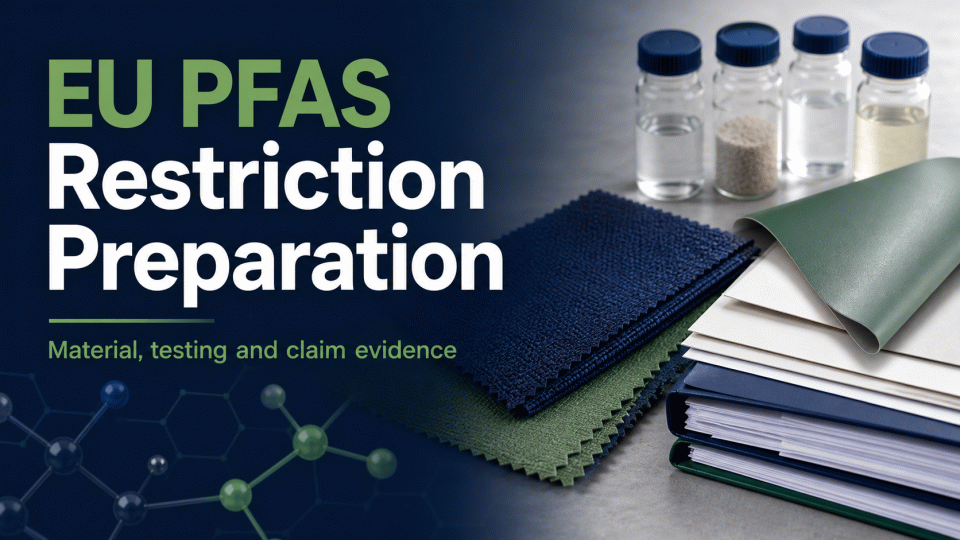
Known as forever chemicals, PFAS are being phased out of the EU market — affecting tens of thousands of consumer products and impacting virtually every cross-border e-commerce seller.
What Are PFAS and Why Is This the Most Important Compliance Issue of 2026?
PFAS (per- and polyfluoroalkyl substances) are a class of synthetic chemicals widely used in consumer product manufacturing due to their water-resistant, oil-resistant, and heat-resistant properties. From the waterproof coating on outdoor jackets and non-stick coatings on cookware, to greaseproof paper in food packaging, cosmetics, and insulation layers in electronics — PFAS are virtually everywhere.
But they have one fatal flaw: they barely degrade in the natural environment, earning them the name forever chemicals. PFAS accumulation in the human body can lead to liver damage, immune system impacts, and even an increased risk of certain cancers.
In January 2023, Denmark, Germany, the Netherlands, Norway, and Sweden jointly submitted to ECHA (European Chemicals Agency) the most comprehensive PFAS restriction proposal ever — proposing a near-total ban on the production, use, and sale of PFAS in the EU market (with limited exemptions).
By mid-2026, this proposal has undergone multiple rounds of review by ECHA's Risk Assessment Committee (RAC) and Socio-Economic Analysis Committee (SEAC). The final restriction is expected to be formally adopted in the second half of 2026, with phased implementation beginning in 2027.
Which Product Categories Will the PFAS Restriction Affect?
PFAS applications are extremely broad. Below are the categories most commonly affected for Chinese cross-border e-commerce sellers:
| Product Category | PFAS Application | Typical Products | Impact Level |
|---|---|---|---|
| Outdoor/Sportswear | Water- and stain-resistant coating (DWR) | Outdoor jackets, ski wear, hiking boots | Extremely High |
| Kitchenware | Non-stick coating | Non-stick pans, baking trays, baking molds | Extremely High |
| Textiles/Home Furnishings | Stain-resistant treatment | Carpets, sofa fabrics, curtains | High |
| Cosmetics | Long-wear, water resistance | Liquid foundation, waterproof mascara, sunscreen | High |
| Food Packaging | Oil and water resistance | Pizza boxes, fast-food wrapping paper, popcorn bags | High |
| Electronics | Insulation materials, cable sheathing | Phone cases, charging cables, earphones | Medium |
| Automotive Care | Water resistance, heat resistance | Car wax, seat waterproofing spray | Medium |
For most cross-border sellers, the easiest categories to get caught are textiles and kitchenware — PFAS use in these two categories is extremely widespread, and many factories do not yet have PFAS-free alternatives available.
Restriction Timeline: What Should You Do Now?
Based on the current review progress publicly available from ECHA, the PFAS restriction timeline is as follows:
| Timeline | Milestone | Impact on Sellers |
|---|---|---|
| Q3-Q4 2026 | European Commission formally adopts PFAS restriction regulation | Regulatory text finalized; transition period begins |
| From 2027 | First wave of category restrictions takes effect (expected priority: food packaging, cosmetics, and other consumer goods) | Affected products can no longer enter the EU market |
| 2028-2029 | Industrial applications, medical devices, etc., phased in | Broader product scope affected |
| After 2030 | Only a small number of exempted uses with no alternative remain | PFAS essentially exit the EU market |
Key principle: The earlier you prepare, the lower the cost. Waiting until restrictions formally take effect to switch your supply chain will leave you facing supplier capacity shortages, rising alternative material prices, and other reactive challenges.
Practical Guide for Sellers
Step 1: Check Whether Your Products Contain PFAS
The simplest way to determine this — ask your supplier three questions:
- Does this product have water-resistant, oil-resistant, or stain-resistant functionality?
- If so, what materials are used to achieve this?
- Does the coating or treatment agent contain fluorine?
If the answers suggest the presence of fluorine, PFAS are highly likely present. It is advisable to request a PFAS test report from your supplier.
Step 2: Find PFAS-Free Alternatives
The good news is that mature alternative technologies already exist across multiple categories:
- Outdoor apparel: Fluorine-free DWR coatings have already been adopted by multiple brands (Patagonia, Vaude, etc.), with close performance but slightly lower durability
- Non-stick cookware: Ceramic coating is a well-established PFAS alternative
- Food packaging: Fluorine-free greaseproof coatings and silicone coatings are already viable substitutes
- Cosmetics: Silicone-based alternatives and natural wax-based formulations can achieve similar effects
Step 3: Prepare Compliance Documentation
Once the PFAS restriction regulation is passed, platforms (Amazon, Temu, SHEIN, etc.) will require sellers to upload compliance documentation. It is advisable to prepare in advance:
- A PFAS content test report from a third-party laboratory (confirming not detected or below the restriction threshold)
- A PFAS-Free declaration letter from your supplier
- Technical specification documents for alternative materials
Additional Reminder: New EU Toy Safety Regulation
Beyond PFAS, there is another important change in 2026 that toy sellers should note —
The EU Toy Safety Regulation replaces the Toy Safety Directive (2009/48/EC) that had been in force for 15 years. It was formally adopted in 2025 with a 30-month transition period. Key highlights of the new regulation include:
- Significantly upgraded chemical requirements: Not only restricts specific hazardous substances, but also introduces controls on sensitizing fragrances and endocrine disruptors
- Digital Product Passport (DPP): Every toy must be equipped with a digital product passport containing compliance information and supply chain traceability
- Enhanced platform accountability: Platforms must ensure that toys sold by third-party sellers comply with the new regulation
If you sell toys or children's products in the EU, it is advisable to complete your compliance upgrade within the transition period (by the end of 2027).
GreenArk (Shenzhen) Certification Co., Ltd. — PFAS Compliance Solutions
GreenArk (Shenzhen) Certification Co., Ltd. provides the following PFAS-related services:
- PFAS Product Screening: Quickly determine whether products contain PFAS and identify compliance risk points
- Third-Party Testing Coordination: Integrate accredited laboratory resources to issue REACH/PFAS compliance test reports
- Alternative Material Consulting: Recommend PFAS-free alternatives and suppliers based on product category
- Regulatory Tracking and Updates: Continuously monitor PFAS restriction regulation progress, helping clients adjust at the earliest opportunity
- Toy Safety Regulation Compliance: One-stop services for testing and documentation preparation for the EU Toy Safety Regulation
We do not sell fear — we provide actionable compliance solutions.
FAQ
Q1: Is the PFAS restriction related to REACH?
Yes. The PFAS restriction is implemented under the REACH regulation framework (EC 1907/2006). Once the European Commission adopts the restriction proposal, it will take effect as a REACH Annex XVII restriction entry. Some PFAS substances have already been included in the REACH SVHC Candidate List — if your product contains SVHC substances at concentrations above 0.1%, you must fulfill the information communication obligation under REACH Article 33 (informing downstream users).
Q2: My products are not exported to the EU (only sold in the US and Japan) — does the PFAS restriction affect me?
There is no comprehensive federal PFAS ban in the US, but multiple states have independent regulations — California AB 1200 (PFAS ban in food packaging), Maine LD 1503 (comprehensive PFAS ban by 2030), Minnesota HF 2310, and others. Japan's Ministry of the Environment is also advancing PFAS management regulations. PFAS restriction is a global trend, and it is advisable to complete the substitution once and for all.
Q3: What proof is needed for PFAS-Free claims?
There is currently no unified certification standard. The most reliable proof is a test report from an ISO/IEC 17025 accredited laboratory, clearly testing against a defined PFAS substance list (it is recommended to reference the OECD PFAS definition, covering 10,000+ substances) and confirming not detected or below the restriction threshold.
Q4: How much will switching to PFAS-free materials increase costs?
It varies by category. Fluorine-free DWR treatment for textiles increases costs by approximately 15-30%; ceramic coatings for non-stick pans are close in cost to PTFE coatings (+5-10%). With bulk substitution, cost differences will narrow further. Compared to the risk of delisting or recall, substitution costs are entirely manageable.
In 2026, Product Compliance Matters More Than a Low Price Tag
The PFAS restriction is not a distant topic — the formal regulation will be enacted in the second half of 2026. For cross-border sellers, beginning to prepare PFAS-free alternatives now is far less costly and far less risky than scrambling for solutions after the regulation takes effect.
Contact GreenArk (Shenzhen) Certification Co., Ltd. today:
- Website: www.greenark-sz.com
- Email: sui@greenark-sz.com
Let us help you plan ahead for PFAS-free product lines and stay one step ahead before the regulation takes effect.
This article is an original publication by GreenArk (Shenzhen) Certification Co., Ltd. Please credit the source when reprinting. Content is based on publicly available regulatory information and ECHA announcements as of June 2026. For specific regulatory requirements, please refer to the Official Journal of the European Union.