
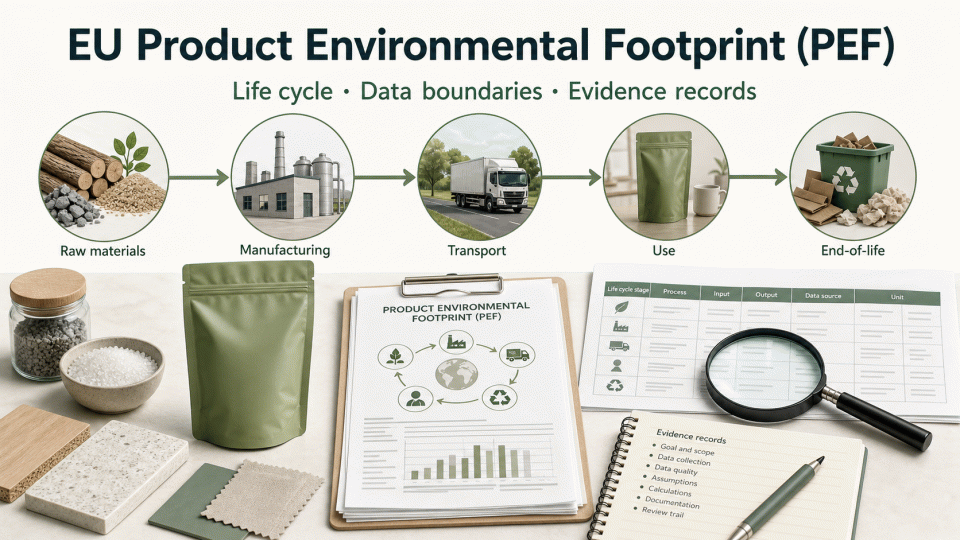
Product Environmental Footprint (PEF) is a life-cycle-assessment-based method for quantifying a product’s potential environmental impacts. It can cover raw-material acquisition, manufacturing, transport, use, and end-of-life stages. This page provides a documentation framework; it does not present PEF studies, environmental claims, or buyer requests as automatic proof of mandatory market access for every product.
Commission Recommendation (EU) 2021/2279 describes the general Environmental Footprint method and explains how Product Environmental Footprint Category Rules (PEFCRs) can add category-specific requirements for the functional unit, system boundary, data, and calculations. Whether a study is needed, which rules apply, and how results may be communicated should be checked against the product category, target market, buyer request, and current source material.
1. Define the product and applicable rules
Record the product name, model or SKU, composition, and sales form. State whether the study covers one product, a product group, or an organisation. Then check whether a relevant PEFCR exists; if it does not, document the general method used, assumptions, and limitations. Similar product names do not prove identical materials, functional units, or life-cycle boundaries, so a result should not be copied to another product without a documented basis.
Create a product–rule–claim map: link the product identity to its formulation and version, the rule to its source and scope, and each claim to the relevant result and evidence location. Before external use, reconcile the study object with the product description shown on the page, packaging, and customer documents.
2. Document the life-cycle boundary
The evidence table should cover raw materials and auxiliaries, manufacturing, energy and water, packaging, transport, product use, and recycling, treatment, or disposal at end of life. For each stage, record included and excluded activities, geography, time representativeness, data source, and allocation approach. Keep data gaps and assumptions visible; do not turn an estimate or generic average into a falsely precise product conclusion.
The functional unit defines what is calculated or compared, such as a quantity, mass, or delivered service. A change in functional unit, reference flow, use scenario, or end-of-life scenario can make results non-comparable. Transport distance, loading, use frequency, and service life should remain consistent with the documented study assumptions.
3. Organise data sources and calculations
Maintain a data ledger for each life-cycle stage. Record the data item, unit, quantity, period, location, supplier or internal-system source, original file name, and version. Supporting records may include the BOM or formulation, purchasing and production records, energy bills, process parameters, packaging specifications, transport records, use assumptions, end-of-life information, database factors, and calculation sheets.
Retain the goal and scope statement, boundary diagram, functional unit, allocation principles, data-quality assessment, assumptions, sensitivity analysis, model version, result tables, and review trail. A third-party report or database entry supports only the object and scope it actually describes. The presence of a laboratory or institution name does not by itself establish certification or market access.
4. Check the boundary of environmental claims
Break each page or packaging claim into its object, attribute, life-cycle stage, data period, comparison basis, and market scope. Avoid broad terms such as “green,” “eco-friendly,” or “sustainable” without an identified basis. If a claim relies on a PEF study, it should be traceable to the relevant study, data, and calculation. An improvement in one impact category should not be presented as an improvement across all environmental impacts.
PEF evidence also does not replace product-specific safety, labelling, producer-responsibility, or other regulatory files. If a platform, brand, or buyer asks for additional records, document that request and its scope separately instead of combining it with PEF into a generic “compliance certificate.” When 绿色方舟(深圳)认证有限公司 assists with evidence organisation, the external wording should remain limited to the actual study scope and records supplied by the client.
5. Pre-delivery documentation checklist
Before delivery, check in sequence: (1) product identity, functional unit, and the PEFCR or general method; (2) the life-cycle system boundary and exclusions; (3) each primary data item, database factor, and version; (4) calculations, allocation, assumptions, and data quality; (5) the mapping from results to every page or customer claim; and (6) the review trail, change log, and final file version.
Keep missing records, estimated inputs, conditions of use, and unsupported claims in separate fields. This distinguishes evidence already available, data still needed, and wording that should not yet be used externally. It also prevents a PEF study from being misrepresented as a fixed-validity certificate, a universal pass standard, or an automatic promise of platform, customs, or sales outcomes.
Sources: Commission Recommendation (EU) 2021/2279 on using Environmental Footprint methods to measure and communicate life-cycle environmental performance; European Commission Joint Research Centre Environmental Footprint materials. Recheck the applicable source and rule version for the specific project.


