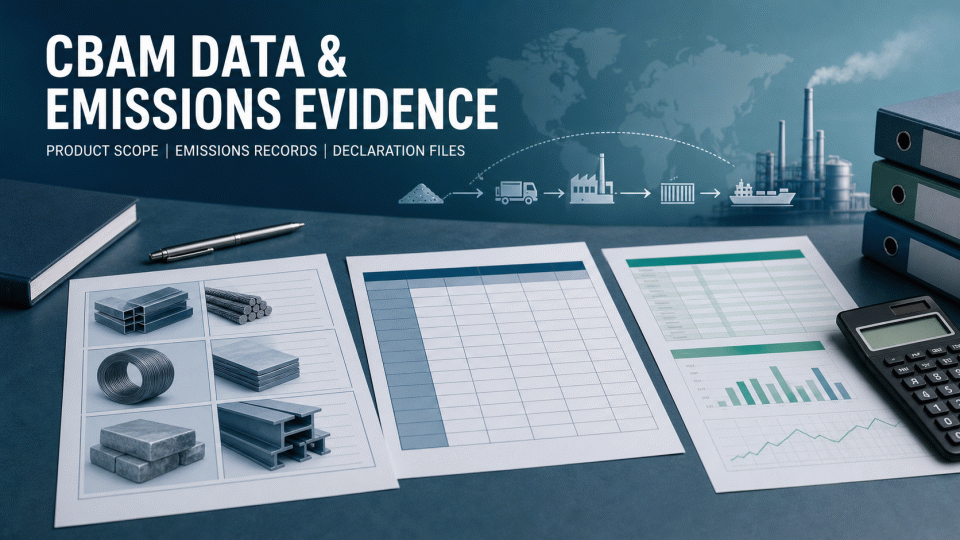
As the Carbon Border Adjustment Mechanism (CBAM) moves into its definitive regime, preparation starts with confirming whether the imported goods are in scope, identifying the responsible declarant, and showing how product and embedded-emissions data are supported by records. Based on the European Commission’s CBAM definitive-regime, sectors, registry and reporting pages and Regulation (EU) 2023/956, this article provides a supplier-side evidence framework. It does not replace the judgement of an EU importer, authorised CBAM declarant, customs authority or competent authority.
1. Confirm what CBAM covers
CBAM is not a universal carbon certificate for every export product. Start by checking the CN code, goods category and any applicable mass threshold or exception against Annex I to Regulation (EU) 2023/956 and the current implementing materials. Cement, iron and steel, aluminium, fertilisers, hydrogen and electricity are among the covered categories, but a product name alone is not enough: the specific code, form and import situation matter. A product outside the relevant list should not be presented as having a general CBAM market-access credential.
Keep the roles separate. A non-EU installation supplies production and emissions data; the EU importer or indirect customs representative handles the import and reporting arrangement; and an authorised CBAM declarant performs the applicable obligations through the CBAM registry. An exporter may support factual records but should not make the declaration or liability decision for the EU responsible party.
2. Link products, batches and emissions data
For each product and installation, build a traceable record set: CN code and description, production site, import batch and quantity, production period, process boundary, direct-emissions sources, relevant indirect-emissions information, activity data, emission factors, calculation method and data sources. Units, periods, output and allocation logic in the data sheet should reconcile with production records, shipping documents and invoices. Do not substitute a value from another plant, model or period.
Supporting files may include energy and raw-material records, meter or supplier data, production logs, batch links, calculation workbooks, method versions, assumptions and internal review notes. If default values, estimates or third-party data are used, record their source and conditions of use. An estimate should not be described as an independently verified on-site measurement.
3. Keep declarations and certificates in context
European Commission materials state that the definitive regime applies from 1 January 2026. Importers or their indirect customs representatives that fall within the rules must consider authorised-declarant status, annual declarations, embedded-emissions data and certificate surrender. Thresholds, dates and purchase or surrender procedures must be checked against the current legislation, implementing acts and CBAM registry guidance. Supplier-side records do not by themselves complete an EU declaration or prove that CBAM certificates have been purchased or surrendered.
If a carbon price was paid in the country of origin, the responsible party must determine under the applicable rules whether it can be taken into account, what evidence is required and how it is reported. Do not turn that possibility into a page claim such as “exempt”, “zero carbon”, “automatically offset” or “CBAM compliant”.
4. Supplier-side checklist
□ CN code, product description and category have been checked by the responsible party; □ installation, model and batch links are clear; □ production period, quantity and units agree; □ boundaries for direct, indirect and other relevant data are recorded; □ emission factors, calculation method and version are traceable; □ energy, raw-material, output and logistics records reconcile; □ estimates, default values and carbon-price evidence are labelled separately; □ document versions, language and access are controlled; □ customer or page wording does not turn record preparation into a declaration, deduction or outcome guarantee.
5. Page wording and maintenance
A page may accurately say that product and emissions evidence is being organised against applicable CN codes and prepared to support an importer’s review, while stating the data period and responsibility boundary. Reassess the record set when materials, processes, facilities, product codes, suppliers or routes change. EU rules and implementation guidance can change; before a declaration, return to the current European Commission, EUR-Lex and CBAM registry materials.
Sources: European Commission CBAM definitive regime, CBAM sectors, CBAM registry and reporting, and CBAM legislation and guidance; Regulation (EU) 2023/956. GreenArk (Shenzhen) Certification Co., Ltd. may support document organisation and claim-to-evidence mapping, but it does not replace an importer, authorised CBAM declarant, customs authority or competent authority. This article is not a declaration, deduction or outcome promise.