
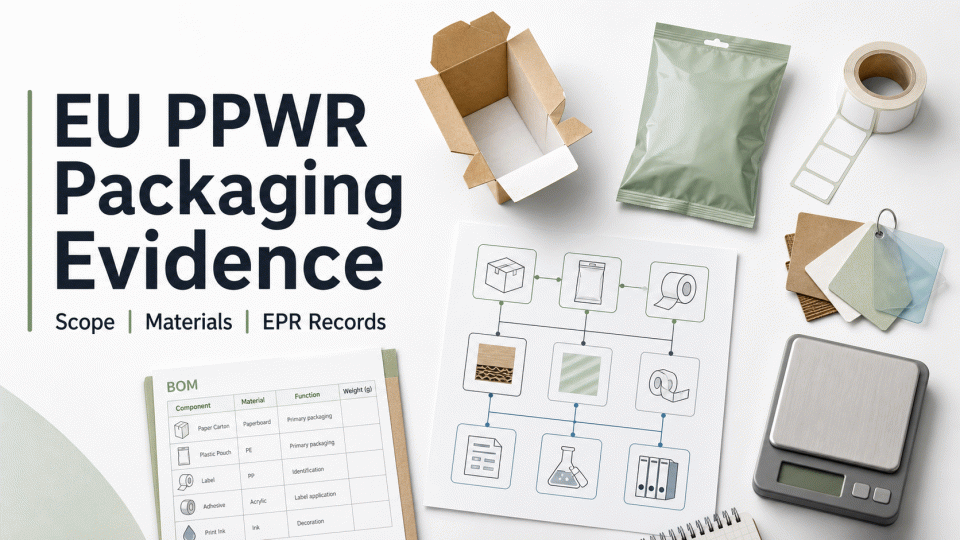
The EU Packaging and Packaging Waste Regulation, Regulation (EU) 2025/40 (PPWR), establishes a common framework for packaging and packaging waste. It entered into force on 11 February 2025 and generally applies from 12 August 2026. The exact duties still depend on the text, annexes, implementing or delegated acts, Member State arrangements and the product scenario. This page is a documentation reference, not legal advice for a specific product or market.
1. Confirm the packaging scope and economic operator
The Regulation generally covers packaging and packaging waste made from any material and used across industrial, commercial, retail, service and household settings. For each SKU, list the sales, grouped and transport packaging placed on the market with the product, including separable components. Record its function, material, weight, dimensions and whether components can be separated.
Relevant economic operators may include the manufacturer, supplier, importer, distributor, authorised representative, fulfilment service provider and operators in the final distribution chain. The responsible party for a given duty depends on its role, supply-chain arrangement and target Member State. It should not be inferred from a label such as “brand owner” or “factory” alone.
2. Build a packaging-component evidence map
For each SKU, record the component, material and composite structure, mass, supplier and production batch, product relationship, target market, and the applicable provision or annex. Do not merge a carton, plastic bag, label, adhesive, coating, cushioning material and transport outer into one unsupported “packaging” conclusion.
For composition, recyclability, recycled plastic content, reusable design or substances of concern, retain the BOM, material specification, supplier declaration, formulation or composition information, batch records, calculations and, where appropriate, test reports. The evidence should resolve to a particular component and version rather than only to a brand or product family.
3. Check substances and packaging-performance requirements
PPWR must be read together with other EU legislation. The Regulation sets a combined concentration limit for lead, cadmium, mercury and hexavalent chromium in packaging and packaging components. It also sets specific PFAS restrictions for food-contact packaging applying from 12 August 2026; check whether another EU act imposes a stricter or different requirement for the scenario.
Recyclability, reusability, prevention, recycled content and labelling do not form one identical test list for every packaging format. Confirm the relevant provisions in the Regulation, annexes, Commission guidance and applicable implementation arrangements. A material test report, supplier-wide statement or platform upload field is not automatically evidence of every PPWR duty.
4. Separate EPR, technical files and page claims
EPR registration, reporting, fees and waste-management arrangements generally require a Member State review. File the Member State, responsible party, packaging type, quantity or mass, reporting period, registration or authorisation records, producer-responsibility organisation details and filing receipts separately, with versions and dates. An EPR record from one Member State should not be assumed to cover all Member States.
Technical files should identify the packaging, explain its composition and design or performance basis, point to calculations or testing, and identify the responsible party and market. Claims such as “recyclable”, “contains recycled material” or “reusable” on a product page should match the specific component, conditions and current evidence. Avoid expanding a qualified statement into an absolute claim about the entire product, every market or an approval outcome.
5. A pre-submission checklist
1) Lock the object by SKU, component and version. 2) Reconcile material, mass, composition and batch records. 3) Separate PPWR evidence from food-contact, chemicals, transport, product-safety and EPR records. 4) Confirm the economic operator, import arrangement and Member State rules. 5) Keep evidence, conditions and dates for each page claim. 6) Preserve the source link and review note for each Regulation annex, guidance document and national implementation item.
绿色方舟(深圳)认证有限公司 recommends using this map as a living index. When packaging, suppliers, formulations, labels, responsible parties or target Member States change, reassess the affected fields and record why evidence is retained, supplemented or replaced.
Sources: EUR-Lex, Regulation (EU) 2025/40; European Commission Environment, Packaging waste; European Commission PPWR Guidance and FAQ. Application and Member State implementation information may change; use the latest official text.


