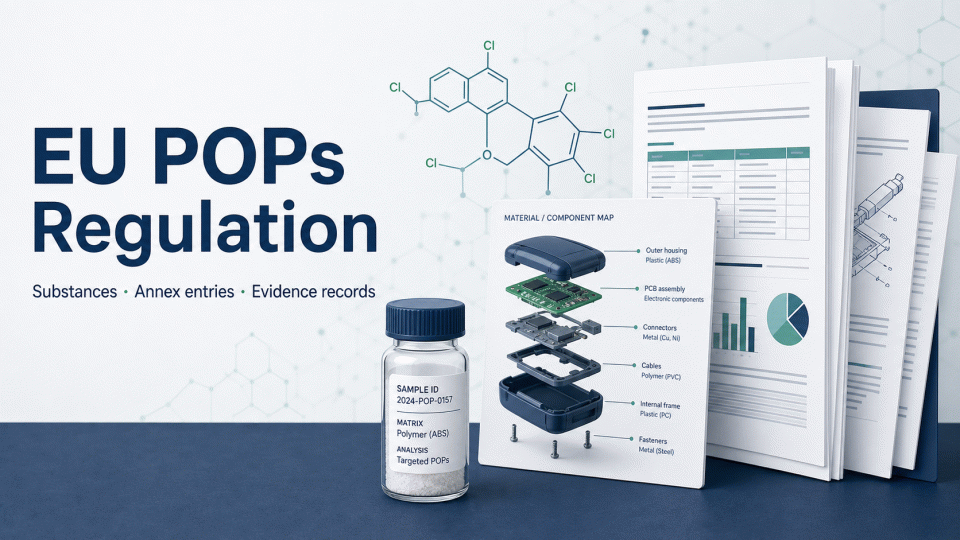
Regulation (EU) 2019/1021 on persistent organic pollutants (POPs) addresses restrictions on the production, placing on the market, and use of listed substances, together with controls for waste consisting of, containing, or contaminated by POPs. A useful file map starts with the substance, product or waste stream, and applicable provision; it does not treat POPs as a universal certificate or a substitute for other legislation.
1. Define the regulatory object and the relevant annex
Regulatory structure: the annexes to Regulation (EU) 2019/1021 list controlled substances and their restrictions, exemptions, or conditions. Annex I is central to production, placing-on-the-market, and use restrictions; Annex III addresses release-reduction provisions; Annexes IV and V address concentration limits and treatment rules for POPs waste. Check the consolidated EUR-Lex text and later amendments for the current annex wording.
Working unit: a specific SKU, formulation or material composition, batch, intended market, and use. For an article, check whether a listed substance could occur in a coating, flame-retardant treatment, plastic component, textile finish, or recycled input. A product name or a supplier’s general “POPs-free” statement is not enough to close the assessment.
A POPs review is not the same as a REACH, RoHS, food-contact, toy-safety, packaging, or platform review. Where another requirement applies, create a separate regulation–SKU–evidence link instead of extending one test report into a broader conclusion.
2. Build substance and limit evidence around the annex entry
For each SKU, keep one evidence row containing the substance name and CAS/EC identifiers, the material or component, concentration or test conclusion, the relevant annex entry, the production or placing-on-the-market stage, any applicable exemption and its conditions, the source, and the review date. Preserve the provision used where an annex entry distinguishes unintentional trace contamination, a specific use, or a product category.
Technical file: BOM and material declarations, formulation or component lists, supplier-change records, process information, procurement batches, and test reports. The method, sample representativeness, detection limit, laboratory, report identity, and product version should map back to the SKU. The POPs Regulation does not create a single general “24-month report validity” rule for every product.
Supply-chain file: supplier composition questionnaires, safety or technical information that can be checked, batch and purchasing records, change notices, recycled-input records, and relevant downstream communications. Mark unresolved assumptions and missing evidence as open items; do not turn them into a statement of compliance.
3. Keep product placing-on-the-market and waste records separate
Product records ask whether the product falls within an Annex I entry, whether its concentration or use triggers a restriction, and whether a clearly applicable exemption or special condition exists. Waste records ask whether a particular waste stream consists of, contains, or is contaminated by POPs, whether an Annex IV concentration limit is reached, whether destruction or irreversible transformation is required, and how transport and treatment records are retained.
The European Commission explains that waste containing POPs above relevant concentration limits must be destroyed or irreversibly transformed so that the POP content is no longer harmful. That statement should not be turned into a universal test or treatment conclusion for every product; assess the actual waste stream, annex limit, and applicable local implementation.
4. Control page wording, customer communication, and maintenance
Keep page wording within the evidence actually held—for example, that a stated POPs screen was completed for identified materials and batches, with the sample, method, report number, and scope retained. Avoid “POPs-free for all products,” “EU customs clearance guaranteed,” or “POPs certification”: a regulatory review does not automatically create a certification mark or a platform outcome.
Review triggers include a formulation, material, supplier, process, recycled-input source, product use, target market, or annex version change. Record the reason, affected SKUs, missing documents, owner, and conclusion. Timing should follow the product risk and regulatory amendments, rather than an invented universal cycle.
Sources: EUR-Lex: Regulation (EU) 2019/1021 consolidated text; European Commission: Waste containing POPs. Recheck the current annexes and relevant Member State implementation before publication or submission.