
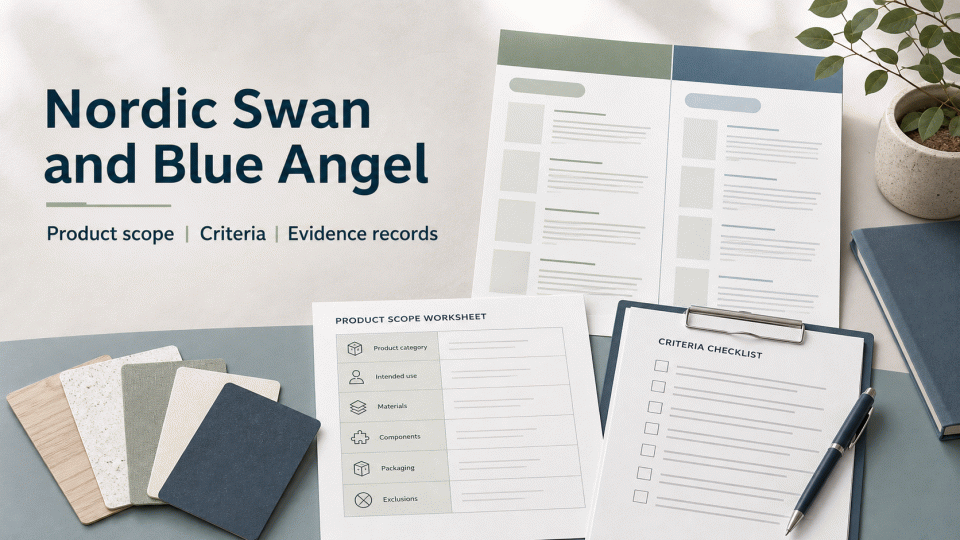
Nordic Swan and Blue Angel are ecolabel systems, but their product scopes, criteria documents and application routes are managed separately. A useful preparation file should identify the target label, product group, applicant and intended environmental claims before linking each claim to traceable evidence.
1. Identify the correct label and product group
Nordic Swan: the Nordic ecolabelling system publishes separate criteria, application guides and fee information for different product and service areas. Applicants normally identify the relevant product group and use the Nordic Ecolabelling Portal. The company must also establish the authorised signatory and the person responsible for managing the application.
Blue Angel: the German scheme uses Basic Award Criteria for individual product groups and services. Each criteria set defines requirements and the associated verification route. Applications are submitted through the RAL gGmbH online portal, followed by the scheme’s review and label-use contract steps.
Neither label can be supported by a generic supplier certificate or by a broad statement that a product is “green”. Product identity, model or range, formulation or materials, production sites, packaging and proposed claims should all be mapped to the selected product group.
2. Build the evidence index around the criteria
Create an evidence index for each SKU or application unit instead of assembling one cross-product “certification pack”. At minimum, record:
Scope and parties: product-group name and criteria version, model or range, brand, manufacturer, applicant or licence holder, production site, sales market and intended use. For Nordic Swan, record the selected criteria and application guide; for Blue Angel, record the relevant DE-UZ product group and Basic Award Criteria.
Product and materials: specifications, BOM or formulation, critical components and suppliers, chemicals or additives, packaging, label artwork and instructions. Where supplier declarations, testing or process data are required, record the source, covered models and conditions of use.
Requirement-by-requirement verification: split each criterion into “requirement, fact to demonstrate, evidence file, owner, status and notes”. Distinguish company declarations, supplier declarations, test reports, audit or site evidence and other scheme-specific verification.
Versions and changes: retain download dates, criteria versions, evidence revisions and product-change records. Recheck the file when formulation, materials, key suppliers, production sites, packaging, labels or intended use changes.
3. Keep an application trail
Before applying, download and read the current product-group criteria, application guide, declarations and appendices. Confirm that the product actually falls within the group. If no suitable criteria exist, do not substitute another category’s requirements; follow the scheme’s route for pending investigations or a new category proposal.
During the application, keep the portal submission record, upload list, questions, supplementary files, version changes and written communications. Blue Angel’s application guidance describes verification being submitted to RAL and the subsequent review and label-use contract route; Nordic Swan directs applicants to the ecolabelling portal and the relevant application guide.
After the process, retain the licence or contract, covered products, permitted label use and any public product information. “Application submitted” or “under review” must not be presented as “label awarded”. An ecolabel statement should not be expanded into a claim of regulatory compliance, marketplace acceptance or guaranteed outcome.
4. Check Chinese and English page wording
Use terms such as “ecolabel licence”, “product-group criteria”, “verification evidence” and “permitted use of the label” consistently. Avoid wording such as “guaranteed approval”, “universal compliance”, “customs clearance” or “platform pass” unless a separate, specific source and scope support that statement.
If the page is prepared by 绿色方舟(深圳)认证有限公司, describe the work as document mapping, evidence indexing and wording review. Whether a product meets a particular product-group requirement remains dependent on the applicable criteria, the actual evidence and the scheme operator’s review.
5. Submission checklist
□ The target label and current product-group criteria are identified; □ applicant, manufacturer, brand and production site are consistent; □ models, materials, formulation, packaging and label versions are covered; □ every requirement has evidence or a named gap; □ supplier documents have been checked for party, scope and version; □ portal submissions, questions and revisions are recorded; □ page claims do not become promises of regulatory compliance, marketplace access or an awarded result.
Sources: Nordic Swan: Criteria, application & fees; Nordic Swan: Application step by step; Blue Angel: Basic Award Criteria; Blue Angel: Application process.


