
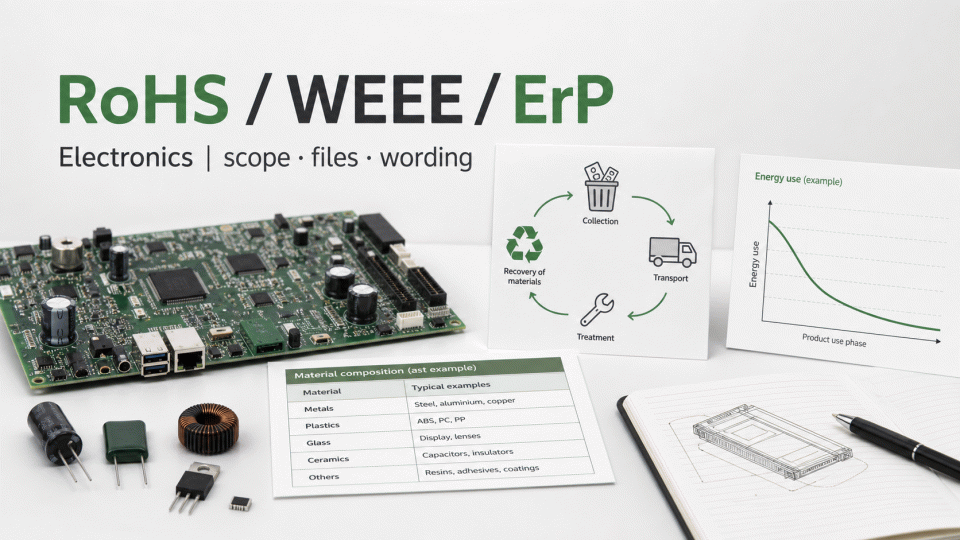
RoHS, WEEE and ErP/energy labelling may all appear in an electronics export file, but they address different questions. RoHS concerns restricted substances in electrical and electronic equipment; WEEE concerns producer responsibility and end-of-life arrangements; ErP concerns ecodesign and, for specific product groups, energy-labelling requirements. Based on European Commission materials, this article sets out a product, party, document and page-wording framework. The actual scope still depends on the model, its functions, how it is placed on the market and the applicable product measures.
1. Separate the product and regulatory objects first
Create a SKU-level record covering the model and variants, ratings, main materials and components, dependence on electric current or electromagnetic fields, sales model, destination countries, manufacturer and importer. “Electronics” is not enough to determine scope, and a supplier report should not be treated as a universal document for all three regimes.
RoHS is a substance-restriction regime. WEEE focuses on producer status, categories, registration/reporting and collection or treatment responsibilities. ErP scope must be checked against the framework rules and product-specific measures for energy-related products. A product may be subject to more than one regime, or only one of them.
2. RoHS: connect restricted-substance evidence to the final model
The European Commission explains that Directive 2011/65/EU restricts specified hazardous substances in electrical and electronic equipment. The current list includes lead, cadmium, mercury, hexavalent chromium, PBB, PBDE, DEHP, BBP, DBP and DIBP. Scope, exemptions and annex changes must be checked against the Directive and its amendments; the words “RoHS certificate” are not a substitute for scope analysis.
Map the final SKU to the BOM or material declarations, critical components and cables, supplier changes, test reports or other technical evidence, applicable exemptions, the manufacturer’s technical documentation, the declaration and marking or manual artwork. The report model, materials, samples and test basis must match the marketed configuration. Mark gaps as pending verification instead of filling them with a universal validity period or “all models covered.”
3. WEEE: the key file is not a product test report
WEEE checks may involve producer responsibility in each Member State, product categories, registration and reporting, collection or treatment arrangements, and the crossed-out wheeled-bin marking and user information. The details depend on national implementation, the sales model and the applicable producer definition. WEEE registration, take-back responsibility and RoHS substance testing are different records.
Keep separate records for the destination Member State, responsible party, registration or reporting, category decision, collection scheme or arrangement, user information and marking artwork, with the source and version for each country. If a page describes a collection arrangement, state only the verified party and market; do not claim one EU-wide registration or automatic exemption from responsibility.
4. ErP and energy labels: check the product-specific measure
The European Commission’s Energy Efficient Products portal explains that ecodesign and energy labelling are built from framework rules and product-specific measures. Some products are covered by ecodesign only, while others are also subject to energy labelling. The product list spans appliances, displays, smartphones and tablets, external power supplies and other groups, so “ErP” alone does not establish scope.
For products subject to energy labelling, check the product group’s technical documentation, measurement methods, product information sheet, label display and EPREL model-registration requirements. Online sales may have specific display obligations. Verify product-specific scope, exemptions, conditions and database fields; do not state that every electronic product must be registered in EPREL.
5. Use one evidence-mapping register
Useful fields include SKU/version, regulatory object, scope decision, manufacturer/importer/producer, BOM and materials, test or technical file, declaration wording, registration or reporting, marking and manual, online wording, Member State differences, source links, review date and open facts.
Each row should answer: which model does the document cover; does it address substances, producer responsibility or energy requirements; which market and product group does it cover; and has the marketed configuration changed? RoHS, WEEE and ErP can share basic product identifiers, but one regime does not replace the legal or technical basis of another.
6. Set boundaries for page and client wording
The title and summary should identify this as an EU electronics evidence reference. Do not show invented registration numbers, test results, official-agency graphics, pass rates, penalty amounts, detention, delisting, recall outcomes or fixed processing times. Do not describe GreenArk (Shenzhen) Certification Co., Ltd. as a regulator’s decision-maker or promise a client outcome.
Before publication, manually check that the regulation and product group match, that the Chinese and English title, summary and body cover the same scope, and that the images show evidence, materials, collection and energy-use review without implying a certification result. Rules, product measures and Member State implementation can change; recheck the European Commission and national sources before use.
Sources: European Commission materials on the RoHS Directive, WEEE, the Energy Efficient Products portal, Ecodesign and Energy Labelling, product lists, suppliers and EPREL. This is an evidence-organisation reference, not a product-specific legal or technical assessment.


