
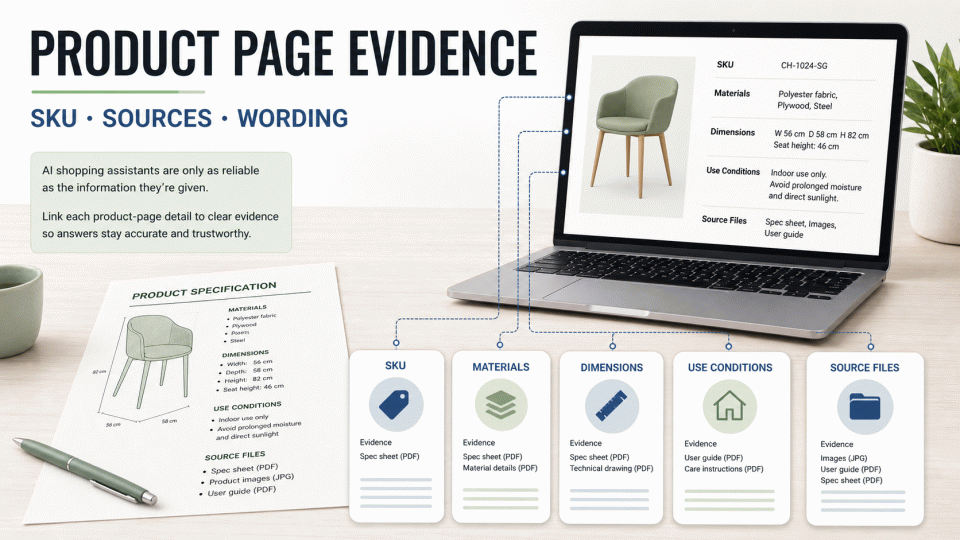
Amazon describes Rufus as a shopping assistant that can answer questions, compare products, and make recommendations using information such as product listings, customer reviews, community Q&As, and other sources. Amazon later noted that the experience was updated to “Alexa for Shopping” on May 13, 2026. For sellers, the practical task is not to engineer a favorable AI answer. It is to keep each product detail page clear, traceable, and consistent with the specific SKU.
1. Identify the information a shopping assistant may use
Amazon’s public descriptions refer to product details, reviews, and community Q&As. Treat the listing as a maintained product record: the title identifies the product, the key features describe what it does, specifications define the model and conditions, and images, instructions, labels, and warnings help customers understand the item.
Do not assume that similar names make different variations, batches, or configurations interchangeable. Every material claim should map to the relevant SKU, version, and source. If a detail cannot be confirmed, remove it, qualify it, or state its limits rather than filling the gap with a broad claim.
2. Build a page-to-evidence map
Product facts: model, variation, materials or formulation, dimensions, weight, functions, conditions of use, package contents, and warnings. Check these against specifications, BOMs, label artwork, instructions, and product images.
Market and rule scope: record the destination market, sales channel, and applicable mandatory rule or voluntary program. Marketplace requirements, import obligations, buyer standards, and environmental claims are different objects with different responsible parties and evidence paths.
Evidence index: record the file name, version or date, issuer, covered products, market, and limitations for each report, certificate, declaration, supply-chain record, or authorization. A supplier document should not automatically be presented as complete evidence for the listing owner’s SKU.
Page wording: separate verifiable statements such as “contains,” “tested by a stated method,” or “intended for a stated use” from claims such as “eco-friendly,” “safe,” “compliant,” or “certified,” which require a defined basis and scope. A broad label cannot replace product-level evidence.
3. A practical pre-publication review
Lock the SKU and destination marketplace first. Then compare the title, bullets, description, specifications, images, labels, and instructions. Check numbers, units, versions, conditions, and limitations for consistency. Map each environmental or certification statement to a source file and record what that file supports and what it does not support. Finally, have a product-literate reviewer read the customer-facing page and confirm that recommendations, review summaries, or marketing language cannot reasonably be mistaken for official certification or a regulatory conclusion.
Reassess affected fields when materials, factories, packaging, models, labels, or destination markets change. Previous use of a statement does not establish that it remains accurate for a revised product.
4. Common mistakes and wording limits
Do not treat Rufus output as a controllable ranking or recommendation result. Do not use a review summary as proof of regulatory compliance. Do not treat a generic supplier file as complete evidence for a current SKU. Avoid claims such as “globally compliant,” “100% safe,” or “guaranteed approval” unless a defined, applicable source actually supports the precise statement.
绿色方舟(深圳)认证有限公司 can help organize a page-and-evidence checklist by product, market, page field, and source file. Any conclusion still depends on the applicable rules, the product facts, and the actual records.
Sources
Amazon About: Amazon’s AI shopping assistant; How customers use Rufus. Accessed August 27, 2026.


