
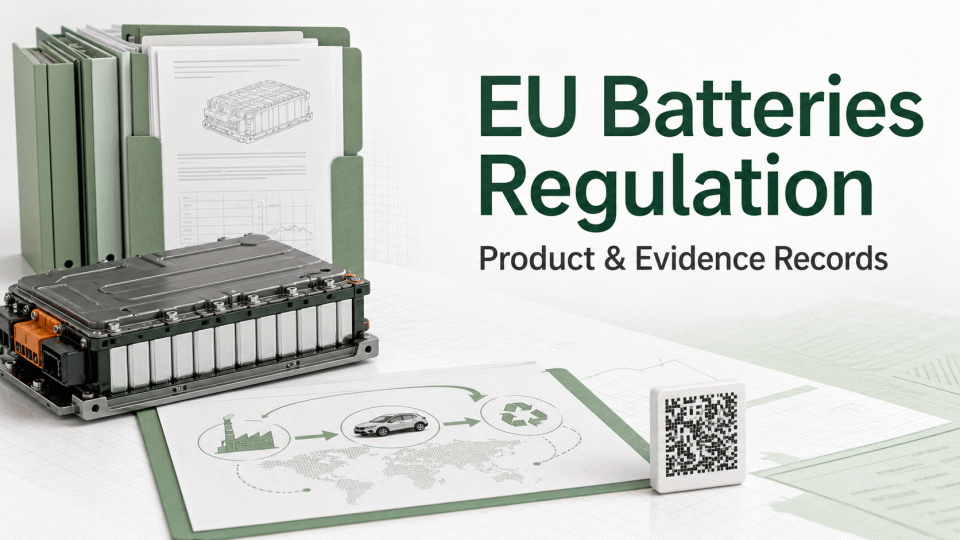
Regulation (EU) 2023/1542 takes a life-cycle approach to batteries and waste batteries. A practical evidence review should first identify the battery category, the economic operators placing it on the EU market, and the destination Member States, then map technical, labelling, carbon-footprint, producer-responsibility and end-of-life records. This page is a reference framework, not a product conformity conclusion.
1. Define the battery and responsibility chain
The Regulation covers portable, starting-lighting-ignition (SLI), light means of transport (LMT), electric-vehicle, industrial batteries and waste batteries. The file should record the model, chemistry, rated capacity, rechargeability, host product, sales markets and the relevant manufacturer, importer, distributor or authorised representative. Requirements differ by category and use; one generic “battery certificate” cannot replace the classification analysis.
Where a business places a battery under its own name or trademark, or incorporates it into a product, map the manufacturer and producer roles before checking producer-responsibility registration, collection arrangements and reporting records in each destination Member State. The EU Regulation is not itself a Member-State registration certificate.
2. Technical documentation and conformity evidence
Build a model-level technical-file index covering specifications, BOM and critical-material information, chemical composition and hazardous-substance data, performance and durability parameters, risk assessment, test records, label/packaging/instruction artwork, production quality records and the EU Declaration of Conformity. Each record should identify the model, version, manufacturing location and responsible entity. Supplier documents are inputs to the file; they do not automatically demonstrate compliance for the finished battery or the operator placing it on the market.
Article 18 requires the manufacturer to draw up an EU Declaration of Conformity after the applicable conformity assessment and to retain the technical documentation described in Annex VIII. The route depends on the applicable requirements and product circumstances. A test report, CE mark or platform upload should not be described on its own as the final regulatory outcome.
3. Labels, carbon footprint and digital information
Use Article 13 and Annex VI to check the manufacturer, category, manufacturing location and date, weight, capacity, chemistry, relevant hazardous substances and critical raw-material label fields. Labels must be visible, legible and indelible; where the battery’s size or nature prevents this, check the permitted placement on packaging and accompanying documents. A required field or future date should not be rewritten as proof that a product already qualifies.
For electric-vehicle batteries, rechargeable industrial batteries above 2 kWh and other applicable categories, separately review the carbon-footprint declaration, performance class and data-carrier requirements against their conditions and implementation dates. From 18 February 2027, each LMT battery, industrial battery above 2 kWh and electric-vehicle battery placed on the market or put into service must have a battery passport; from the same date, batteries must carry the QR-code information route described by the Regulation. The applicable delegated and implementing acts should be checked for calculation and implementation detail.
A battery passport links to a unique identifier and separates information available to the public, authorities/notified bodies and persons with a legitimate interest. Prepare model data, individual or batch identification, manufacturing location, performance and durability records, composition and dismantling information, status changes and access controls, while keeping the record complete, accurate and current.
4. Producer responsibility, supply chain and end-of-life records
Index Member-State registrations or authorisations, placed-on-market volumes by category, collection and treatment arrangements, downstream operator details, transport and handover records, and reuse, repurposing or remanufacturing status records. For critical raw-material due diligence, keep the applicable policy, risk-management, third-party verification and public-reporting evidence tied to the battery category and threshold; do not generalise it into one obligation for every battery or supplier.
5. Evidence map and wording boundaries
A useful tracker is “battery model — provision — responsible operator — evidence — version/date — gap — reviewer”. Review technical files, labels, the Declaration of Conformity, producer responsibility, carbon footprint, battery passport and waste-battery records separately. Reassess the impact when the model, chemistry, manufacturing location, intended use or applicable implementation act changes.
Customer-facing pages should state only verified facts about the product, market and documents. Avoid replacing evidence review with claims such as “approved”, “guaranteed customs clearance”, “valid across the EU” or a fixed delivery time. The primary references are Regulation (EU) 2023/1542 and the European Commission batteries page; Member-State requirements and product conclusions depend on the actual evidence.


