
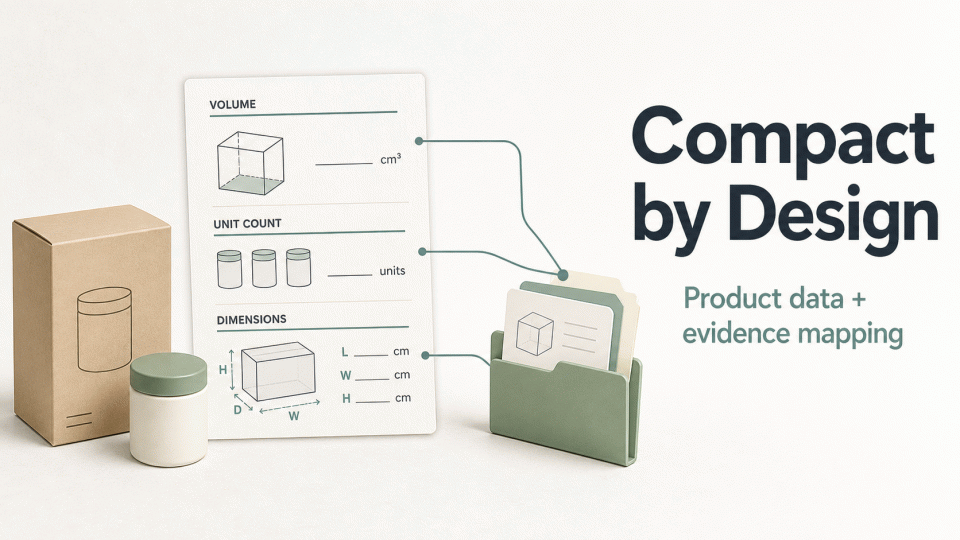
Compact by Design is an Amazon program used to identify products with more efficient design. Amazon’s public description focuses on reducing unnecessary air and water in products or packaging, which can improve unit efficiency and shipping efficiency. It is not a universal product-law checklist and does not replace mandatory requirements in a destination market.
1. Define the program boundary
Compact by Design is an Amazon-owned program associated with Climate Pledge Friendly. Eligibility should be checked against the current marketplace, catalog category, brand status, and Amazon’s current seller or program guidance. The program is separate from import rules, product safety, chemicals, packaging responsibility, and private buyer requirements.
Keep “Amazon program data,” “legal or market-access records,” and “buyer or company requirements” in separate columns. A checked data field is not the same as a confirmed program award or guaranteed badge placement.
2. Product-data checklist
Amazon’s published Compact by Design category material identifies the following data points to check for each SKU:
- whether the product is in an eligible category and has the correct PRODUCT_TYPE;
- whether it is associated with a registered brand;
- whether unit count is populated and unit_count_type matches the category requirement;
- whether measurement data has been populated by an Amazon Fulfilment Centre; and
- for concentrated products, whether equivalent_product_volume is correctly populated with a documented unit basis.
Record the SKU, ASIN, variation, packaging level, dimensions, weight, unit count, and data source. Do not treat a supplier statement such as “space-saving” or “more sustainable” as Amazon program data without supporting records.
3. Build an evidence index
For each SKU, create an evidence index covering catalog records, product specifications, packaging dimensions and weight, the definition of the counted unit, equivalent-volume calculations where relevant, and submission or support correspondence. Label each file with the responsible entity, SKU or ASIN, version, measurement date, and source.
Keep warehouse or platform measurements separate from internal measurements. If they differ, first confirm whether the measurement covers the product, a single packaged unit, or a shipping carton. Complete documentation does not itself confirm eligibility; the current Amazon system or official guidance controls the program decision.
4. Page-wording boundaries
A product page may state objective specifications, unit count, packaging dimensions, and the source of verified data. Use a program mark or describe a product as enrolled only when Amazon has actually displayed the relevant status and the product-to-status association can be verified. Do not create a badge, seal, or “Amazon certified” claim independently.
Claims such as “smaller,” “uses less packaging,” or “more efficient to ship” need a defined comparator, product scope, and evidence basis. Without a documented calculation or official basis, do not add emissions percentages, savings amounts, rankings, sales figures, or broad environmental conclusions.
5. Pre-submission review
- Confirm the marketplace, category, brand, SKU, and ASIN mapping.
- Recheck unit count, unit_count_type, dimensions, weight, and equivalent volume.
- Make the specification, packaging record, catalog data, and page copy use the same version.
- Separate Amazon program records from mandatory law, import documents, and buyer audits.
- Keep the comparator, scope, and source for every environmental statement.
- Review Amazon’s current guidance before submission and record the page version or access date.
Sources and limitations
This reference page is based on Amazon’s public descriptions of Climate Pledge Friendly and Compact by Design, together with Amazon’s published Compact by Design category-threshold material. Categories, fields, and thresholds may change. This page is not legal advice, an eligibility determination, or a promise of platform display.


