
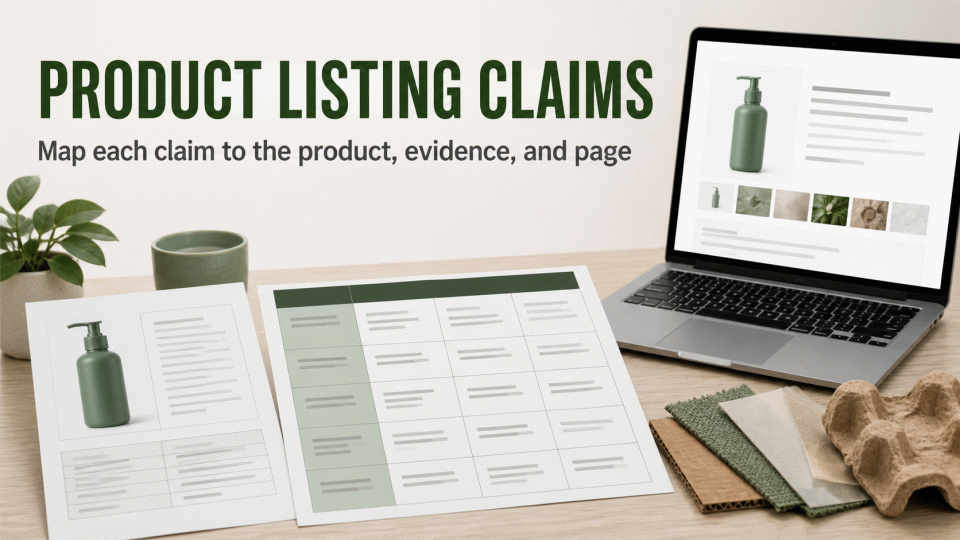
This reference page helps cross-border sellers, brand owners, and review teams turn environmental claims into traceable listing information. The starting point is not a broad “green” label. It is a defined product scope, a specific environmental attribute, and records that support the exact wording shown to customers.
1. Define the claim before choosing the marketing phrase
Break terms such as “eco-friendly,” “sustainable,” “lower carbon,” or “recyclable” into a specific attribute that can be checked. Does it concern the product material, the package, a manufacturing stage, or a limited supply-chain statement? If the evidence covers the package only, the page should not present the whole product as environmentally improved. A carbon statement also needs a retained boundary, functional unit, data basis, and calculation version.
Use product or SKU, market, and page version as the working record unit. Note variants, formulation or material, packaging, manufacturing location, and target market. A supplier file is not automatically applicable merely because the supplier is named; check the legal entity, product description, model, material scope, date, and document version.
2. Map each claim to evidence
Create a claim–evidence–page table. Keep one testable main claim per row:
Claim: the exact page sentence and its qualifiers;
Product scope: SKU, model, batch, or packaging layer;
Evidence: specifications, BOM, supplier statement, purchasing and batch records, testing or calculation file, and certification or program file where applicable;
Review points: entity, scope, method, data date, version, signature, or verification information;
Page location: title, bullets, image text, A+ content, Q&A, or package label.
The U.S. FTC Green Guides explain that broad, unqualified “green” or “eco-friendly” claims are difficult to substantiate. A more defensible approach is to identify the specific benefit and place clear, prominent qualifications close to the claim. European Commission material on green claims likewise emphasizes information that is understandable, comparable, and verifiable. These sources guide claim and evidence design; they are not automatic platform-review rules.
3. Keep platform programs separate from the claim
If a listing refers to a platform program such as Amazon Climate Pledge Friendly, maintain a separate record for the program name, product scope, submission route, current page requirements, and files submitted. A program status must not be rewritten as proof that the whole product is environmentally preferable, compliant with every applicable law, or certified. Program conditions may differ by marketplace and change over time, so check the relevant official requirements before publishing.
The same SKU may also face advertising rules, product requirements, packaging obligations, or buyer standards in the target market. Their responsible parties and evidence expectations differ. Do not treat one supplier document as sufficient proof for every market, page, and attribute, and do not substitute a platform field for a regulatory or advertising review.
4. Review the complete page before release
Review in order: (1) title, bullets, images, and Q&A refer to the same SKU and attribute; (2) the claim stays within the evidence and does not turn a partial attribute into a whole-product conclusion; (3) numbers, units, comparators, qualifiers, and material proportions can be located in the records; (4) Chinese and English describe the same scope, with English adapted for the target reader; (5) image text, icons, and labels do not imply unsupported certification, regulatory status, or outcome; and (6) the final page version, evidence filenames, and review date are retained for change tracking.
5. Recheck after a change
A change to materials, formulation, factory, supplier, packaging, label, target market, or page version can change the claim scope. If a file is missing, an entity does not match, a model cannot be identified, or the calculation boundary has changed, pause the related wording, record the open question, and retain the reason for the decision. Restore the wording only after the new evidence and page text have been mapped again.
Minimum team file set: product and packaging specifications, BOM or material records, supply-chain and batch files, testing or calculation basis, applicable certification or program files, the claim–evidence–page map, final bilingual copy, and change history. 绿色方舟(深圳)认证有限公司 uses “Can we support this exact sentence?” as the starting question for page review, rather than treating a label or platform status as the conclusion.


