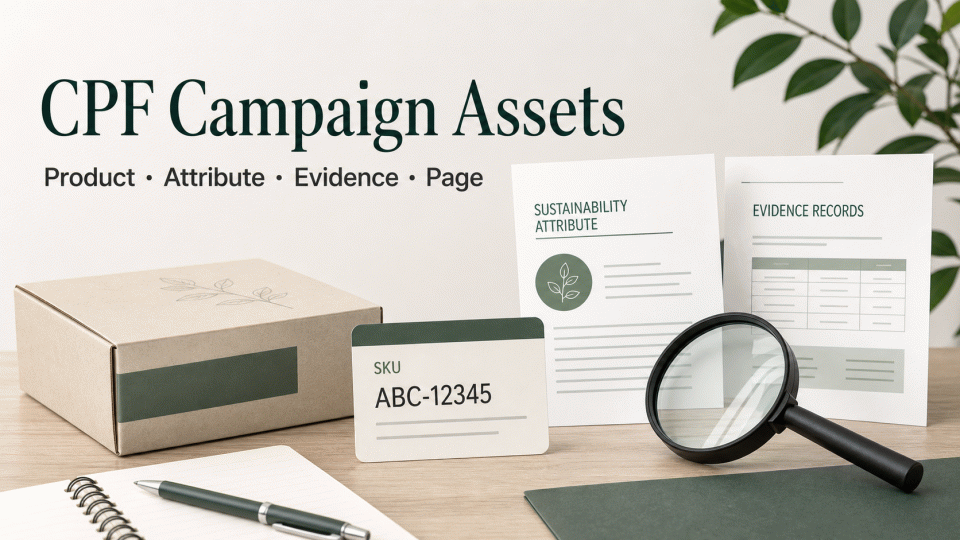
The first step in a Climate Pledge Friendly (CPF) campaign is not to lead with “green.” It is to identify the specific, supportable sustainability attribute of the product, the scheme or certification behind it, and the exact SKU, page, and advertising context to which the statement applies.
1. Define the object of the asset
Create one record per product: brand and product name, ASIN or internal SKU, variation relationship, marketplace, product version, packaging version, and relevant production batch. Keep the product, packaging, shipping method, and company-wide goals separate. Evidence for a packaging attribute does not automatically support a broad claim that the whole product is “more sustainable.”
Record the intended placement as well: detail page, Brand Store, sponsored ad, distributor material, or physical packaging. Review the final copy and image against the confirmed marketplace, version, and use case.
2. Connect each attribute to evidence
For every proposed claim, keep a “claim—evidence—scope” record. For example, “the package contains recycled material” should be supported by records showing the material percentage, packaging version, supplier or production record, document identifier, and date. The scope should identify the covered SKUs, variations, and markets.
For a third-party certification, check the certificate or license holder, scheme, covered products, status, validity information, and public verification route. A supplier certificate is not automatically evidence for the brand owner’s listing or the current product. One certification should not be presented as proof of superiority across every environmental dimension.
Amazon’s public materials describe CPF as relying on qualifying sustainability certifications or programs, with product pages able to show specific sustainability features and certification details. Confirm current eligibility and required records in the relevant Amazon account and current program guidance.
3. Write the campaign asset
Lead with the specific attribute and its evidence path. “Recycled content in this package | Review the material record and certification scope” is more precise than “an all-around green product.” If CPF recognition has not been confirmed, say that product information is being organized for review; do not call it a CPF-recognized product.
Use a three-part structure: explain the product and attribute; state what the evidence covers and what it does not; then give a review action such as matching the SKU, checking the version, verifying the certification record, and having the page owner approve the final wording. Images must match the page facts; checkmarks, seals, and “approved” visuals are not substitutes for evidence.
4. Human review before use
Ask five questions sentence by sentence: Which product or package does it describe? Is the attribute specific? Does the evidence cover the same version and scope? Does the wording overstate program status, certification, or future results? Do the English and Chinese versions, title, image, and landing page agree? Delete, qualify, or return any sentence that cannot answer these questions.
The U.S. FTC Green Guides caution that unqualified general environmental claims such as “green” or “eco-friendly” are difficult to substantiate, and that qualifications should be clear and prominent. Environmental marketing claims also need competent and reliable scientific evidence. Review the target market and the current platform policy before use.
5. Maintenance and responsibility
Recheck the claim-to-evidence link when the product, formula, material, packaging, supplier, certification status, or marketplace changes. The brand or page owner should retain the approved version and change record; the evidence owner should explain document scope. 绿色方舟(深圳)认证有限公司 can help organize a review framework, but it does not replace a platform decision or promise an unverified certification or advertising outcome.
In short: A responsible CPF campaign asset aligns the product, sustainability attribute, evidence scope, and page wording. Verify first, then write; qualify first, then promote.