Maintaining Climate Pledge Friendly evidence is not a matter of attaching one generic “green certificate” to every listing. The practical task is to keep the specific product, sustainability attribute, certification or standard, supporting file, and page wording aligned. Amazon describes Climate Pledge Friendly as a way to help customers identify sustainability features backed by trusted third-party certifications and related standards. Current eligibility should be checked against the program’s current pages and the account record.
This reference page covers product evidence records and wording review only. It is not a customs, product-safety, import, or regulatory clearance guide, and it makes no promise about a platform outcome. 绿色方舟(深圳)认证有限公司 may help organize a review, while certification decisions and marketplace display remain subject to the relevant certifier and platform rules.
1. Define the product, attribute, and program scope
Create a separate record for each ASIN, SKU, or variant: product name, brand entity, marketplace, model, material or formulation, sustainability attribute, and proposed certification or standard. Do not merge brand-level information, factory qualifications, packaging statements, and finished-product attributes into one conclusion.
Check whether the cited certification is within the program’s recognized scope, whether the certified product is the same product being listed, and whether the certificate holder and authorization relationship are clear. Amazon materials describe certifications from government agencies, nonprofits, and standards bodies among the program’s sources, but recognition and program conditions can change; record the source page and review date.
2. Make each file traceable to the product
Useful fields include certificate or report number, issuing body, certificate holder, applicable standard or scheme, covered model and variants, attribute scope, issue and expiry information when stated, authorization or transaction records, original PDF location, public verification link, file version, and latest reviewer.
Treat supplier documents as material to verify, not as a conclusion. Compare the legal entity, brand authorization, model, material or formulation, production site, scope, and document version. If names conflict, the scope is vague, the page cannot be verified, or pages are missing, mark the item “evidence gap” instead of calling it certified or eligible.
3. Keep page wording within the evidence
State the object and scope of the claim. For example, identify the product feature supported by a named certification or standard and link it internally to the relevant file. Do not expand “uses a material” or “the supplier holds a certificate” into an environmental conclusion about the entire product or brand.
Review absolute, comparative, universal, and outcome-oriented wording such as “fully green,” “zero impact,” “officially approved,” or “guaranteed to receive the badge.” Where the record does not support the scope, data, certification, or marketplace status, use a narrower factual description. Handle any fixed platform badge or wording only under the platform’s own usage rules; do not redraw it as a certification seal.
4. Maintain the record and review change triggers
Evidence maintenance is not a mechanical renewal on one universal schedule. Recheck the impact when the certificate, scheme, model, formulation, packaging, production site, brand entity, authorization, or marketplace changes. Follow the issuing body’s document for any stated expiry, surveillance, or reassessment requirement.
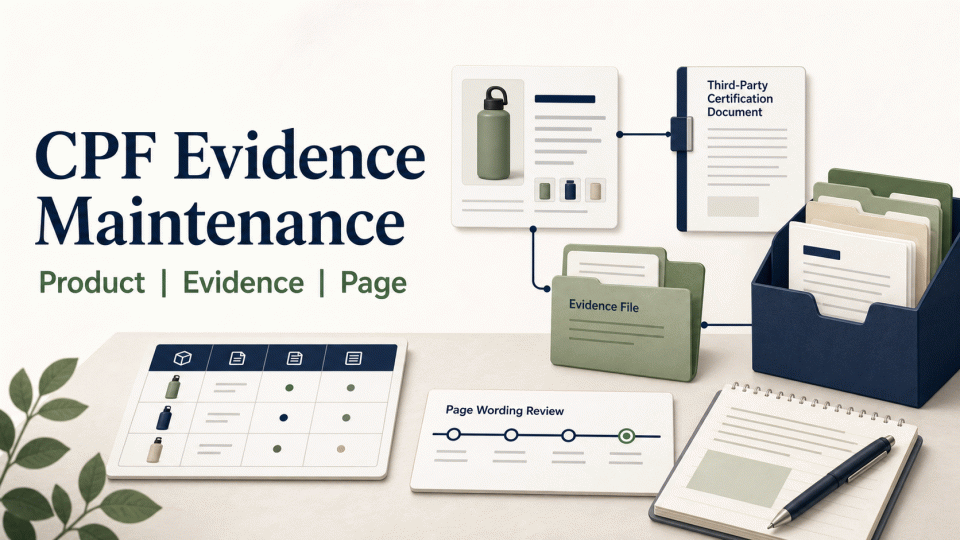
Before each submission or page revision, review five points: product/ASIN match; attribute-to-evidence scope; entity and authorization; complete, verifiable, current files; and wording within the evidence boundary. Record missing items with an owner and requested document. “Submitted” is not the same as “approved.”
5. Minimum fields for the evidence sheet
Product: ASIN/SKU, model/variant, marketplace, brand entity; attribute: claim object, scope, and limitations; evidence: certification/standard, body, number, holder, product scope, version, dates, verification link; page: current title, bullets, visual claims, and fixed platform elements; maintenance: change log, gap, owner, and review date. The sheet supports an item-by-item review; it is not a certification or marketplace decision.
Sources: Amazon Climate Pledge Friendly program materials, Amazon Ads environmental claims policy and CPF creative guidance, and Amazon Buy with Prime Sustainability Features FAQ. Program names, recognized certifications, and display conditions may change; return to the applicable official page before use.