
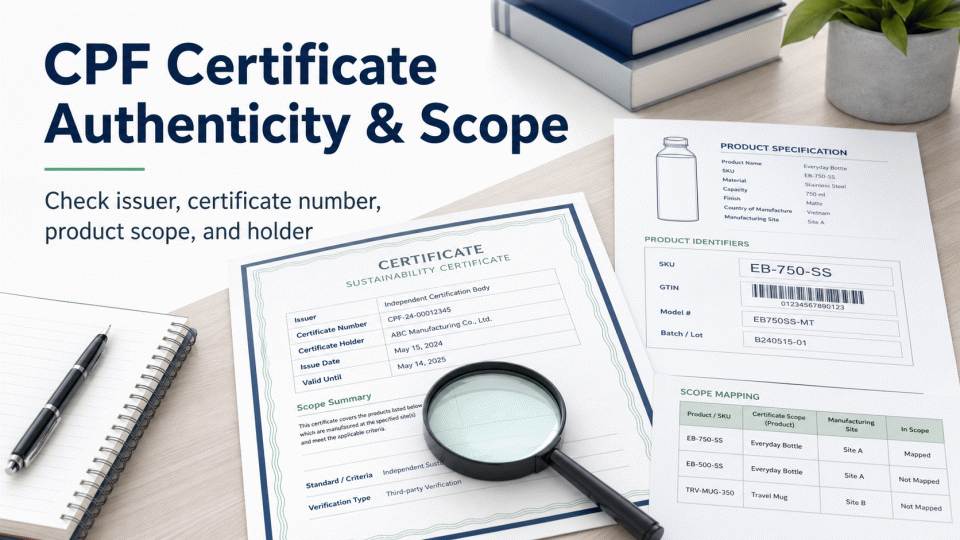
Climate Pledge Friendly (CPF) is one Amazon program framework for presenting sustainability attributes on products. An attribute may be supported by a recognized third-party certification or another program pathway; a certificate by itself does not establish that Amazon has recognized a product or that the product meets every mandatory rule in a target market.
1. Define the review object
Treat each review as a defined record: marketplace and target country, brand or seller entity, product ASIN/SKU, model or variation, claimed sustainability attribute, certification or program route, and the exact page sentence under consideration. A brand, factory, or product family should not be treated as an automatic scope.
CPF identification is connected to product-level qualification. Amazon’s public materials explain that shoppers can view sustainability features and the certifications behind them. Keep “what the document covers” separate from “what the page says,” and keep program identification, third-party certification decisions, and mandatory legal duties in separate fields.
2. Check authenticity and the certificate holder
Retain the original PDF or a traceable electronic record. Transcribe the issuer’s legal name, certificate number, scheme or assessment route, certificate holder, issue date, status or dates shown in the document, locations, product or scope wording, signatures, and verification route where available. Do not turn the dates on one document into a universal validity rule; follow the document and the issuer’s current instructions.
Compare the holder with the brand owner, seller-account entity, manufacturer, importer of record, and actual production site, recording the evidence for each relationship. A supplier or contract manufacturer’s certificate does not automatically cover another company’s product. Where entities differ, obtain a traceable scope statement or narrow the page wording instead of extending the certificate by assumption.
Prefer the issuer’s public directory, verification page, or a traceable official response for the number and status. Search-result screenshots, forwarded images, and scans that cannot be linked back to a source are pending evidence, not an authenticity conclusion.
3. Map product scope to evidence
Build a “product–file–attribute–page sentence” map that includes at least:
- ASIN/SKU, model, variation, packaging version, and production site;
- certificate or report number, product name, material or composition, site, and stated scope;
- the specific attribute supported and its evidence location, without expanding it into “overall sustainability” or “fully compliant”;
- the exact title, bullet, detail-page, or advertising sentence and the matching evidence version;
- differences, gaps, questions for the issuer or platform, and the responsible owner.
A matching product name does not prove a matching model, material, formula, size, or production site. Recheck the scope when an SKU, material, factory, packaging version, or page attribute changes; do not copy the conclusion from another product.
4. Separate page wording from program decisions
Write only the object, attribute, and scope supported by the evidence. For example, a page may describe “the recycled-material attribute stated for this model,” when the source actually covers that model and attribute. Do not turn “submitted” or “has a certificate” into “CPF-recognized” or “Amazon-approved,” and do not promise acceptance, uninterrupted listing, or a particular outcome.
Amazon’s advertising guidance describes CPF as a program that works with sustainability certifications to help customers identify related product attributes. Qualification, display behavior, and submission routes remain subject to Amazon’s current account interface and program instructions. The issuer’s scope decision, Amazon’s program identification, and a target market’s legal assessment are separate questions.
Read the Chinese and English pages independently. Product name, attribute, scope qualifiers, holder, and conditional language must correspond. Do not translate “evidence available for review” into “verified,” or “evidence supporting an attribute” into “certified product,” unless the source supports that wording.
5. Five checks before submission
- Confirm the current ASIN/SKU, variation, packaging version, and page version.
- Confirm a source location for the original certificate, number, holder, scope, and dates.
- Confirm the number or status through a traceable issuer channel; mark anything that cannot be checked separately.
- Review the page sentence by sentence for scope, product, site, and date overreach, and remove outcome promises.
- Keep the submission file, page version, correspondence, and review date; reassess after a material, site, supplier, design, or certificate-status change.


