Packaging evidence is more useful as a traceable record than as a standalone “green” spreadsheet. Start with the exact product and packaging configuration, then connect each data point to a source file, version, and page location. This article offers a working framework for internal records and pre-publication review; it does not replace market-specific law, platform rules, or customer requirements.
1. Define the record’s scope first
Identify the SKU or model, packaging version, market, responsible entity, and record date. Separate the primary package, transport protection, labels, inserts, and other packaging layers. If one product has multiple packaging configurations, keep separate records rather than treating the whole product family as one configuration.
State whether the record includes tape, adhesives, inks, coatings, cushioning, accessory bags, or transport pallets. Materials with the same everyday name may have different layers, finishes, weights, or disposal pathways. Appearance alone is not a reliable basis for combining them.
2. Build the packaging materials checklist
Product and configuration: SKU, model, packaging version, photographs or a structure drawing, market, record date, and reason for any change.
Materials and construction: material category for each component, composite or coating details, colour and printing method, supplier or manufacturing location, and the presence of adhesives, inks, or other attachments.
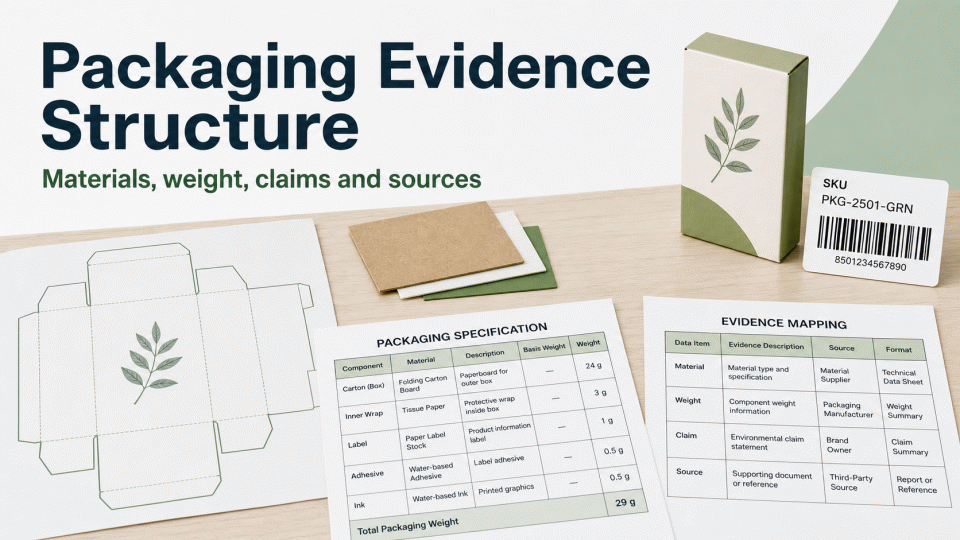
Quantity and weight: component count, unit, weighing method, component weight, total packaging weight, and measurement date. If a value is estimated, record the basis of the estimate instead of presenting it as a test result.
Source and version: the file name, identifier, revision, date, provider, and storage location for specifications, BOMs, supplier statements, purchasing records, weighing records, and test or assessment documents.
Claim and limitation: the proposed environmental claim, the object of the claim (product, package, or a component), the comparison basis, market, qualifier, evidence gap, and reviewer. When support is incomplete, mark the item for review rather than turning it into a conclusion.
3. Link data, evidence, and page wording
Create a four-column mapping for each proposed statement: data item, evidence, source, and page location. For example, “the outer pack is paperboard” should point to a material specification or supplier record; a package-weight figure should point to the same configuration and weighing record; a recycled-content statement should identify the component, the definition used, and its supporting basis.
The U.S. Federal Trade Commission’s Green Guides emphasise clear, specific, and substantiated environmental marketing claims. Broad terms such as “green” or “eco-friendly” should not be presented without a clear basis and qualification. For “recyclable,” “compostable,” or “recycled content,” check the relevant conditions, access to facilities, material scope, and comparison basis instead of keeping only a prominent short phrase.
The EU Packaging and Packaging Waste Regulation, Regulation (EU) 2025/40, must be assessed against the packaging, the operator’s role, and the relevant market. It should not be reduced to one universal green-label checklist. Where producer responsibility, collection arrangements, labelling, or material requirements are relevant, retain the regulation version and the applicability reasoning in the record.
4. Use a human pre-publication review
First compare the physical pack, structure drawing, or production record with each component entry. Then check the weight, unit, method, and configuration. Next compare the supplier document’s entity, scope, date, and version. Read each page claim beside its evidence, and confirm that a qualifier has not disappeared from the title, image, or bullet list.
Reassess the affected data and wording when packaging material, supplier, dimensions, printing or coating, pack count, or market changes. Keep older records as history, but do not use them as current evidence without checking the configuration again.
5. A minimum record you can reuse
For every packaging component, retain: SKU/model, packaging layer, component name, material and construction, quantity, component and total weight, supplier or manufacturing location, evidence file and revision, proposed claim, qualifier, page location, review date, and open items. If a field does not apply, say so and explain why rather than leaving it blank.
The value of this record is traceability: a reviewer can see which package, document, and version support a phrase on the page. It is not a certification or regulatory approval, and it does not guarantee a platform outcome. The final assessment depends on the product, market, responsible entity, applicable rules, and official requirements in force when the record is used.
Sources: EUR-Lex: Regulation (EU) 2025/40; FTC: Guides for the Use of Environmental Marketing Claims. These sources frame the evidence boundary; applicability still requires a product- and market-specific review.