
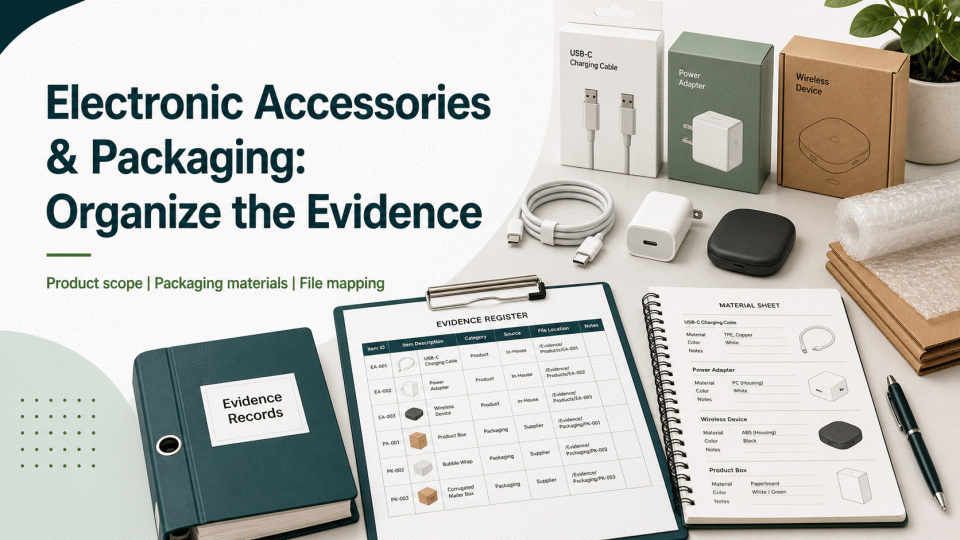
Product records, packaging records, and environmental claims for electronic accessories are often maintained by different teams. The first task is not to collect every certificate in one folder. It is to make each claim traceable to a defined product scope, material record, and source document.
1. Define the product, market, and claim scope
Use a specific SKU, model, or revision as the basic record unit. Keep the product name and model, key functions, ratings, power source, product and packaging weights, material composition, manufacturing location, destination markets, producer or importer role, and the environmental or take-back wording planned for the page. Different models, packaging configurations, or markets should not automatically share one conclusion.
Separate legal obligations from customer or platform requirements and voluntary claims. Their scopes, evidence thresholds, and submission routes are different; a platform request is not the same as a government rule. Flag batteries, wireless functions, external power supplies, and special materials separately so electronics, chemicals, packaging, and end-of-life responsibilities are not collapsed into one label.
2. Keep product and packaging files distinct
Product files: specifications, the BOM and critical-material declarations, structural or circuit information, label and manual revisions, supplier records, production-batch or change records, and market-specific test or technical documentation. For electrical and electronic equipment, EU RoHS addresses restricted substances, while WEEE concerns responsibilities such as registration, reporting, collection, and treatment after products are placed on the market. They should not be summarized as one generic environmental certificate.
Packaging files: packaging levels, material and weight for each level, relevant ink or adhesive information, dimensions, supplier and revision, separation or sorting instructions, and producer-responsibility arrangements in each destination market. The EU PPWR covers packaging and packaging waste. Its dates, detailed duties, and national implementation should be checked against the regulation and official guidance; words such as “recyclable” or “made with recycled content” are not evidence by themselves.
3. Connect claims to files with an evidence register
Give each record a unique ID and capture the exact claim wording, claim object, covered SKU or packaging level, target market, document name and revision, issuer or data source, test method or calculation boundary, date, owner, page location, limitations, and review trigger. Identify the source type: a supplier declaration, laboratory report, legal text, and internal calculation are not interchangeable and a supplier statement should not be presented as third-party certification.
For claims such as “recyclable,” “lower-carbon,” or “contains recycled material,” check the object, boundary, method, and available supporting records. If evidence covers one packaging component or one batch, the page should not broaden it to the entire product, all packaging, or every market. Where evidence is incomplete, describe the record status or the material fact without implying a completed conclusion.
4. Perform a two-way review before submission or publication
Read from page to file: can every environmental or take-back claim be located in a specific record? Then read from file to page: do the product scope, material, revision, and market match? Check the legal entity, address, model, batch, language, units, and dates. A material change, supplier change, packaging or label revision, new destination market, or regulatory update should trigger an impact review rather than a filename replacement.
If the market requires producer registration, waste marks, technical files, or a platform-specific form, prepare it through the relevant route and responsible role. A public web page, an old report, or a generic template cannot establish that a current SKU satisfies every requirement, and a complete file set is not the same as a final decision by an authority, customer, or platform.
5. A practical handover checklist
□ SKU, model, packaging level, and destination market are fixed; □ product and packaging files are separated; □ each claim has a source, scope, and revision; □ test methods, calculation boundaries, and dates are traceable; □ page wording does not exceed the evidence scope; □ change triggers and owners are recorded; □ registration, reporting, and platform submissions are confirmed separately for the market concerned.
绿色方舟(深圳)认证有限公司 recommends using this register as a handover record between product, procurement, quality, and content teams. It makes gaps and claim boundaries visible; it does not replace a decision by a competent authority, customer, or platform for a particular product.


