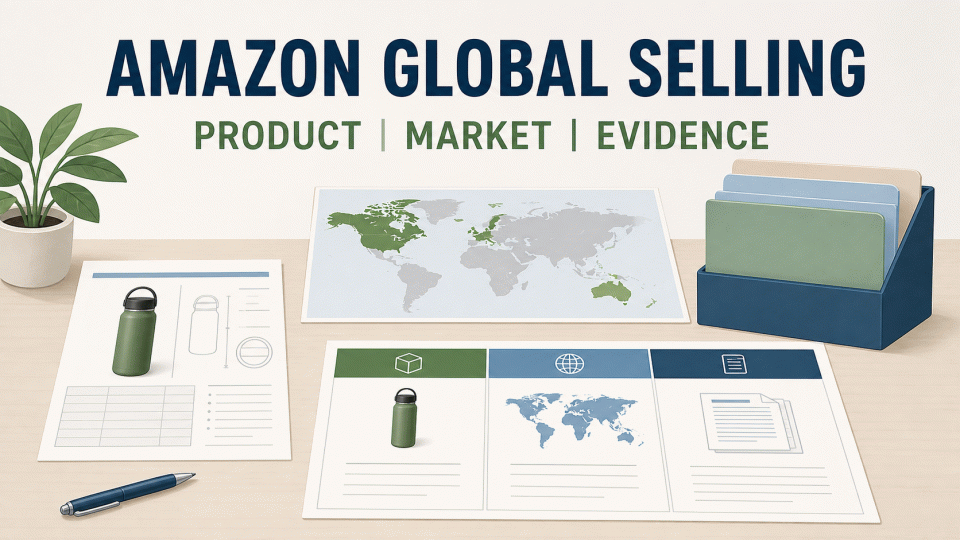
Opening a new Amazon store is not a reason to treat one document set as valid for every market. Start with a working record that connects the specific product, target marketplace, selling entity, fulfillment route, and supporting evidence. Then review the wording that will appear on the listing.
1. Define the selling unit and target market
Limit each review row to one SKU or ASIN, product model and revision, marketplace, selling entity, and fulfillment route. Record the product name, material or formulation, dimensions, rated parameters, packaging, and label revision. Do not replace a model-level check with a broad statement about a product family or factory.
Amazon’s official Global Selling guidance separates choosing countries from reviewing tax, regulatory, product compliance, safety, and listing requirements. Treat each target marketplace as its own review record; do not turn one store’s page or document into a conclusion for another store.
2. Classify each requirement and keep its source
Platform requirements: Record the current Seller Central, Manage Your Compliance, category, or restricted-products page, including the marketplace, submission route, document type, and page version.
Market requirements: Use the destination authority, regulation, official guidance, or designated registry. Record the product scope, responsible role, labeling language, and any testing or registration condition.
Customer or channel requirements: Keep retailer, brand-owner, or purchasing-contract terms separate. Label them as contractual or second-party requirements rather than general legal conclusions.
For every requirement, keep the source URL or document number, access date, scope, responsible role, and open question. For changeable policies, retain the downloaded file or screenshot with its version date and reopen the official source during review.
3. Build a requirement–evidence–listing map
Useful fields include requirement ID, market, SKU and revision, responsible role, source, evidence filename and revision, issuing party, scope, test or assessment boundary, listing field, current status, and the event that triggers the next review.
Check four matches: Does the named entity correspond to the selling or importing role? Does the model, material, and parameter set cover the current SKU? Can the issuing party be verified? Does the listing claim stay within the evidence boundary? When evidence is missing, record “open” or “to be confirmed” instead of replacing the gap with “compliant” or “approved.”
4. Keep listing copy and customer communication within scope
Titles, bullets, image text, and support responses should describe the same product scope. State only attributes supported by the record, such as a material, test item, model, or documented use instruction. Do not convert a supplier’s general capability, a factory certificate, or another product’s result into a universal promise for the current SKU.
Separate “ready for a platform submission” from “all destination-market requirements confirmed.” Also separate “documents collected” from “conclusion confirmed.” For environmental claims, retain the claim object, comparison basis, data scope, and evidence source; avoid unqualified terms such as “green,” “eco-friendly,” or “zero risk.”
5. Human pre-listing review
Confirm that: (1) the marketplace, selling entity, and fulfillment route are defined; (2) the SKU, model, material, packaging, and label revision match; (3) platform and market requirements have separate sources; (4) each material statement links to a document or official page; (5) the English listing is reviewed independently for the target market; and (6) a material, factory, packaging, label, formulation, or source-page change triggers a new assessment.
This map helps a team find gaps and preserve the basis for its decisions. It does not replace the current Amazon workflow, a destination authority’s requirements, or professional advice for a specific product.