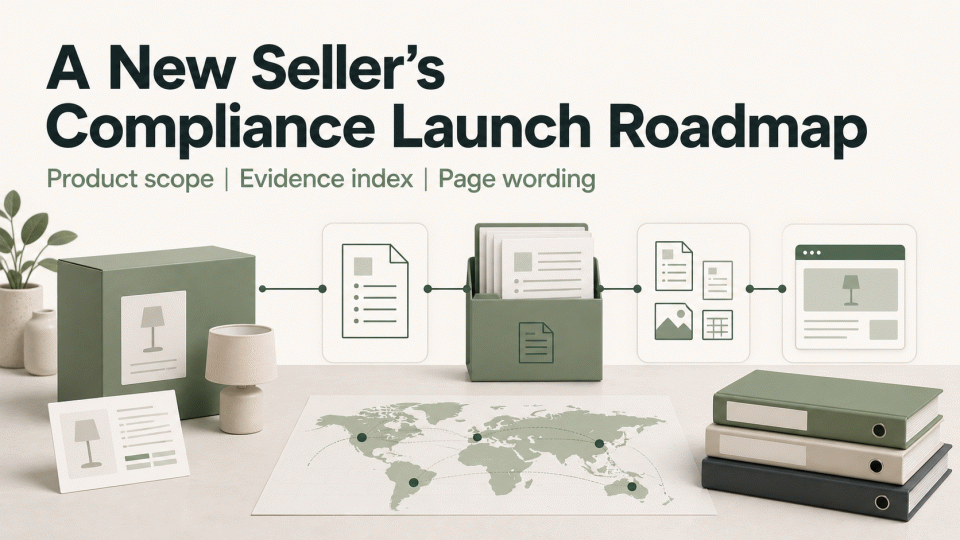
For a new seller, compliance work should start with a defined product, market, responsible party, applicable requirement, and evidence trail—not with the purchase of a generic certificate. Requirements vary by product, destination, sales arrangement, and channel. This roadmap is a working framework for intake and review; it is not legal advice, a conformity assessment, or a promise about a platform decision.
1. Define the question before collecting files
Create a product register with the SKU or model, variants, materials or formulation, dimensions and key functions, packaging layers, manufacturer, brand owner, seller, importer or fulfilment arrangement. Add the destination country or region, sales channel, and intended route to market. “Has a certificate,” “may be sold,” and “can be listed” are not interchangeable conclusions; they may belong to different responsible parties and decision systems.
For each SKU, state what is covered, what is excluded, why, and when the scope must be reviewed again. A change to the model, material, formulation, supplier, factory, packaging, destination, or claim should trigger a scope check rather than automatic reuse of an old file.
2. Separate requirement layers
For each product and market, identify mandatory product rules, import or labelling duties, platform or channel submission requirements, and buyer or brand-specific standards. Record the official source, scope, version or date, responsible role, and open questions. A platform workflow does not replace a legal assessment, and a buyer standard is not automatically a statutory obligation.
For an EU product subject to CE rules, the manufacturer must identify the applicable legislation, prepare technical documentation, complete the relevant conformity assessment, and—where the conditions are met—issue the EU Declaration of Conformity and affix the CE marking. The route depends on the product category; a generic checklist is not a substitute. For U.S. environmental marketing, keep reliable support for each specific attribute and avoid broad, unqualified claims such as “green” or “eco-friendly.”
3. Build six evidence folders
Product scope: SKU register, specifications, BOM, formulation or critical-component data, revision history, packaging, and label artwork.
Responsible parties: manufacturer, brand owner, seller, importer, or authorised representative, including names, addresses, and role relationships. Check that each file names the relevant party.
Technical and risk evidence: applicable-requirement register, risk assessment, test or evaluation reports, instructions, warnings, and local-language versions. Note the models, samples, and test items actually covered.
Claim support: split every product or environmental claim into claim object, qualification, evidence, and page location. Keep the source file, date, version, and reviewer. Do not turn a limited attribute into an unqualified overall benefit.
Supply-chain records: collect purchasing, production, batch, transport, transaction, or origin records only where the applicable rule or scheme calls for them and the records genuinely cover the product.
Page and submission pack: retain the final images, title, bullets, detail-page copy, labels, and upload version. Link each page statement to the evidence index and review the pack across product, evidence, and page owners.
4. Use one launch-review table
Useful columns are SKU/version, market, channel, responsible party, applicable requirement, official source, evidence ID, coverage, file version, page location, current conclusion, gap, owner, and review trigger. Use bounded conclusions such as “checked,” “pending evidence,” “not applicable (reason recorded),” or “requires specialist judgment.” Do not turn “file received” into “compliant.”
Before submission or listing, ask: Does the file cover this SKU and revision? Do the party and market match? Does the evidence support the complete page statement? Are qualifications clear? If a gap remains, narrow or revise the claim and record the task; do not fill it with an unverified logo, outcome word, or promise.
5. Maintenance boundaries
Recheck scope and evidence when the product, material, formulation, critical component, factory, supplier, packaging, label, seller, market, channel rule, or claim changes. Also record the effect of updated legislation, official guidance, scheme rules, or platform requirements. Retention periods, testing frequency, and submission formats follow the applicable current rule or program; do not apply universal “24-month” or “weeks-before-expiry” numbers.
绿色方舟(深圳)认证有限公司 can help clients organise product scope, evidence indexes, and page-wording boundaries. Whether a product meets a regulation, certification scheme, or platform requirement must still be assessed against the specific product, market, party, rule, and authentic records.
Sources
European Commission guidance for manufacturers and CE marking; Your Europe guidance on technical documentation; and the U.S. Federal Trade Commission’s Environmental Marketing and Green Guides materials. These sources establish general boundaries; the applicable rule, current official version, and authentic evidence remain decisive for a specific product.