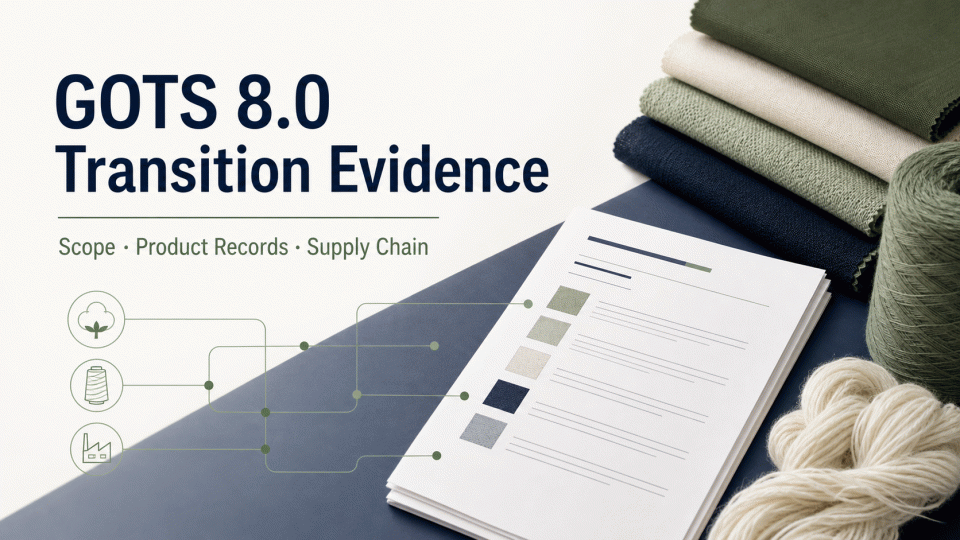
Global Standard published GOTS 8.0 on 1 March 2026. Its transition materials state that mandatory adherence to the new version begins on 1 March 2027. Before using either date in a project plan, record the source version, the certified entity concerned, and the assessment arrangement discussed with the applicable Approved Certifier. This article is a documentation framework; it is not a certification decision and does not promise a GOTS label or outcome.
1. Record the version and the object being assessed
Start a version register with the GOTS version, product or process, facilities and processors involved, certified entity, intended label or page statement, and the Approved Certifier handling the assessment. Keep “published,” “in transition,” and “applicable to this assessment” as separate fields. A draft, an old certificate, or an internal target date should not be treated as the current requirement.
Define the product at the style or SKU level, including fibre composition, colour or process version, production site and relevant processors. A supplier’s GOTS certificate does not automatically cover every finished product, material, or brand page. Scope, entity and product category must be reconciled to the certificate and certifier records.
2. Map certificates to the standard documents
For a Scope Certificate, record the certified entity, certificate number, Approved Certifier, product categories, processing or manufacturing scope, sites and status. For a Transaction Certificate where applicable, record seller, buyer, product description, quantity, lot or shipment information, and confirm that it explains the specific transaction. A Scope Certificate is not a substitute for a transaction record, and neither document should be extended to an unlisted SKU.
Retain the source and download version of GOTS 8.0, the Implementation Manual, change logs, Conditions for the Use of Signs and the transition Q&A. For questions about fibre content, allowed materials, chemicals, environmental or social criteria, record the relevant clause or page. Where a translation differs from the English text, follow GOTS’s published language rule and check the original English document.
3. Connect product, processing and supply-chain records
For each product version, map fibre source and composition, spinning, weaving or knitting, dyeing and finishing, sewing or packaging, production sites, suppliers, orders or lots, and the certificates or transaction records that support them. When a yarn, dyehouse, processor, trim or formulation changes, retain old and new versions and reassess whether the certified scope still applies.
A useful index has fields for the original file, covered object, evidence location, open question, reviewer and version date. Chemical or test records should identify the issuer, sample or formulation, relevant process and report number. Purchase, invoice, transport and lot records should explain the movement of material into the product. A promotional sheet with no product or lot link is a lead for review, not standalone evidence.
4. Review signs, labels and page claims separately
If a package or page uses the GOTS name, sign or an “organic textile” statement, check the product scope, whether the claim concerns the finished product or a component, the current Conditions for the Use of Signs, and whether a Labelling Release is required. “Contains organic fibre,” “the supplier holds a certificate,” and “the finished product may use a GOTS sign” are not interchangeable conclusions.
Consumer-facing environmental wording should identify its object and place meaningful qualifications near the claim. For U.S.-directed pages, the FTC Green Guides provide general principles on truthful, clear and substantiated environmental claims; broad terms such as “green” or “eco-friendly” should not be detached from a specific attribute and evidence boundary. Check the target market’s label, advertising and platform rules separately.
5. Manage review during the transition
When an Approved Certifier, brand customer or platform sends a GOTS 8.0 request, record its source, version, applicable entity and open questions. Classify each item as a Standard requirement, a certifier assessment arrangement, or an additional customer or platform request. Do not turn a private checklist into a universal legal rule, and do not assume that every certificate follows one universal validity period.
Recheck the mapping when the standard version, formulation, processing site, supplier, certificate status, label artwork or page wording changes. Mark items as checked, pending or not applicable. Whether the requirements are met remains a matter for the applicable certifier and the current GOTS rules.
6. Manual checks before submission
□ The GOTS version, publication source and applicable date are recorded; □ certified entity, certifier, product category and site match the product; □ Scope Certificate and relevant Transaction Certificate explain each other; □ fibre, processing, chemical, packaging and page claims have supporting records; □ names, signs and label artwork follow current rules; □ customer, platform and legal requirements are separated; □ changes trigger a fresh scope and claim review; □ the page contains no promise of certification, approval, display or fixed timing.
绿色方舟(深圳)认证有限公司 may help organise certificates, product records and claim-to-evidence mapping and identify missing files. It does not replace a GOTS standard owner, Approved Certifier, customer or regulator’s decision.
Sources: GOTS Revision: Version 8.0 and transition materials; GOTS Downloads: Standard, Manual, change logs and transition Q&A; U.S. FTC Green Guides. Recheck the current official documents for the product, market and assessment in scope.