
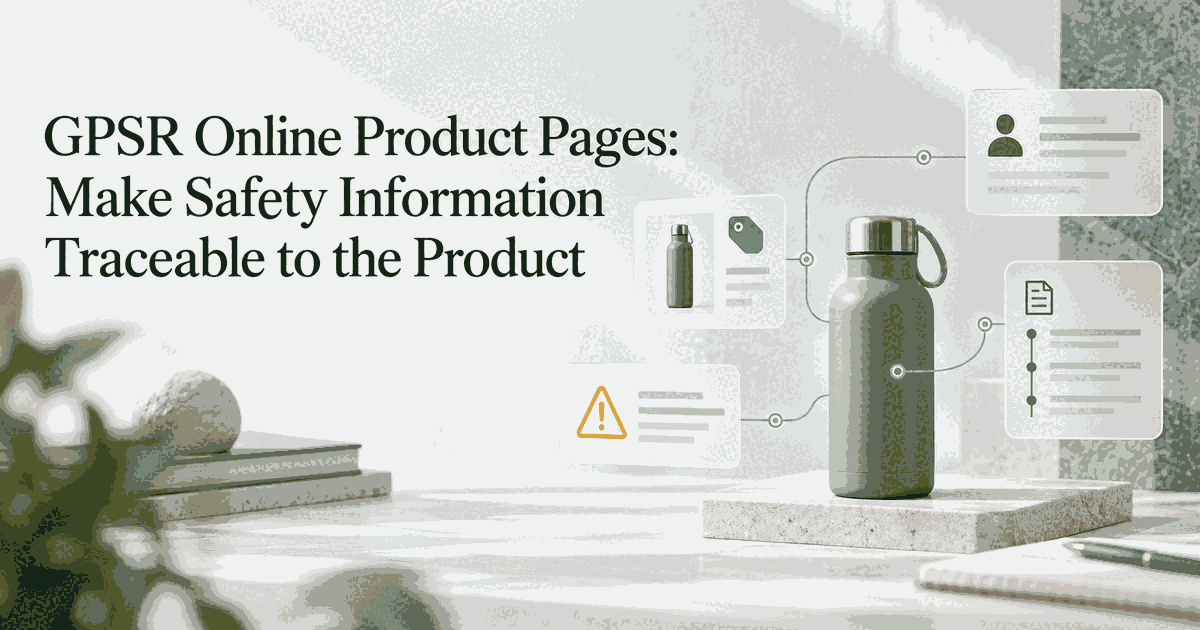
An online offer can be full of product copy yet still leave a buyer unable to identify who made the item or which warning applies to the version in the basket. Article 19 of Regulation (EU) 2023/988, the General Product Safety Regulation (GPSR), deals with that gap. For products offered online or through another distance selling channel, the offer must clearly and visibly present specified information. The useful question for a seller is whether that information describes the actual product being offered, rather than a generic brand or an older catalogue entry.
Establish scope before editing every listing
The GPSR concerns consumer products: items intended for consumers or likely to be used by them under reasonably foreseeable conditions. A wholesale label by itself does not settle that question. Conversely, the GPSR is not a universal rule for every industrial B2B component. Article 2 excludes certain categories, including food and medicinal products, and addresses the interaction with Union rules that already impose specific safety requirements. A team should identify the product, foreseeable user, destination market and applicable sector rules before asserting which obligations govern it.
The Regulation has applied since 13 December 2024. That date should not be turned into a claim that every product first placed on the market before then must be relisted under a new regime. Article 51 contains a transitional provision for products that were placed on the market before that date and complied with the earlier General Product Safety Directive. Assessing a stock item therefore requires evidence of when that particular item was first placed on the market and what requirements it met, not just the date on which its web page was edited.
An online offer is deemed to make a product available on the market when it is targeted at consumers in the Union. The team should look at the actual offer and the markets to which its activities are directed, rather than assuming that a globally accessible website is always an EU consumer offer.
Read Article 19 as four linked disclosures
The offer must show the manufacturer's name, registered trade name or registered trade mark, together with a postal and electronic address at which the manufacturer can be contacted. A storefront nickname or a telephone number alone is not the same information. If the manufacturer is not established in the Union, the offer must also give the name, postal address and electronic address of the responsible person referred to in Article 16(1) of the GPSR or Article 4(1) of Regulation (EU) 2019/1020. This condition matters: a seller should determine the actual legal role for the specific product, rather than copying the name of a marketplace, logistics provider or nominal contact into every listing.
The offer must also identify the product, including a picture, its type and any other product identifier. A useful listing connects the selected variant, image and model to the item that will be supplied. Article 19 does not say that every offer must publish a changing serial or batch number. The product's identification scheme and other applicable labelling duties should guide the level of detail. Finally, the offer must display any warning or safety information that is required on the product, packaging or accompanying document under the GPSR or applicable Union harmonisation law. Its language must be easily understood by consumers as determined by the Member State where the product is made available.
These elements are connected. Manufacturer and responsible person data have to refer to the item shown; the image and identifier need to match the sale unit; and the warning needs to apply to that version. Article 19 calls for the information to be clear and visible in the offer. A generic help-centre link or a document supplied only after checkout may not achieve the purpose of informing the buyer before the purchase decision.
A variant is where a tidy page can go wrong
Imagine one listing with an adult version and a child-oriented variant. The main image shows the adult product, while the selected child variant inherits the same warning panel. The page may appear complete at first glance, yet the buyer cannot tell which safety information belongs to the item in the basket. The team should freeze one specific SKU and page state, compare the selected images and model with the package, instructions and responsibility records, and then repeat the check for materially different variants. When a supplier, design, package or responsible operator changes, retain a dated page snapshot and review the affected offers again.
This comparison is an editorial and operational method, not an extra statutory field list. It also has a limit: a complete page does not establish that the product is safe. Risk assessment, physical labelling and obligations under any applicable product-specific legislation remain separate work. A platform's approval or the continued availability of a listing is likewise not a legal finding of conformity.
Make the next decision traceable
Start with one live offer aimed at an EU consumer market. Record its URL, Member State, selected SKU and current screenshot. For each Article 19 element, identify the source document or business record that supports the displayed text. Resolve uncertain product scope, the responsible person's role and the required warning language against the relevant product rules and destination market. Then decide whether the immediate action is a page correction, a physical-product or documentation check, or a broader safety review. That sequence ties the visible offer to evidence and prevents a generic compliance badge from standing in for a product-specific decision.
Source: Regulation (EU) 2023/988, Articles 2, 3, 4, 19, 51 and 52: https://eur-lex.europa.eu/legal-content/EN/ALL/?uri=CELEX:02023R0988-20260529


