
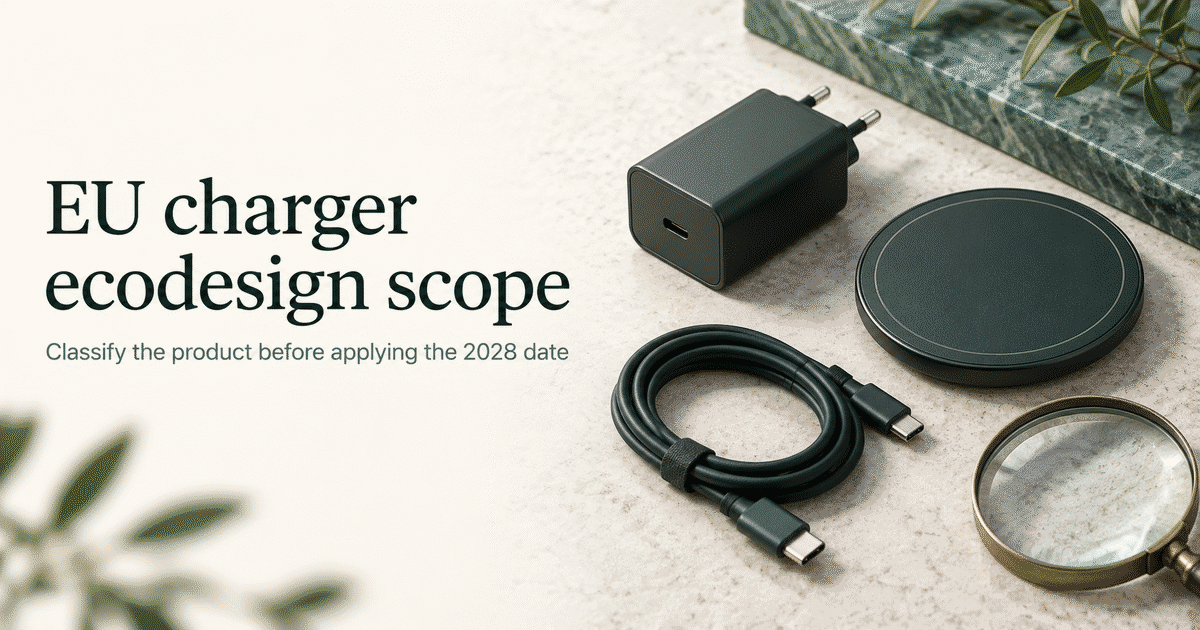
A product team may sell a wall adapter, a wireless charging pad and a USB-C cable under one “charger” family. Can it use one scope decision and one evidence file for all three? Regulation (EU) 2025/2052 gives a reason to separate them: it names several product categories, each with its own definition and relevant requirements. Start with the actual item placed on the EU market, not the family name or the connector in a listing.
The European Commission says the new ecodesign requirements apply from 14 December 2028. This is a planning date for the new requirements. It does not make every USB-C product in scope, and it does not suspend rules that apply now. Scope, current obligations and future changes need separate entries in the compliance record.
A connector is not a product category
Article 1 covers external power supplies (EPS), battery chargers for portable batteries of general use, wireless chargers, wireless charging pads and USB Type-C cables. An EPS is defined separately from a battery charger and a wireless charger. Calling all of these products “EPS” obscures the distinction the regulation asks a business to make.
Consider the goods in a bundle. A wall adapter may need an EPS assessment even when marketing calls it a charger. A device for removable AA or AAA batteries raises a different battery-charger question. The distinction between a wireless charger and a wireless charging pad includes whether the power supply is integrated in the same unit. A USB Type-C cable under the regulation has USB Type-C plugs at both ends and must meet its specified cable and power-rating criteria. A USB-C receptacle on a laptop does not turn the laptop into a USB Type-C cable.
These are classification examples, not determinations for a particular SKU. For each sale unit, preserve the electrical design, intended use, physical enclosure, connection to the end product, cable ends and power source. Then test the facts against the full Article 2 definitions.
An exclusion needs more than a label
Article 1 also excludes defined products. The list includes uninterruptible power supplies, EPS designed, tested and marketed exclusively for medical devices, and EPS designed, tested and marketed exclusively for transport. It also distinguishes a consumer product whose converted DC power is mainly used internally instead of supplying a separate end-use product. The Commission uses a TV or laptop with USB ports as an illustration of that last boundary.
A “medical” phrase in a catalogue is not a substitute for the conditions in the legal text. If the same adapter is advertised as a general-purpose supply, a claimed exclusive-use exclusion needs careful re-examination. Record the supporting design, test and marketing evidence; where an element is unknown, leave the scope decision open rather than stating an exemption on the product page.
Build evidence around the configuration sold
The Commission describes efficiency and no-load power limits for EPS, standby power limits for wireless products, and separate areas for interoperability, surge resistibility and information provision. USB Type-C cables have their own specification, electrical performance and power-marking questions. A report about EPS efficiency does not by itself establish a cable's marking, or a wireless pad's standby performance.
A model-family name is also a poor evidence key. Two listings can share that name while differing in output range, ports, hardware revision or included cable. Conversely, a cosmetic variation need not automatically trigger an entirely new test programme. The applicable requirements and technical differences should guide the evidence boundary. Keep an explicit link from each test result and technical document to the configuration it covers; do not assume that a family label proves coverage.
What to put in the first scope record
For every EU-facing SKU, list the sale unit and its included components. Record input and output ratings, port arrangement, whether a power supply is integrated, both cable ends, intended use, version identifiers and the equipment supplied with it. Alongside those facts, cite the candidate Article 2 definition or Article 1 exclusion and note any missing evidence. Only after that should the team assign applicable requirements, the relevant date, test work, markings and listing changes.
This order catches a common listing problem: an adapter and a pad are sold together, while the page uses evidence for one component to imply a conclusion about the bundle. Review each component first and then review the impression created by the combined listing. If a supplier has not identified a component revision, narrow the claim until the documentation is available.
This article explains a method for scope review; it does not determine the status of any individual model. Check Regulation (EU) 2025/2052, especially Articles 1 and 2 and the relevant annexes, against the product facts. The European Commission product page is a useful orientation, while the legal text controls the assessment. Sources checked 3 October 2026.
绿色方舟(深圳)认证有限公司
Email: sui@greenark-sz.com Website: www.greenark-sz.com Phone: +86 18407559004


