Amazon Seller Central Europe Seller Forums published a News_Amazon announcement at 12:40:02 UTC on 14 October 2026 about an update to Seller Fulfilled Prime (SFP) eligibility in the Amazon UK store. From 30 October 2026, existing metrics will be measured by product tier rather than only at account level. The announcement identifies three tiers: standard-size, oversize and extra-large. Two new conditions have a stated grace boundary through 6 January 2027. This article does not promise Prime eligibility, placement, traffic, rankings, sales or an approval outcome.
Who is in scope
The update concerns seller-fulfilled orders in the Amazon UK store and sellers using or applying for Seller Fulfilled Prime. It is not an FBA update, and it does not mean that every UK seller must join SFP.
Amazon identifies three product tiers: standard-size, oversize and extra-large. The public announcement confirms the change in assessment level, but it does not publish the complete size definitions, a complete qualification table, or every account-specific detail. Sellers should confirm the tier shown in Seller Central rather than infer it from a product name, packaging impression or a self-created size threshold.
What changes when assessment moves from account level to tier level
The announcement refers to existing observations such as weekend operating delivery methods, on-time shipment rate, use of Buy Shipping or Easy Ship, and cancellation rate. It does not say that every historical threshold has been rewritten uniformly. The important change is that these observations are now read by product tier.
That means a healthy account-level result cannot automatically prove that every SKU meets the same condition. A store selling both small items and extra-large items may have different delivery promises, carrier paths, tracking evidence and on-time performance for each tier.
The tier-specific conditions
Standard-size: a customer-page delivery signal
For standard-size products, the announcement adds a condition that at least 25% of customer page views display a one-day delivery date. This is a page-view measure: it concerns what customers see on the product page. It should not be rewritten as “25% of orders must ship within one day”, a conversion-rate target, a sales target, or a result the seller can guarantee independently.
The announcement says sellers can monitor this percentage in the SFP dashboard. The useful operational link is therefore: SKU → tier shown in the account → delivery date displayed to customers → dashboard percentage. A store average should not be used as a substitute for the SKU-level evidence.
Oversize: keep it as a separate tier
Oversize is one of the three product tiers in the new assessment model. The public announcement does not provide a complete size threshold or a separate full qualification table that can be reconstructed in an article. Oversize should therefore remain a separate tier-level check, not be silently merged into standard-size or extra-large.
Extra-large: a carrier path with two evidence conditions
For extra-large Prime orders, the announcement allows a seller to use a carrier other than Buy Shipping or Easy Ship only when Amazon receives a valid carrier tracking number and those orders maintain at least a 97% on-time delivery rate.
This is not unrestricted carrier choice. A carrier name alone does not prove that Amazon received valid tracking, and valid tracking does not replace the on-time delivery condition. The condition is tied to the extra-large Prime-order scenario; it should not be expanded to every tier or treated as a guarantee that eligibility will be retained.
Read the two dates separately
The date relationship is easy to flatten into a misleading headline. From 30 October 2026, Amazon starts measuring existing metrics by product tier. The new standard-size one-day-delivery page-view condition and the extra-large condition involving a non-Buy-Shipping/Easy-Ship carrier have an announced grace period through 6 January 2027 and are not used for formal eligibility assessment during that period.
30 October 2026 is the start of tier-level measurement; 6 January 2027 is the stated grace boundary for the two new conditions; the actual account and SKU eligibility status still has to be read in Seller Central under the current SFP policy.
The public announcement does not explain the final combination of the new conditions with all existing metrics after the grace period. It is therefore inaccurate to say that SFP is universally cancelled on 30 October, and also inaccurate to say that all new conditions can be ignored until 6 January.
A practical SKU review path
Start with UK seller-fulfilled SKUs that actually use SFP. Confirm the store, fulfilment mode and SFP status, then record the tier shown in the account.
For standard-size, capture whether the page displays a one-day delivery date and the customer-page-view percentage shown in the SFP dashboard. Treat this as an eligibility signal, not a sales promise.
For extra-large, record whether the shipment uses a carrier outside Buy Shipping or Easy Ship, whether Amazon received a valid tracking number, and the on-time delivery rate for the relevant Prime orders. Do not record only the carrier name.
Keep the 30 October measurement start, the 6 January grace boundary and the current account eligibility status as separate fields. If the tier is unclear, the dashboard does not match the page, or tracking evidence is incomplete, mark the item for Seller Central verification instead of declaring it qualified or disqualified.
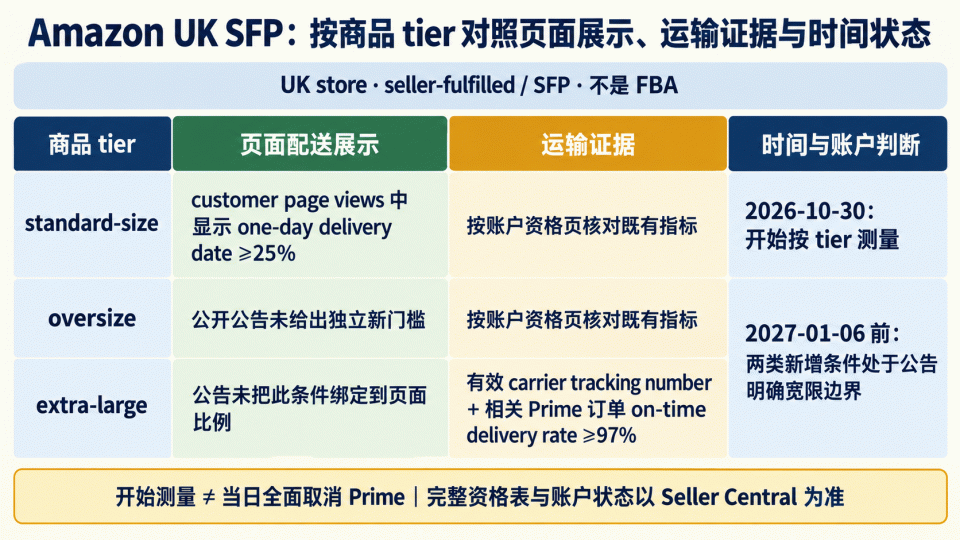
The relationship map separates product tier, customer-facing delivery promise, shipping evidence and the two time boundaries; 30 October 2026 starts tier-level measurement, while 6 January 2027 is the stated grace boundary for the two new conditions.
What the public announcement does not establish
The public announcement is not enough to fill in the complete size thresholds, the complete logged-in qualification table, the full list or technical rules for carriers whose tracking Amazon will accept as valid, or the final combination of the two new conditions with existing metrics after 6 January 2027.
Those points require the current Seller Central account, SFP dashboard and updated policy. They should not be completed by guesswork. The announcement also makes no promise of a Prime badge, higher traffic, better ranking or more sales.
What to do now
Do not start by rewriting every UK listing. Start with the actual SFP SKU set and create a traceable review record linking the SKU, Amazon-displayed tier, customer-facing delivery date, dashboard metrics, shipping route, tracking status, on-time delivery rate and the two time boundaries.
绿色方舟(深圳)认证有限公司 can assist with reviewing the rule boundary, page information and evidence record. It cannot replace Amazon’s account assessment and does not promise Prime eligibility, placement, traffic, rankings, sales or approval.
Official source: Update to UK Seller Fulfilled Prime eligibility criteria, the News_Amazon announcement in Amazon Seller Central Europe Seller Forums, published at 12:40:02 UTC on 14 October 2026. The complete size definitions, qualification table and live account status remain subject to the logged-in Seller Central pages.