
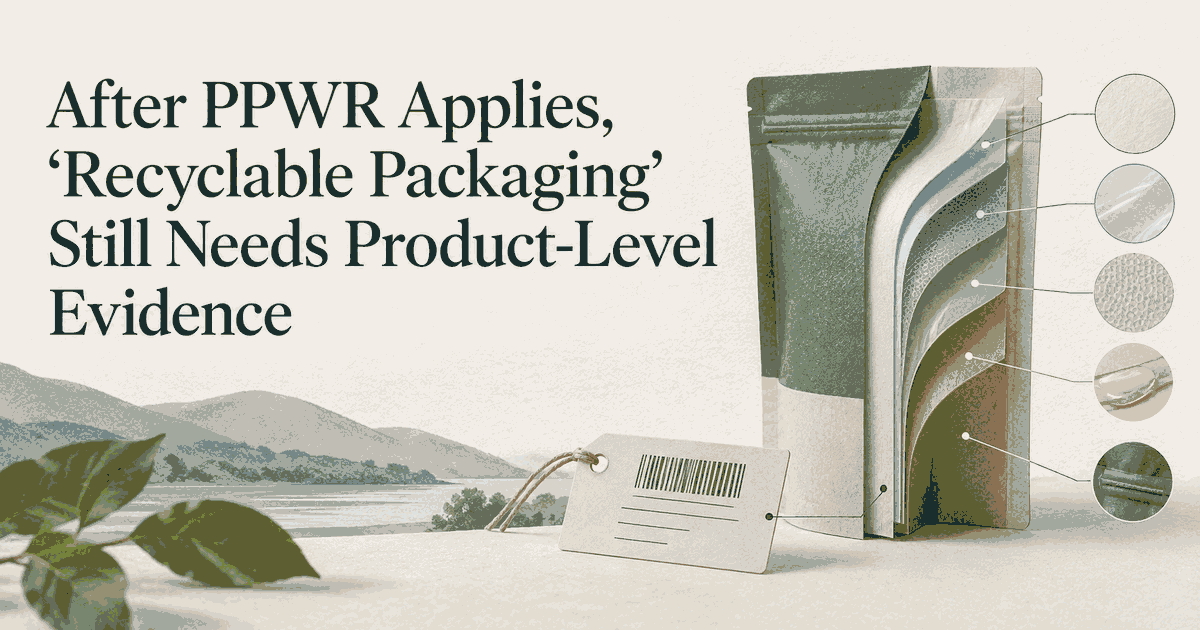
Imagine a seller replacing a multilayer pouch with one from a new supplier. The product photograph and listing still say “recyclable packaging.” The immediate question is not whether the new pouch contains a familiar resin. It is whether that sentence describes the pouch now shipped, and whether the evidence covers the whole pouch rather than one film layer. A change in adhesive, zipper, coating or supplier may break the link between an old assessment and the pack in the customer's hands.
Regulation (EU) 2025/40, the EU Packaging and Packaging Waste Regulation (PPWR), began to apply in phases on 12 August 2026. That date does not make every later design criterion, recycled-content target or calculation method effective at once. For a brand selling into the EU, a useful first decision is to freeze the packaging configuration and ask two separate questions: which provision applies now, and what exactly does the public claim assert?
Three records answer three different questions
A bill of materials identifies the packaging unit and its components. Recyclability concerns the packaging design and the conditions under which waste can be collected, sorted and recycled. Recycled content concerns the origin and proportion of recovered material in a specified plastic component. These records can inform one another, but a supplier's recycled-resin statement cannot establish the recyclability of a finished pouch.
Article 6(1) of the PPWR says packaging placed on the market shall be recyclable. The Commission's 2026 guidance interprets that principle as applying from 12 August 2026. The detailed conditions in Article 6(2) have later application points linked to delegated and implementing acts: the design-for-recycling condition is tied to 2030 or 24 months after the relevant delegated acts, whichever is later; the collection, sorting and recycling-at-scale condition has later dates and dependencies. It would be misleading to present a future grading methodology as an official grade already awarded to a current packaging SKU.
Article 7 is a different provision. Its minimum recycled-content targets concern plastic parts, with percentages differentiated by packaging type and format. The first target date is 1 January 2030 or three years after the relevant implementing act enters into force, whichever is later, and exceptions must be checked. A “30% recycled content” statement on a listing is therefore not proof that every PPWR obligation is met, nor is 30% a universal threshold for every pack. The percentage, component, calculation basis and source records each need checking.
Define the subject of the claim
Suppose the supplier documents recycled material in an outer film, while the listing calls the entire zippered pouch “recyclable.” The evidence and the sentence have different subjects. The adhesive, laminate, closure and disposal context may matter to the complete-pack claim. A true statement about one layer can still leave a whole-pack statement unsubstantiated.
Article 14 adds a particular rule for environmental claims about packaging properties regulated by the PPWR. Such claims must concern properties exceeding the applicable minimum requirements, follow the Regulation's criteria and methods, and specify whether they concern the packaging unit, part of that unit or all packaging the operator places on the market. Compliance with that Article is demonstrated in the packaging technical documentation. Merely meeting a legal floor should not be advertised as an extra environmental benefit. This provision does not turn every accurate material description into the same kind of performance claim; it makes the wording and its likely meaning important.
Review a sentence by underlining its subject. Does “recycled” refer to a resin, one component or the whole pack? Does “recyclable” refer to the current finished configuration, and is the applicable method available for the conclusion being made? If the file only supports a component fact, state that limited fact accurately. A broad finished-pack assertion needs evidence at that broader level. This is a way to review wording, not a determination that any example package complies.
Keep one change-controlled evidence trail
Record a photograph of the shipped packaging, its component list, layer and closure specifications, weight, supplier, market and version date. Distinguish the consumer pack from any shipping pack. Copy each environmental sentence from the product page, label and artwork into a claim register, then name its subject, territory and packaging version. Link it to the relevant material record, assessment method and technical file. If a link is missing, narrow or pause the statement while the evidence is resolved.
The legal role matters as well. Article 15 requires manufacturers to carry out or arrange conformity assessment and draw up Annex VII technical documentation before placing packaging on the market. Other operators have their own duties under the Regulation, so a distributor or importer should not be described as if it automatically has the manufacturer's exact tasks. A supplier declaration is an input to the finished-pack assessment, not a substitute for it. Set a review trigger when the pouch structure, supplier or public wording changes; an undated certificate attached to an old SKU is a weak version-control system.
The source basis for this review is Articles 6, 7, 14 and 15 of Regulation (EU) 2025/40 and the Commission's 2026 PPWR guidance. The guidance helps interpret timing but does not amend the Regulation. Product-specific exceptions and later delegated or implementing acts need a fresh check against the law in force when a claim is made. The practical outcome is a traceable relationship among the shipped packaging, the applicable rule, the supporting file and the words customers see.
Regulation: https://eur-lex.europa.eu/eli/reg/2025/40/oj
Commission guidance: https://eur-lex.europa.eu/legal-content/EN/TXT/?uri=CELEX:52026XC03084


